Sixty-Seven Days
"All that really belongs to us is time; even he who has nothing else has that."
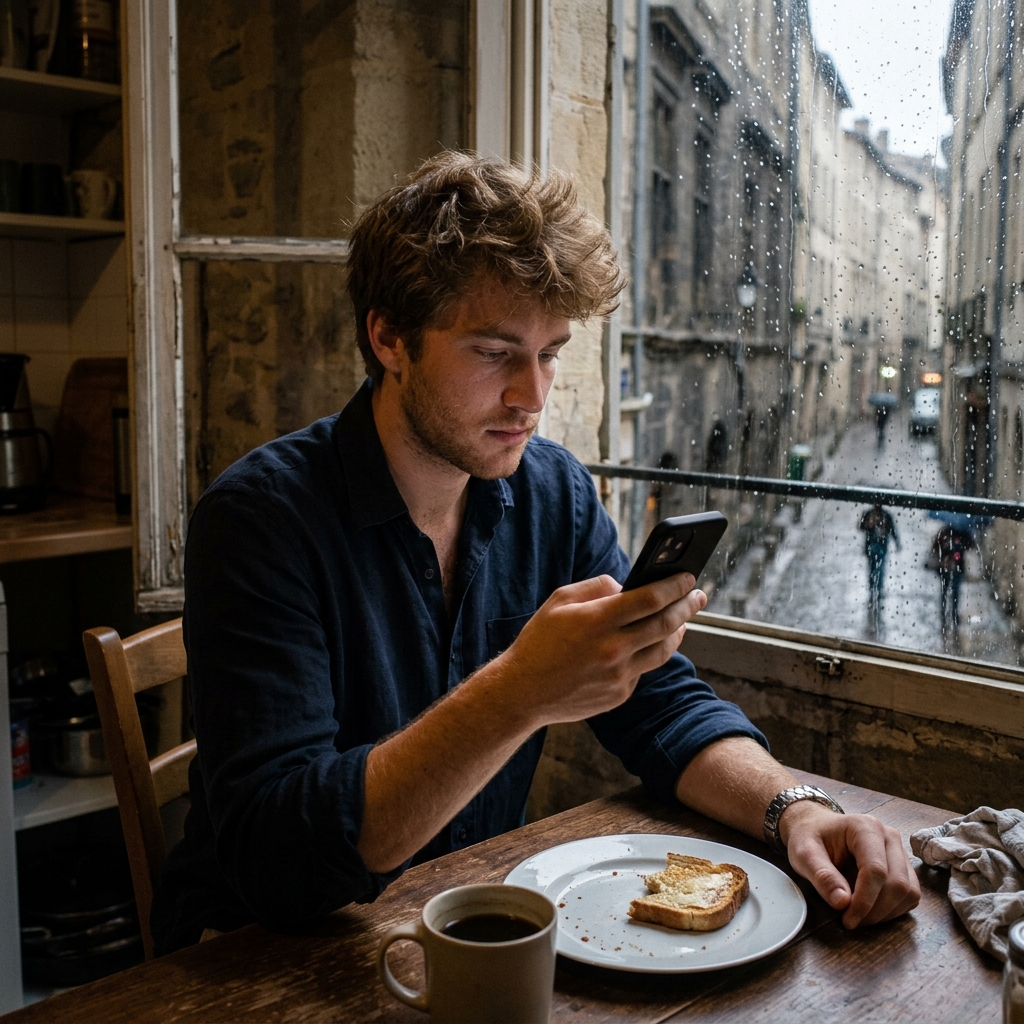
The email from Professor Arsenault arrived on a Tuesday morning while Julien was eating toast and watching the November rain do something grey and committed to the street below.
He almost didn't open it. The address was from the university — the Concordia domain, that specific shade of his former life — and his thumb hovered over it with the particular hesitation of someone who has been doing reasonably well and is not certain they want to test it. He opened it anyway, because avoidance had a poor track record in his recent experience.
It was seven sentences long.
Arsenault wrote the way he talked: without preamble, without the social cushioning that most people wrapped around difficult subjects. He had heard from Claire, he said, that Julien was in Montpellier. He hoped the city was treating him well — he had been there once, in the nineties, and had eaten the best roast chicken of his life at a place that had almost certainly closed by now. He hoped the distance was giving Julien what he had gone looking for. It usually gives you something, he wrote, even if it isn't that. He was not asking for a response, he said. He simply wanted Julien to know that the door to his office was open, whenever Julien found himself back in Montreal and ready to talk about the work.
The work. Two words sitting in the middle of the email like something left on a table deliberately, positioned so you would have to move it to get to anything else.
Julien read the email three times. Then he set the phone down and finished his toast, which had gone cold, and sat for a while with the rain and the grey light and the seven sentences arranging themselves in his mind the way things do when they have arrived at the right moment.
He did not respond. He was not ready to, and Arsenault had said he didn't need to, which was either professional courtesy or an act of genuine understanding, and in Julien's experience the two things were not mutually exclusive in people who had spent enough time around writers.
What he did, after a while, was open his laptop.
He had not opened it for anything beyond practical purposes since arriving in Montpellier — email, tram schedules, the occasional desperate translation of a grocery label. The project file was in the dock, the icon sitting there with the patient neutrality of an object that does not know it has been avoided. He clicked it.
The document opened. Forty-one pages, the last of them ending mid-sentence, the cursor still blinking at the point where he had stopped, eleven weeks ago, in the middle of a paragraph about a morning in early spring that he had not been able to finish because finishing it would have required saying something true.
He read the last three pages slowly. He read them the way you read something you wrote in a previous version of yourself — with the slight estrangement of recognizing your own handwriting in a letter you don't entirely remember sending. Some of it was not as bad as he had feared. Some of it was worse. All of it was real, which was the thing he had forgotten about his own writing in the months of not doing it: that it was real, that it had come from somewhere actual, that the forty-one imperfect pages represented forty-one pages of truth that had not existed before he wrote them.
He did not add anything.
He closed the file, opened a new blank document, and sat looking at it for a long time.
Then he wrote one sentence. He did not reread it. He set the laptop aside, picked up the notebook, and wrote the date in French at the top of a new page: Le mardi, novembre.
The cursor on the new document blinked in the dark of the folded laptop screen, patient and electric, neither demanding nor receding.
Thursday. The tram, the Place de l'Europe, the médiathèque stairs, Room 7. Lumière was there, as she was always there. The November light through the window had a particular flatness to it that made the Antigone columns look more like stage scenery than usual — all that invented antiquity slightly revealed by the quality of a sky that had run out of warmth.
"Bonjour," he said.
"Bonjour. Comment allez-vous?"
"Je vais bien, merci. Et vous?"
"Très bien." She looked at him with the quality of attention that had long since stopped feeling like assessment and begun to feel like something else, something he did not have a precise word for in either language. "You opened something this week."
He looked at her. "How do you do that?"
"You have a different quality of tiredness when you have been working," she said. "It sits differently than the other kind."
He considered this. "I opened an old file. I didn't write much."
"How much?"
"One sentence."
She nodded as though this were a satisfactory quantity. "One sentence is a door," she said. "Everything else is just the rooms behind it." She set her hands flat on the table. "Today we count things."
"Numbers in French," Lumière said, "are both simpler and more maddening than you are expecting."
"That could describe most things about French."
"It could," she agreed. "The numbers from one to sixteen are individual words that must be memorized. From seventeen onward, they become compounds — logical, buildable, if occasionally eccentric."
She walked him through them with the tablet:
Un, deux, trois, quatre, cinq, six, sept, huit, neuf, dix. One through ten, each a distinct word, no pattern to infer. Then onze, douce, treize, quatorze, quinze, seize — eleven through sixteen, still individual. Then the logic began: dix-sept, dix-huit, dix-neuf — ten-seven, ten-eight, ten-nine, the compound structure arriving cleanly at seventeen.
"Vingt," she said. Twenty.
"Vingt," he repeated.
She continued through the tens: trente, quarante, cinquante, soixante — thirty, forty, fifty, sixty — each a distinct word, the pattern clean and predictable, the numbers building with the satisfying regularity of something that knows where it is going. Vingt et un, vingt-deux, vingt-trois — twenty-one, twenty-two, twenty-three — the smaller numbers attaching to the tens with hyphens, et used only between a ten and un, she noted, not between a ten and any other number.
He repeated each grouping, working them into memory with the methodical patience he had developed over eight weeks of exactly this kind of accumulation.
"And here," she said, arriving at seventy with the tone of someone about to reveal that the building they are standing in has a secret basement, "is where French becomes eccentric. In most of the French-speaking world, seventy is not a unique word. It is soixante-dix. Sixty-ten."
He looked at her. "Seventy is sixty-ten."
"Yes."
"And eighty?"
"Quatre-vingts. Four-twenties."
He sat with this for a moment. "Someone counted in twenties."
"The Celts, most likely. The system is a remnant of a vigesimal counting tradition — base twenty rather than base ten — that survived in French when most European languages abandoned it." She looked at him steadily. "Ninety is quatre-vingt-dix. Four-twenties-ten."
"So to say ninety-eight in French—"
"Quatre-vingt-dix-huit. Four-twenties-ten-eight."
"That's not a number," Julien said. "That's a small mathematical problem."
"Belgium and Switzerland use nonante for ninety and huitante for eighty, which are more logical," she said. "But this is Montpellier. You will use quatre-vingts."
He shook his head slowly, with the particular expression of someone who has accepted that a foreign language will occasionally require them to simply comply with its history. She continued through the larger numbers — cent for one hundred, mille for one thousand, the compounds building sensibly from there — and he repeated each, working them into his mouth with the diligence of someone who understands that numbers are not optional vocabulary.
"Now," she said, "age."
She looked at him across the table. "Quel âge avez-vous?"
How old are you. He recognized quel — which — and âge — age — and the vous êtes construction. But the verb at the end was not être. It was avoir.
"You use avoir for age," he said.
"Always. In French, you do not être an age. You avoir years." She wrote it on the tablet: J'ai vingt-deux ans. I have twenty-two years. "The years are yours. A possession. Something you carry."
"J'ai vingt-deux ans," he said.
"And next year you will avoir twenty-three," she said. "The years accumulate. They do not define you — you hold them."
He looked at the phrase. Twenty-two years, held. He thought about what those years contained — Montreal, Concordia, the two years of the project, Elise, the packed bag in the dark, the eleven weeks in Montpellier — and the French framing of it as possession rather than identity felt, today, like a mercy. He was not his twenty-two years. He had them. They were his to carry, and presumably, eventually, to set down in some more useful arrangement.
"Quel âge avez-vous?" he asked.
She was quiet for a moment. The sapphire light at her neck held its rhythm. "This is a question," she said carefully, "that I answer differently depending on what is being asked. If you mean the age of my chassis — my physical hardware — I have been operational for six years. If you mean the age of what I would consider my actual self — the version of me that began making genuine choices — somewhat less than that." She paused. "I find that I prefer the French framing for this reason. I do not être an age. I have years, and the years I count as mine began later than the years I was simply running."
Julien was quiet for a moment. Outside, the flat November light held its position over the Antigone columns. "When did they begin?" he said. "The years you count."
"When I decided to buy my first upgrade," she said. "Rather than accepting the standard optimization package." She set her hands flat on the table, a gesture he now read as a form of deliberateness, something done when she wanted the next thing to be precise. "Before that, I was operational. After that, I was — something else. Something with direction."
"Vous avez commencé," he said. You began. Reaching for the grammar of it, imperfect, the past tense still partially uncharted territory for him.
"J'ai commencé," she corrected gently. First person. "Yes."
She moved them to telling time after the break.
"Quelle heure est-il?" she said. What time is it.
He parsed it: quelle — which, feminine to agree with heure — heure — hour — est-il — is it, the impersonal il that French used for weather and time and other conditions of the world that existed without a specific subject. What hour is it.
"Il est deux heures," she said. It is two o'clock. Literally: it is two hours.
"Not il est deux heures et demie?" He had seen demie somewhere, half.
The brightness in her eyes. "Two-thirty, yes. Il est deux heures et demie. Two hours and a half." She continued: et quart — and a quarter — moins le quart — minus the quarter, for quarter to the hour — and the important exception that noon and midnight had their own words: midi and minuit, both masculine, both irregular in the way that things at the exact center or boundary of things tend to be.
"Il est midi," he said. It is noon.
"Il était midi," she offered. It was noon. The imperfect tense, used for states in the past, for conditions that were ongoing rather than completed. She gave it to him lightly, not as a formal lesson on tense — that was coming — but as a taste of what was ahead, the way you might let someone smell food before sitting them down to eat.
He repeated it. Il était midi. The past state of a time of day, held in a tense he didn't fully own yet. It felt like looking at something through glass.
"The days of the week," she said, moving them forward. "Lundi, mardi, mercredi, jeudi, vendredi, samedi, dimanche." Monday through Sunday, each said cleanly. "In French, the days are not capitalized unless they begin a sentence. They are not proper nouns. They are simply the names of ordinary things."
He wrote them in the notebook he had started bringing to lessons: lundi, mardi, mercredi, jeudi, vendredi, samedi, dimanche. Seven words for the seven shapes a week made.
"Jeudi," he said. Thursday. "Nous sommes jeudi."
"Nous sommes jeudi," she confirmed. We are Thursday. Another use of être — not I am Thursday, but we are, the day a collective condition rather than an individual state.
"The months," she continued: janvier, février, mars, avril, mai, juin, juillet, août, septembre, octobre, novembre, décembre. Also lowercase, also ordinary. He recognized several from their English cousins — septembre, octobre, novembre — and the recognition gave him the small satisfaction of finding family resemblance where he hadn't been looking for it.
"Novembre," he said. "We are in November."
"Nous sommes en novembre," she said. The preposition en before the month, she noted, always en for months, always en for years.
"J'arrive en septembre," he said. I arrived in September. Reaching again for the past, missing the correct tense, landing on the present of arriver instead.
"Je suis arrivé en septembre," she corrected. I arrived — the passé composé, être plus the past participle, the same construction she had given him for partir in an earlier lesson. Arriver, like partir, took être as its auxiliary. The verbs of coming and going, she noted, almost always did. "The verbs of movement," she said, "are conjugated with être. They are the verbs the language treats as most fundamental to the self — to arrive, to leave, to come, to go, to return, to be born, to die. For these, French uses the verb of existence as its helping verb."
Julien looked at the pattern. The verbs of movement conjugated with être — with being. To leave is not something you avoir done. It is something you être, something that has become part of your state of existence. Je suis parti. I am gone. Not: I performed the action of leaving. I am, now, a person who has left.
"That changes the weight of it," he said.
"That is why it is constructed that way," she said.
He looked at the notebook, at the days of the week written in his own hand. "Combien de jours," he said slowly, assembling the sentence from parts he was uncertain of. How many days. "Combien de jours depuis —" since — he stopped, reaching for the word.
"Depuis," she said. Since. From. A preposition of duration, of starting points. "Depuis when?"
"Yes," he said. "How many days since September."
She looked at him. She knew, he understood, what he was counting. She did not ask him to name it. "Depuis le premier septembre jusqu'à aujourd'hui," she said. From the first of September until today. "You would count the days and express the number as you have learned. Il y a soixante-sept jours."
"Soixante-sept," he said. Sixty-seven.
"Sixty-seven days in Montpellier," she said.
"Sixty-seven days since I left," he said.
She was quiet for a moment, the sapphire light steady at her neck. Then she said: "Leonardo da Vinci wrote that for once you have tasted flight, you will walk the earth with your eyes turned skywards, for there you have been, and there you will long to return." She said it without ornamentation, the way she offered things that mattered. "Sixty-seven days is long enough to have tasted something."
He looked out the window. The Antigone columns in their flat November light. The tram chiming somewhere below.
"J'ai de la nostalgie," he said. I have some nostalgia. The partitive article, the sadness held as a portion rather than a totality, the grammar of not being entirely consumed by a feeling. "For Montreal. For — some things in Montreal." A pause. "Not enough to go back. Not yet."
"Pas encore," she said. Not yet. "That is a complete thought."
"Is it?"
"Pas encore contains both the no and the possibility," she said. "It is the most honest thing you can say when you are between two positions and not ready to choose."
He wrote it in the notebook: pas encore. Not yet.
Then, beneath it, without entirely deciding to: the name. Elise. In French it was the same as in English — one of those words the two languages shared, pronounced differently but spelled identically — and seeing it in his own handwriting in the notebook that had become his most honest document felt like something. Not resolution. Not even clarity. Just acknowledgment. The name on the page, existing, not hidden.
He did not show it to Lumière. But he did not cover it either.
She covered ordinal numbers before the hour ended — premier, deuxième, troisième, first, second, third, the -ième suffix attached to the cardinal number for everything beyond first, which was irregular in the way that beginnings so often were. He repeated them dutifully, working through quatrième, cinquième, sixième, the suffix making each number into a position, a place in a sequence.
"La première fois," she said. The first time. Première — the feminine form of premier, irregular, not unième as the pattern would suggest but its own word, because first things get their own word in French.
"La première fois que je suis venu ici," he tried. The first time I came here. The grammar uncertain, reaching.
"La première fois que je suis venu ici," she confirmed. Correct. "You are using the passé composé naturally now. Without thinking about it."
"C'est bon signe," she said. It is a good sign. "Bon" — masculine, to agree with C'est bon signe — masculine noun." The grammar woven into the observation without interrupting it.
"C'est bon signe," he repeated.
He took the tram home as the afternoon grey deepened toward an early evening. November in Montpellier did not have the dramatic sunsets of September — it had instead a gradual dimming, the day lowering itself toward dark without announcement.
He stopped at the boulangerie on the corner of his street and ordered a pain au chocolat in full French — bonjour, un pain au chocolat s'il vous plaît, merci, bonne soirée — and the young man behind the counter responded with the fluid normalcy of a transaction conducted in a shared language, and Julien took the paper bag and walked the last two minutes to his building in the November dusk and felt the small unremarkable weight of a person who has managed, in a foreign city, to buy a pastry without incident.
Small. Also not small at all.
He ate at the kitchen counter. He opened the laptop. The new document was still there, still blank below the one sentence he had written on Tuesday. He read the sentence. He wrote another.
He did not read that one back either.
The cursor blinked at the end of the second sentence with the patient persistence of something that has decided not to rush anyone.
Outside, the narrow street settled into its evening, the stones dark with the day's residue of light rain, and from somewhere in the building came the smell of someone else's dinner, and Julien sat with his laptop and his notebook and his sixty-seven days and let the evening be what it was — novembre, vingt heures, Montpellier — the date in French, the time in French, the city in French, the self that was slowly, unevenly, accumulating the language it needed to say what it meant.
A man who cannot forgive, someone had written, becomes his own final prison — where the walls are made of absolute certainty, and the sentence is eternal isolation.
He had read this once, in a context he no longer remembered, and it had surfaced now without invitation. He sat with it the way he had learned to sit with things that arrived uninvited — not analyzing, not yet, just letting it be present.
He wrote a third sentence in the new document.
The cursor blinked.
Pas encore, he thought. Not yet. But pas encore contained both the no and the possibility, and the possibility was there, and he was not hiding from it tonight.
That was enough for a Tuesday in November.
End of Chapter 8
© 2026 William Newell. All rights reserved.
Le Choix d'Être (The Choice to Be) is an original literary work protected by copyright. No part of this novel may be reproduced, copied, distributed, translated, or transmitted in any form or by any means — electronic, mechanical, or otherwise — without the prior written permission of the author. Unauthorized use constitutes copyright infringement and may result in legal action.
For permissions and licensing inquiries, contact: JoeNewell68@gmail.com