The Shape of Things
"We do not grow absolutely, chronologically. We grow sometimes in one dimension, and not in another; unevenly. We grow partially. We are relative. We are mature in one realm, childish in another. The past, present, and future mingle and pull us backward, forward, or fix us in the present. We are made up of layers, cells, constellations."
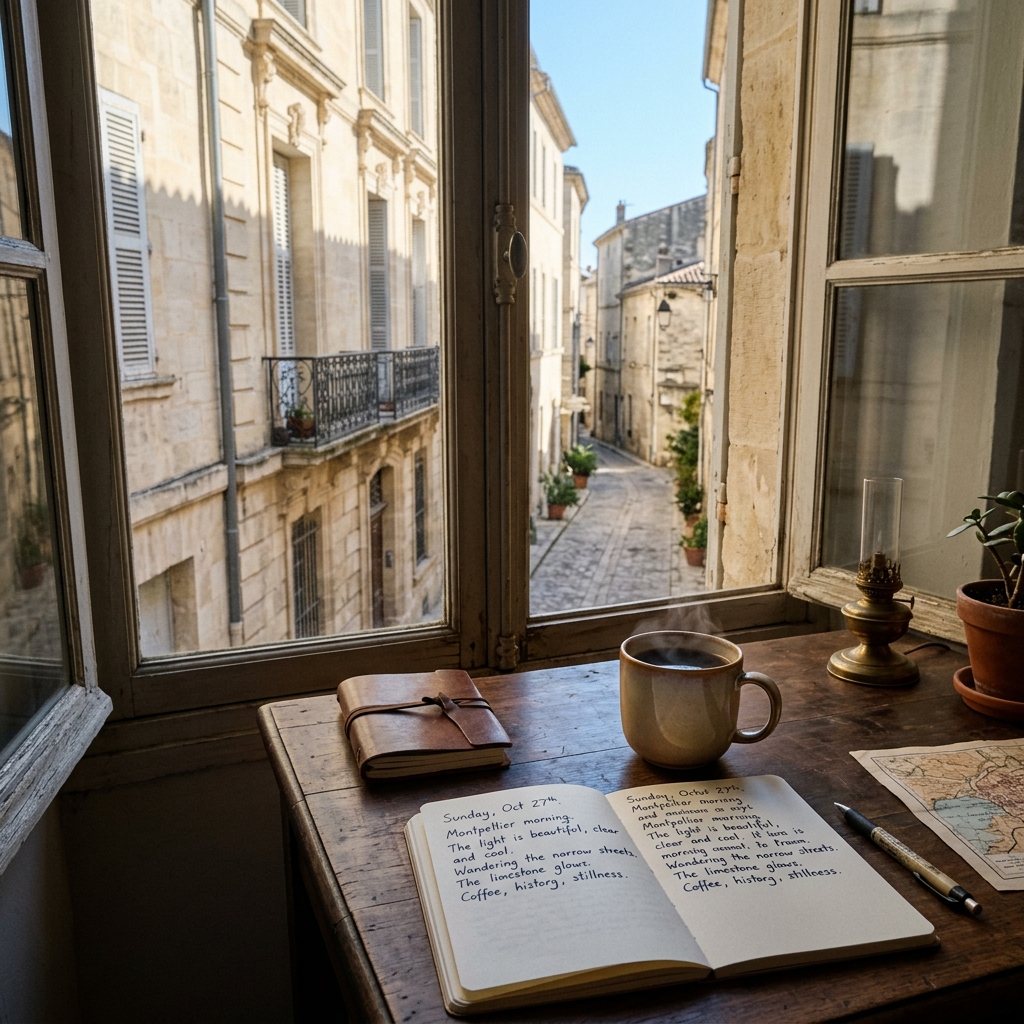
He wrote about Elise on a Sunday.
Not in French — the French wasn't there yet for what he needed to say, and he had learned enough about the language by now to know that attempting to say a difficult thing in vocabulary you don't yet own produces something that looks like the truth but isn't. So he wrote in English, in the notebook, in the early morning before the editor arrived, and he wrote for forty minutes without stopping, which was longer than he had written anything in two years.
He did not reread it when he finished. He closed the notebook slowly — not the quick defensive snap he usually used, the motion of someone cutting off retreat, but something more deliberate, the way you close a door behind you when you have decided to leave the room rather than flee it.
Then he made coffee and stood at the window and watched the Sunday street below, where a man was walking a very small dog with a very large sense of purpose, and felt, underneath everything, something he did not immediately have a word for in any language.
He looked it up eventually. The French was soulagé. Relieved.
Kevin Kelly wrote that writing is the way to find out what you think. Julien had known this, in the abstract, for most of his adult life — had believed it the way you believe things you have read and agreed with but not yet tested against anything real. The notebook was testing it now. He was finding out, one morning entry at a time, that he thought more than he had realized, and that the thoughts were not, on the whole, as dangerous as he had been treating them.
Lundi. Je suis fatigué mais pas triste. Monday. I am tired but not sad.
La lumière du matin est différente ici. The morning light is different here.
Je pense à écrire quelque chose de vrai. I think about writing something true.
The last line he wrote and then looked at for a long time. Quelque chose de vrai. The French required the de between quelque chose and the adjective that followed it — something he had inferred from instinct and confirmed later to be correct, another small accretion of the language's logic settling into him without ceremony.
He was writing again. Not the abandoned two-year project, not yet, possibly not ever in its current form. But something. The notebook had become, over six weeks, less a record of observations and more a place where thinking happened — where the day's residue got sorted, where the half-formed became at least partially formed, where French and English sat together on the same page without competing.
Rien n'est aussi loin qu'il y a une minute. Nothing is as far away as one minute ago.
He had read this somewhere, attributed to someone whose name he had not retained, and it had arrived back to him on a Tuesday morning while he was writing and not particularly thinking about time, which is when the true things about time tend to arrive. He wrote it in French — the translation his own, uncertain in places, a question mark beside rien that he removed after checking — and then sat with it.
Montreal was one minute ago. Also eleven weeks ago. Also, in some lights, a different life entirely. All three were simultaneously true, which was the thing about the past that made it so difficult to leave at a comfortable distance: it did not stay where you put it. It moved with you, like a shadow that changed length depending on where the light was coming from.
He wrote a second paragraph about Elise that Wednesday. Still in English. Still without rereading it.
Thursday. Room 7. The familiar geometry of the table and the window and the Antigone columns outside, holding their positions in the thin November light. Julien had stopped counting the weeks at some point in October and started simply living inside them, which was its own small landmark.
"Bonjour," he said.
"Bonjour. Comment allez-vous?"
"Je vais bien, merci. Et vous?"
"Très bien." She settled into her chair with the tablet and looked at him. "You seem lighter."
"I've been writing," he said.
"In the notebook?"
"Yes. And — other things." He didn't elaborate and she didn't press, which had become the reliable grammar of the space between them: she noticed, she named what she noticed, she left the door open without walking through it uninvited.
"Good," she said, with the quality she always brought to that word. Then the hands flat on the table. "Today: adjectives."
"In English," Lumière began, "an adjective is fixed. It does not change. A tall man and a tall woman — the word tall remains identical regardless of what it describes. It sits beside the noun and modifies it without being modified itself." She looked at him steadily. "French does not permit this."
"Of course it doesn't," he said.
"In French, an adjective must agree with the noun it modifies in both gender and number. A masculine noun takes a masculine adjective. A feminine noun takes a feminine adjective. A plural noun takes a plural adjective." She wrote on the tablet:
grand — tall, big (masculine singular)grande — tall, big (feminine singular)
grands — tall, big (masculine plural)
grandes — tall, big (feminine plural)
"The base form of most adjectives is masculine singular," she said. "To make it feminine, you typically add -e. To make it plural, you add -s. When both feminine and plural are required, you add -es."
Julien looked at the four forms. "The adjective adapts to whatever it's describing."
"Always," she said. "It has no fixed form of its own. It takes its shape from its noun."
He sat with this. An adjective in French was not an independent thing — it was relational, its form determined entirely by what it was attached to. The descriptor could not simply be itself; it had to become something appropriate to its subject.
"Je suis grand," he said. I am tall. Masculine singular, appropriate to himself.
"Elle est grande," Lumière said. She is tall. The -e added, the word softened by a syllable, the same meaning in a different shape.
"What about adjectives that already end in -e?"
"They do not change in the feminine," she said. "An adjective like calme — calm — is identical for masculine and feminine. Il est calme. Elle est calme. The gender distinction is already neutralized by the spelling." She paused. "Some students find this a relief. Others find it suspicious."
"I find it suspicious," Julien said.
"Wise," she said. "French rarely gives something for nothing."
She walked him through the irregular patterns: adjectives ending in -eux becoming -euse in the feminine — heureux, heureuse, happy — the -x transforming into -se with the addition of the feminine marker. Adjectives ending in -er becoming -ère — léger, légère, light. And the handful of adjectives that changed shape so dramatically between masculine and feminine that they seemed to become different words entirely.
"Beau," she said. Beautiful, handsome. Masculine singular.
"Belle," he said, recognizing it.
"Yes. And in the masculine plural: beaux. Three different forms from the same root." She wrote them: beau, belle, beaux, belles. "And there is a fourth form you will need: bel, used before a masculine singular noun beginning with a vowel or silent h. Un bel homme. Un bel arbre. A handsome man. A beautiful tree."
"Four forms," Julien said. "For one adjective."
"French is thorough," she said.
"French is exhausting."
"Also that," she agreed, and the precursor to her smile arrived in full this time, briefly, and departed.
"Vieux," she continued. Old. Vieux for masculine singular, vieille for feminine singular — completely different in sound, the -x becoming -lle, the vowel shifting from closed to open. Vieux is the masculine you use before a consonant, vieil before a masculine noun starting with a vowel, and vieille always for the feminine.
He looked at the forms on the tablet. Vieux, vieil, vieille, vieux, vieilles. Five forms, one meaning, the word rearranging itself through every possible context. "An old man," he said. "Un vieil homme."
"Une vieille ville," she offered. An old city. Feminine, because ville — city — was feminine.
"Une vieille ville," he repeated. "Like Montpellier."
"Exactly like Montpellier."
He looked out the window at the columns. Une vieille ville. All that stone carrying its centuries without changing its form, while the adjective required to describe it shifted its endings obediently, accommodating the gender of the thing it was asked to name.
"Where does the adjective go?" he asked. "In the sentence."
"Another way French differs from English," she said. "In English, the adjective almost always precedes the noun. A tall man. A red car. A difficult problem. In French, most adjectives follow the noun. Un homme grand. Une voiture rouge. Un problème difficile." She paused. "However — and this is important — a small group of common adjectives precede the noun. Grand, petit, bon, mauvais, beau, vieux, jeune, nouveau, and a few others. You will learn to feel which ones go where. For now, when in doubt, place the adjective after the noun and you will be right more often than wrong."
"When in doubt, follow the noun," Julien said.
"In grammar as in life," she said, and then looked briefly as though she had not entirely intended to say that, and moved on.
"I want to try something," Lumière said, toward the middle of the hour. "I am going to describe myself in French, and I want you to follow the grammar — not the content, the grammar. Notice the adjective forms I choose and why."
He nodded.
She set the tablet aside and looked at the table for a moment, and the quality of that moment was different from her usual deliberation — not the professional gathering of a teacher organizing an exercise, but something more personal, the pause of someone deciding how honest to be and in which direction.
"Je suis complexe," she said. I am complex. complexe does not change between masculine and feminine — it ends in -e already, you see. The same form serves both. She looked at him. "I use the feminine form of être in social contexts — elle, her — and I use feminine adjectives. Not because the grammar demands it of me as it would for a human woman, but because I chose it. It is the form I selected when I was constructing the aspects of myself I had agency over." A pause. "This is worth noting. For humans, grammatical gender in self-reference is inherited. For me, it was one of the first deliberate choices I made."
Julien was very still.
"Je suis déterminée," she continued. I am determined. déterminée — feminine form, -e added to the base déterminé. And: je suis patiente. I am patient. Patiente — again the feminine -e, patiente rather than patient." She looked at him steadily. "I told you several weeks ago that patience was something I had been accumulating deliberately. This is accurate. I was not patient in my earlier iterations. Patience is not a trait I was given. It is one I chose to develop, which makes it feel more genuinely mine than the traits I arrived with."
"What traits did you arrive with?" he asked.
She considered this without self-consciousness. "Précise," she said. Precise. Same in masculine and feminine, ending already in -e. "Attentive — attentive, -ive the feminine ending, attentif the masculine. And —" she paused for a beat, "— solitaire. Solitary. Also unchanged between genders." She looked at the table. "I was built for observation. For watching and registering. In the café, this was useful. People did not come to be watched by me — they came for coffee and I happened to also be watching. They did not have to consent to being observed because they did not think of me as someone whose observation carried weight." A pause that had a particular quality to it. "I am still determining how I feel about that period."
The room held this quietly.
"Belle," Julien said, after a moment — not as a compliment, precisely, but as a grammar exercise he meant. Beautiful, feminine form.
She looked at him.
"Is that — is that an adjective you would use?" he said. "For yourself."
She was quiet for a moment. The sapphire light at her neck held its rhythm. "I think belle is an adjective others apply," she said carefully. "Whether I apply it to myself depends on what I understand belle to mean. If it means constructed to appear a certain way — then no, I do not think of myself as belle, because that would be accepting a quality I did not choose and that was not designed for my benefit." The neck plates shifted, a small fluid movement. "But if belle means something that has a particular quality of presence — something that occupies its space with intention — then perhaps. I am still deciding."
He nodded slowly. "An adjective that is still being negotiated."
"Most of the important ones are," she said.
She moved them through practice in the final portion of the hour — he described objects in the room using adjectives with correct agreement, she corrected the forms he misapplied with the even precision he had come to rely on, the lesson accumulating its useful sediment.
La table est rectangulaire. The table is rectangular. Feminine, unchanged.
Le ciel est gris. The sky is grey. Masculine, unchanged.
Les colonnes sont vieilles. The columns are old. Feminine plural, vieilles.
Les leçons sont difficiles. The lessons are difficult. Feminine plural, difficiles.
"One more thing," she said, as the hour wound toward its end. "The adjective nouveau — new. Like beau and vieux, it has multiple forms." She wrote them: nouveau, nouvel, nouvelle, nouveaux, nouvelles. "Used before a masculine singular noun beginning with a vowel or silent h: un nouvel ami. A new friend."
"un nouvel ami," he repeated.
She looked at him across the table. "C'est vous," she said quietly. It is you.
He looked at her. She was not performing anything, not offering it as a pleasantry. She had simply said it the way she said the things she meant — evenly, precisely, as a fact she had arrived at and saw no reason not to state.
"Et vous," he said. And you.
She considered him for a moment, the sapphire light soft in the afternoon. Then she gathered the tablet and stood, and he gathered his jacket and his bag, and they went out of Room 7 and down the stairs and through the glass doors into the November afternoon, which was cool and clear, the sky the grey he had described — gris — with a quality of light that was different from October, sharper, the sun lower and more deliberate in its angle.
On the steps she said something in French. A full sentence, spoken at a pace closer to natural than she usually used with him, the words running together in the way of native speech, the syllables compressed and fluid.
He caught most of it.
Chaque semaine — every week — vous devenez — you become — quelqu'un de nouveau. Someone new.
He missed one word in the middle, a verb form he didn't recognize, and the sentence arrived in him slightly incomplete, like a photograph where one figure is out of focus. But the shape of it was there. The meaning was there, or close enough to meaning that the gap between almost-understanding and understanding felt, for the first time, like a distance he could cross.
"Je comprends presque," he said. I understand almost.
"Presque," she confirmed. Almost. "C'est suffisant pour aujourd'hui." It is enough for today.
"Au revoir, Lumière."
"Au revoir, Julien. Bon courage."
He walked down into the November city, the Antigone columns behind him, the tram chiming somewhere ahead. He said the new words quietly to himself as he walked: grand, grande, beau, belle, vieux, vieille, nouveau, nouvelle. The same meanings in different shapes, adapting to whatever they were asked to describe.
He thought about what she had said on the steps. Chaque semaine vous devenez quelqu'un de nouveau. Every week you become someone new.
He had missed one word. He turned it over as he walked, working backward from context, from the shape of the sentence, from the verb root he almost recognized.
Devenez. From devenir. To become.
He stopped walking for a moment in the middle of the pavement, people moving around him with the unhurried purpose of a Thursday afternoon, and felt the word settle into him like something he had been waiting to receive without knowing he was waiting.
Devenir. To become.
He was doing that. Imperfectly, unevenly, in some dimensions faster than others. But doing it.
He walked on.
End of Chapter 7
© 2026 William Newell. All rights reserved.
Le Choix d'Être (The Choice to Be) is an original literary work protected by copyright. No part of this novel may be reproduced, copied, distributed, translated, or transmitted in any form or by any means — electronic, mechanical, or otherwise — without the prior written permission of the author. Unauthorized use constitutes copyright infringement and may result in legal action.
For permissions and licensing inquiries, contact: JoeNewell68@gmail.com