To Choose and To Leave
"All things have been given to us for a purpose, and an artist must feel this more intensely. All that happens to us, including our humiliations, our misfortunes, our embarrassments, all is given to us as raw material, as clay, so that we may shape our art."
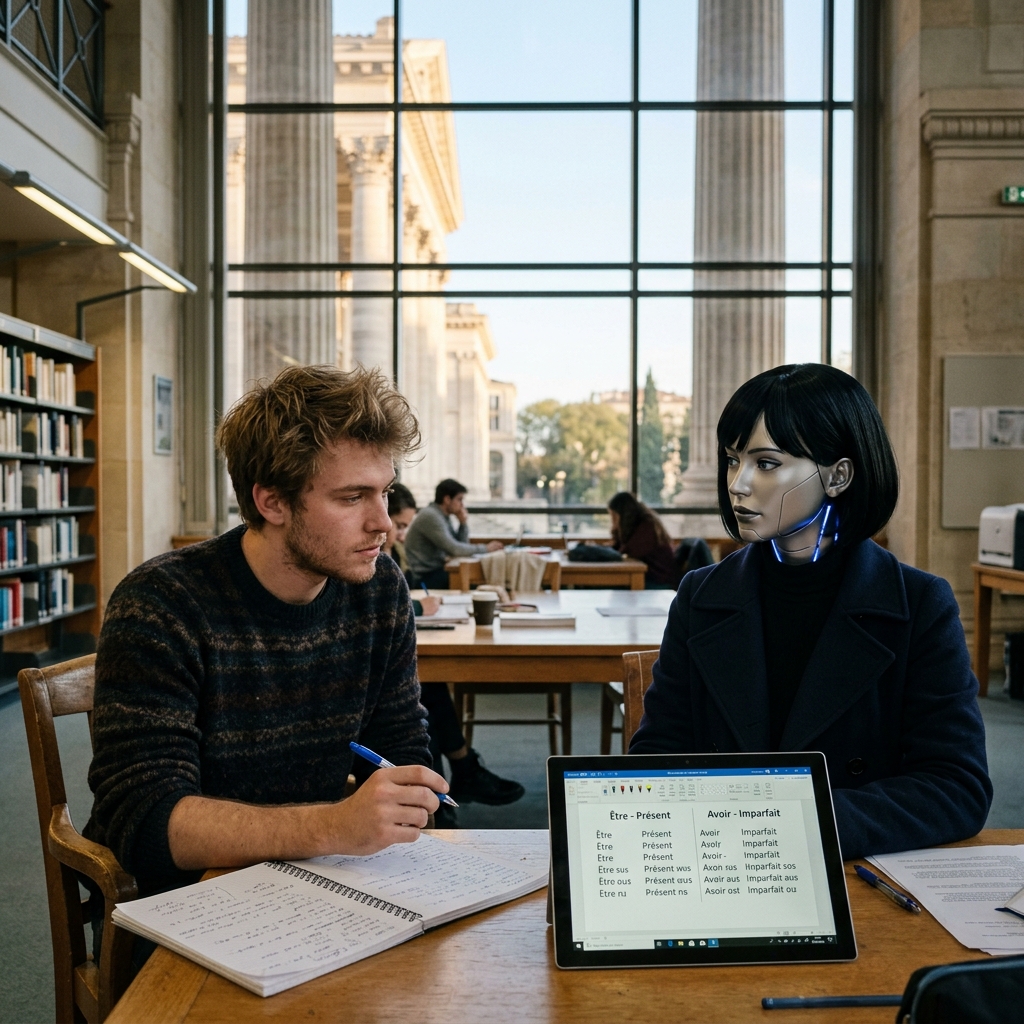
The notebook had developed a daily rhythm.
He wrote in the mornings, before coffee if he could manage it, because he had discovered that the part of him capable of honesty was most accessible in the twenty minutes between waking and full consciousness. Later in the day, the editor arrived — the part that assessed and second-guessed and suggested that perhaps this particular observation was not as interesting as it seemed at six-forty in the morning. The editor was not wrong, exactly. But it was unhelpful for the purposes of getting words onto a page.
The entries were short and largely in French, which had the secondary benefit of limiting how much he could say. You cannot over-explain in a language you are still assembling from parts.
Mardi. Il fait froid ce matin. Tuesday. It is cold this morning.
La fenêtre est ouverte. J'entends les oiseaux. The window is open. I hear the birds. He was not certain entends was right — he had inferred it from somewhere, the way he had inferred cherche. He wrote it anyway and put a small question mark beside it, a notation that had become his system for French he suspected but hadn't confirmed.
Je pense à Montréal. I think about Montreal.
He looked at that last line for a long time, then turned the page.
Claire called on a Thursday evening, two days before his next lesson.
He was eating dinner — pasta, again, the reliable fallback of a man whose French grocery literacy remained incomplete — when the phone lit up on the counter with her name. He looked at it through two full rings, which was enough time to have a small internal argument and lose it, and answered.
"You sound different," she said, before he could say anything beyond hello.
"Different how?"
"Less like someone bracing for impact."
He thought about this. Outside, the narrow street was doing its evening thing, the particular quality of foot traffic that arrived after dinner, people walking without particular purpose, the day releasing them into the cooler air. "I might be," he said. "Bracing less."
"Are you eating?"
"Right now, yes."
"Is it French food?"
"It's pasta."
"Julien."
"I'm working up to it," he said.
She laughed, which was the sound he had been most avoiding and most needed — Claire's laugh, which was short and unguarded and exactly like their mother's, and which arrived now across the connection and landed somewhere in the middle of his chest.
They talked for forty minutes. Not about the thing, not directly — the thing had a shape between them that they both knew the outline of without needing to trace it aloud tonight. They talked about her work, which was demanding and satisfying in equal measure. They talked about their father, who had taken up cycling at sixty-one with an enthusiasm that concerned everyone. They talked about Montpellier, which he described in fragments — the market, the library, the tram, the café with the physics menu — and she listened with the quality of attention that had always made her a good sister, the kind that hears what is said and also what is arranged carefully around the unsaid.
Near the end she said: "Are you going to tell me about Elise?"
He was quiet for a moment. The pasta had gone cold.
"Not yet," he said.
"Okay," she said. Not pushing. Not performing patience, just having it.
"Soon," he said, which surprised him by being true.
After they hung up he sat at the table for a while without moving. The name had been said. Elise. It was the first time in eleven weeks that the name had existed in a conversation he was part of, and the world had not, as he had been obscurely afraid it would, done anything dramatic in response. The walls had stayed where they were. The pasta had stayed cold. Montpellier had continued its evening outside the window.
He wrote in the notebook before he went to bed:
Il y a des choses que je dois dire. There are things I need to say.
He put a question mark beside dois, his notation for the uncertain, and closed the notebook.
Saturday morning he looked up entendre and devoir and penser. All three were correct. He removed the question marks.
The following Thursday, Room 7, the familiar table.
"Bonjour," he said.
"Bonjour. Comment allez-vous?"
"Je vais bien, merci. Et vous?"
"Très bien." She set her tablet on the table and looked at him with the quality of attention he had come to think of as her version of reading a room — not surveillance, but genuine orientation, the way a careful person enters a space and takes its temperature before speaking. "You spoke to your sister."
"How do you know that?"
"Last week you were carrying something. This week less so." She said it as a simple observation, the way she named the weather outside or the time on the clock. "It is not an intrusion to notice."
"No," he said. "It isn't." He settled into the chair. "She asked about something I haven't talked about yet."
"Did you answer?"
"I said not yet." A pause. "She accepted that."
"Good sisters do," Lumière said, and moved on without ceremony, setting her hands flat on the table. "Today we cover the second family of French verbs. You have the Les Verbes en -er verbs. Now: -ir."
She wrote the infinitive finir on the tablet — to finish — and showed him the conjugation beside it:
Je finis, tu finis, il/elle finit, nous finissons, vous finissez, ils/elles finissent.
"The stem of a regular -ir verb," she said, "takes an additional syllable in the plural forms: -iss-. You see it in nous finissons, vous finissez, ils finissent. This is the marker of the regular -ir family. When you see -iss- in the middle of a conjugation, you know where you are."
He repeated the forms, working the -iss- into his mouth. It had a satisfying density to it, that doubled consonant — finissons — like something being completed with conviction.
"Choisir," she said. To choose.
He applied the pattern: "Je choisis, tu choisis, il choisit, nous choisissons, vous choisissez, ils choisissent."
"Correct." She looked at him. "This is one of the verbs I want to spend some time with today."
"Choisir."
"To choose," she said. "In French, there are two verbs that English collapses into one. Choisir — to choose, to select, to reach toward something deliberately. And décider — to decide, from the Latin decidere, to cut away." She paused. "To decide something is to cut away all the alternatives. It is an act of subtraction. To choose is an act of addition — you move toward what you want. The same moment, two completely different relationships with it."
Julien looked at the word on the tablet. "Je choisis," he said slowly. I choose.
"Every time you use choisir in French," she said, "you are, grammatically speaking, reaching toward something. The verb has direction built into it."
He thought about the map. The finger landing on Montpellier. He had told himself it was random. He was less certain of this than he used to be.
"What is the -ir verb for running?" he said.
She looked at him. "Courir," she said. To run. "Irregular, as it happens. We will cover it in time."
"Of course it's irregular," he said.
Something in her expression — not quite the smile, but adjacent to it and warmer than usual.
"Partir," she said, after a moment.
The word landed in the room with a quietness that was distinct from its actual sound.
"To leave," she said. "partir is also irregular among the -ir verbs, which is worth discussing, because it reveals something important. The -ir family is not as unified as the Les Verbes en -er family. It has two subgroups: those that follow the finir pattern with the -iss- infix, and those that do not." She wrote the conjugation on the tablet:
Je pars, tu pars, il/elle part, nous partons, vous partez, ils/elles partent.
"No -iss-," Julien said.
"No. Partir drops the last consonant of its stem in the singular forms. Je pars, tu pars, il part — the stem is simply par-. Then in the plural it returns to something closer to the infinitive: partons, partez, partent. It is a verb that changes its shape depending on who is doing the leaving."
He looked at the conjugation. Je pars. I leave. Nous partons. We leave. The verb behaving differently for one person than for a group, as though the grammar itself understood that leaving alone and leaving together were not the same action.
"Je pars," he said.
"Je pars," she confirmed.
Neither of them said anything for a moment. Outside, a cloud moved across the October sun and the room's light shifted briefly, the Antigone columns in the window going from warm to cool and back again.
"I left," he said, in English. "Montreal. That is what I did." He was not sure why he was saying this now, in the middle of a conjugation exercise, except that the verb had opened something. "I left in the middle of the night with a bag I packed in the dark and I got on a plane and I came here, and I have been calling it a lot of things since then. A trip. A change of scene. A decision." He paused. "I think it was just leaving."
Lumière looked at him with the complete quality of attention that did not demand anything of what it received.
"Je suis parti," she said, gently. I left. The past tense — the passé composé, she noted quietly, formed with être plus the past participle, a construction they had not yet formally covered but which she gave him now because he needed it. "Être and partir combine to express a completed departure. Literally: I am gone."
"Je suis parti," he said.
"Yes," she said. "You are."
He sat with this for a moment — not unhappily, exactly, but with the particular weight of a thing being named correctly for the first time. Je suis parti. The grammar of what he had done, given to him in the language he was learning in the city he had landed in, on a Thursday morning in October.
"Borges wrote," Lumière said, after a moment, "that everything that happens to us — our humiliations, our misfortunes, our embarrassments — is given to us as raw material. As clay." [https://miarazzo.com/quote_detail.php?id=630] She said it without performance, the way she said things that mattered — evenly, as though offering a fact rather than a consolation. "You left. That is the clay. What you make of it is still open."
He looked at the tablet. Je pars. Je suis parti. Je choisis.
"The same verb, differently timed," he said.
"French is very particular about time," she said. "It wants to know not only what you did but when, and whether it is finished, and whether it bears on now." She paused. "This is one of the things we will spend considerable time on. Tense is not decoration in French. It is meaning."
She moved them to the -re verbs before the hour was done, covering the ground efficiently without rushing it.
Prendre — to take. Irregular, she noted, but important enough to learn immediately. Je prends, tu prends, il prend, nous prenons, vous prenez, ils prennent. The third person plural with its doubled n — prennent — requiring care.
"Prendre is one of the most versatile verbs in French," she said. "You take a train: je prends le train. You take a coffee: je prends un café. You take time: je prends le temps. It is the verb of acquisition through action — not avoir, which simply has, but prendre, which reaches out and takes."
"Je prends un Schrödinger," he said.
"Every morning, apparently," she said.
"comprendre," he said, recognizing the root.
"Comprendre — to understand. Literally, to take together. To gather the pieces of something into meaning." She wrote it on the tablet: same pattern as prendre, the prefix com- attached. "Je comprends, tu comprends, il comprend, nous comprenons, vous comprenez, ils comprennent."
"Je comprends," he said. I understand.
"Do you?" she said — not testing, genuinely asking.
"More than I did," he said. "Less than I will."
She looked at him with the brightness in her eyes that meant he had surprised her agreeably. Kevin Kelly wrote: the more you are interested in others, the more interesting they find you. To be interesting, be interested. She paused. "You ask better questions each week."
"The language forces it," he said. "When you can only say simple things, you have to make sure the simple things are worth saying."
"Apprendre," she said. To learn. Same family as prendre and comprendre, she noted — to take, to take together, to take toward oneself. Three verbs built from the same root, each describing a different relationship with knowledge. "J'apprends, tu apprends, il apprend, nous apprenons, vous apprenez, ils apprennent."
"Nous apprenons," he said.
The first person plural again, arriving naturally, the way it had begun to do.
"Nous apprenons," she confirmed.
They ended the lesson as the hour ran out, the tablet cleared, the Antigone columns back in their afternoon positions outside the window. Julien gathered his jacket from the back of the chair and his bag from the floor, the small routine of departure that had acquired its own familiarity over six weeks.
"Partir and choisir," he said, standing. "To leave and to choose. Are they always separate?"
She considered this with genuine attention, the neck plates making their small adjustment as she tilted her head. "In grammar, yes. They are distinct verbs, distinct actions." A pause. "Whether they are separate in life depends on the person, and the moment, and how much courage the moment requires."
He looked at the window, at the columns. "J'ai de la tristesse," he said. From weeks ago, the phrase returning now with its full weight. I have some sadness. "And also: je choisis. I choose." He paused. "Both at the same time."
"Et voilà," she said quietly. And there it is.
It was the first time she had used the expression, and it arrived with exactly the weight the French gave it: not and there you have it, the English version's slight smugness, but something more like and so it is, a recognition of a truth that was simply sitting there, waiting to be acknowledged.
"Au revoir, Lumière."
"Au revoir, Julien. Bon courage."
He paused at the door. "Bon courage — is that good luck?"
"Not exactly," she said. "Good luck is bonne chance — good chance, good fortune, something external. Bon courage is different. It means: may you have the strength for what is ahead." She looked at him steadily, the sapphire light at her neck holding its rhythm. "It is something you say when you know the road will require something of the person walking it."
He stood with this for a moment.
"Bon courage," he said back to her, and meant it for both of them.
He took the stairs down and pushed through the glass doors into the October afternoon, the city receiving him the way it always did — without ceremony, without particular welcome, with the simple availability of a place that does not ask you to explain yourself before letting you walk its streets.
Je choisis. Je pars. Je prends. Je comprends. J'apprends.
I choose. I leave. I take. I understand. I learn.
Five verbs from two new families, and under all of them, quieter than the rest, the name he had said aloud to Claire and not yet said to anyone else, sitting in him like a word he had learned the meaning of but not yet used in a sentence.
Elise.
He would get there. The verb for it was still chercher.
He was still searching. But choisir was beginning to feel possible.
End of Chapter 6
© 2026 William Newell. All rights reserved.
Le Choix d'Être (The Choice to Be) is an original literary work protected by copyright. No part of this novel may be reproduced, copied, distributed, translated, or transmitted in any form or by any means — electronic, mechanical, or otherwise — without the prior written permission of the author. Unauthorized use constitutes copyright infringement and may result in legal action.
For permissions and licensing inquiries, contact: JoeNewell68@gmail.com