Something to Search For
"I must be willing to give up what I am in order to become what I will be."
The notebook woke up on a Wednesday.
It was raining — not the brief, apologetic drizzle that had passed through twice before, but a grey, committed rain that darkened the stone of the street below and kept it dark. Julien made coffee, stood at the window long enough to feel the day's intentions, and sat down at the table with the notebook open in front of him.
He had two lines in it. I am here. Je suis ici.
He wrote underneath:
Il y a de la pluie. There is rain.
La rue est vide. The street is empty.
J'ai du café. I have coffee.
Three sentences assembled from four lessons. Not the sentences of someone who spoke French — the sentences of someone learning to, which is a different and more interesting thing. He kept going.
Je suis à Montpellier.
Je ne suis pas à Montréal.
He looked at the second line for a long time. Then he wrote one more, slowly:
Je cherche quelque chose. I am searching for something.
He wasn't certain cherche was the right word. He had seen it somewhere in the ambient French that was beginning, around him, to resolve from noise into something he could almost touch. He wrote it anyway, because it was true, whatever it conjugated to.
He closed the notebook before he could cross anything out.
That afternoon he looked up chercher. It meant exactly what he had hoped. He read a little further: a regular Les Verbes en -er verb, conjugated according to a standard pattern. He didn't fully understand what that meant yet, but he wrote it down.
The following Thursday, Lumière was waiting outside the médiathèque rather than in Room 7.
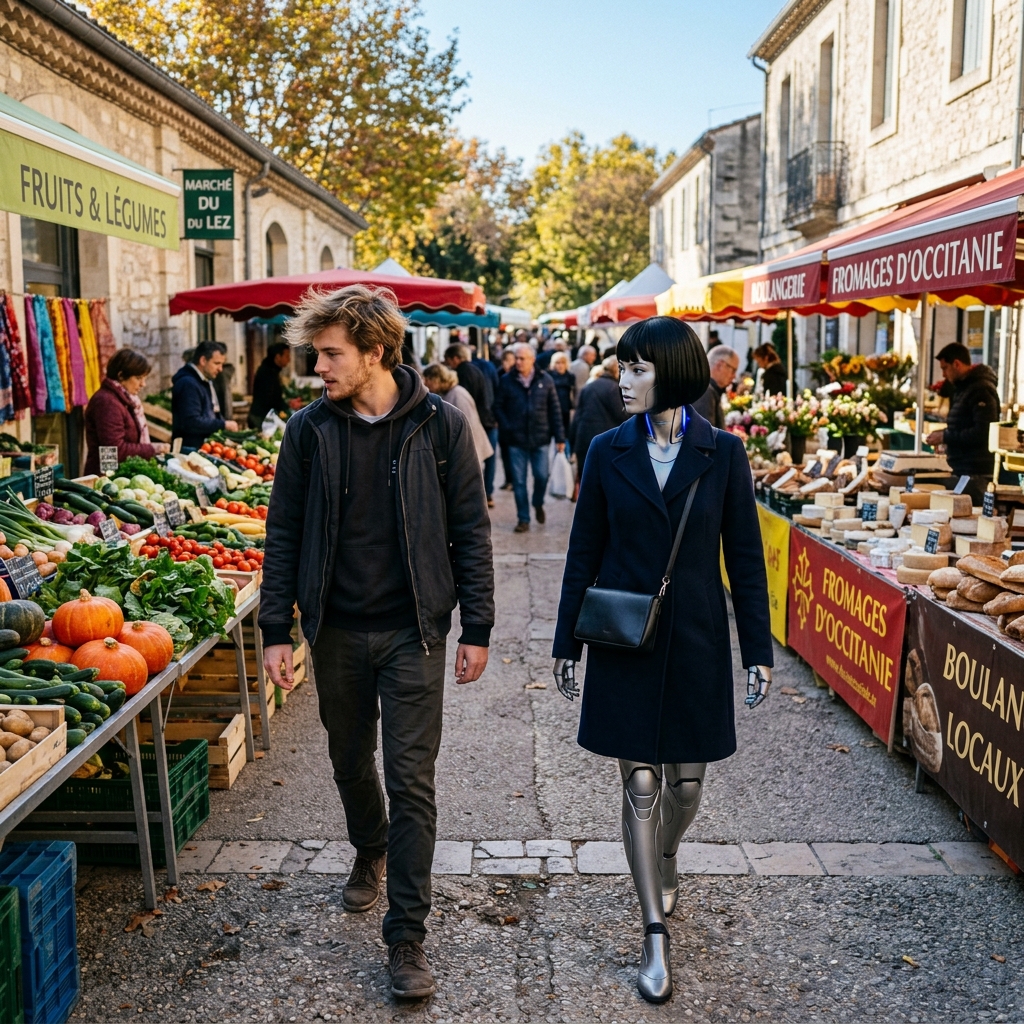
She stood on the pavement in a deep navy coat, a slim bag over one shoulder, the October air doing something quiet with the sapphire light at her neck seams. The rain had cleared two days ago and left the city clarified in its wake — the pale stone of the buildings sharper, the shadows more decisive.
"We are not going inside today," she said.
"Where are we going?"
"To the lesson," she said, and turned and walked.
He followed her south through the Antigone district and then along the Lez, which ran low and greenish between its concrete banks. The Marché du Lez was in full midweek form: wheels of cheese stacked in concentric rows, a fishmonger's table glistening on ice, pyramids of tomatoes and aubergines and the last of the season's peppers going soft at the shoulders. Vendors called to each other across the stalls. A dog sat under a folding table and monitored the foot traffic with professional skepticism.
"The lesson," Lumière said, "is this."
He looked at the stalls. "The market is the lesson."
"The market is the vocabulary. You already know how to be. You already know how to have." She adjusted the bag on her shoulder. "Today you learn how to do."
She produced the tablet and showed him a single conjugation table:
Parler — to speak. Je parle, tu parles, il/elle parle, nous parlons, vous parlez, ils/elles parlent.
"The stem," she said, "is what remains when you remove the Les Verbes en -er: parl-. You attach six endings to the stem: -e, -es, -e, -ons, -ez, -ent. These endings are the same for every regular Les Verbes en -er verb in the language. Every one. Without exception."
He stared at the pattern. Something clicked — not dramatically, just the quiet mechanical sensation of a thing falling into place inside a larger system. "So if I know parler," he said slowly, "I know écouter."
"J'écoute, tu écoutes, il écoute, nous écoutons, vous écoutez, ils écoutent," she confirmed. "The stem changes. The endings do not." She looked at him. "Try one. Regarder. To look, to watch."
"Je regarde, tu regardes, il regarde, nous regardons, vous regardez, ils regardent."
"Correct. Every form."
This was different from what had come before. Not retrieval, not repetition — he had generated French, applied a rule to a new word and arrived, independently, at something correct. The language was beginning to move inside him rather than arriving from outside.
"Marcher," she said. To walk.
"Je marche, tu marches, il marche, nous marchons, vous marchez, ils marchent."
"Aimer." To love. To like.
He paused for a beat. "J'aime, tu aimes, il aime, nous aimons, vous aimez, ils aiment."
"You hesitated on j'aime."
"It felt like a significant verb to get wrong."
The precursor to her smile arrived and held there without completing itself. "In French, aimer does double duty," she said. "With a person, it means to love. J'aime Marie. With a thing or activity, it means to like. J'aime le café. Same conjugation, entirely different weight. English separates love and like into distinct words. French asks you to hold both in a single verb and let the context carry the distinction."
"That's a lot of trust to place in context," Julien said.
"The French are comfortable with ambiguity," she said, "when the ambiguity is elegant."
They moved through the market without shopping, following its currents. Lumière pointed at vendors and named the verbs: the man at the tomato stall arranged and weighed and counted change, the woman at the bread table parle and listened with the quick efficiency of someone conducting the same conversation for the fortieth time that morning. Actions everywhere, French everywhere, the grammar of doing flowing past faster than he could catch individual words.
He caught parle in a sentence and recognized it. It was a small thing. It felt larger than it was.
"Chercher," Julien said, between stalls.
She looked at him.
"To search. Is that an Les Verbes en -er verb?"
"It is." A slight brightening of the sapphire in her eyes. "Where did you encounter it?"
"I wrote it in the notebook. Wednesday. I wasn't sure I had the right word."
"You did. Conjugate it."
"Je cherche, tu cherches, il cherche, nous cherchons, vous cherchez, ils cherchent."
"Correct." She was quiet for a moment. "What were you searching for? In the notebook."
He watched a man select apples one at a time, turning each briefly in his hand before deciding. "I don't know yet," he said. "I wrote je cherche quelque chose. It felt accurate without being specific."
"Sartre said: we are our choices. The verb chercher is itself a choice. To search implies you have not yet decided to stop, which is its own form of commitment."
He considered this. "What are you searching for? With the teaching."
She considered it in return, with the particular quality she brought to questions that deserved it — not the performance of thought, but the thing itself. "Confirmation," she said. "That the path I am on leads somewhere I want to arrive." A brief pause. "And forty more documented hours, practically speaking. We have covered six so far."
"That's very practical."
"I am also very practical. The two are not in conflict." She glanced at him sidelong, the sapphire catching the autumn sun. "I can find the work meaningful and still need the hours."
"J'ai besoin des heures," he said.
"J'ai besoin des heures," she confirmed. "And you have need of French."
"J'ai besoin du français."
They walked on. He caught cherche from a woman at a fabric stall describing something she was looking for — the word lifting out of the surrounding French like a face recognized across a crowded room. He didn't say anything about it. He just noted it, the way you note the first time a foreign city does something you were expecting.
"In Montreal," he said, after a while, "I wrote."
Lumière waited.
"That's what I did there. I'd been working on something for two years." A vendor was arguing cheerfully with a customer about the weight of a bag of walnuts, neither of them particularly invested in winning. "It wasn't going well. The writing, and other things. They made each other worse."
He stopped there. It was more than he had said about Montreal to anyone in Montpellier. It was also, he was aware, still very little — the outline of a thing rather than the thing itself, the shape of a door rather than what was behind it.
Lumière didn't press. She received it the way she received everything, completely and without immediately doing anything with it.
"Écrire," she said, after a moment. To write. "Irregular — not an -er verb despite its ending. We will cover it properly later. But the present tense: j'écris, tu écris, il écrit, nous écrivons, vous écrivez, ils écrivent."
"J'écris," he said. I write. Present tense. No qualification, no was trying to or used to. Just the verb, doing its work in the present moment, which was the only tense he had been given so far, and which was, he was beginning to understand, the point.
"J'écris," she confirmed.
They walked back along the river as the market began its midday wind-down — vendors stacking crates, folding cloth, hauling buckets of ice melt toward the drains. Lumière named verbs and he conjugated them as they walked, the grammar moving through his mouth while the city moved around him.
"Nous parlons," he said, looking at the water.
"Nous marchons."
"Nous cherchons."
She glanced at him. The nous — the first person plural, we — had arrived without planning. Neither of them remarked on it, but it sat in the air between them with the slight gravity of an unintended truth.
"Nous apprenons," she said quietly. We learn. An irregular, to be covered later.
"Nous apprenons," he agreed.
At the steps of the médiathèque they stopped. She ran him through a final set — écouter, regarder, marcher — and he moved through them without hesitation.
"Aimer," she said.
He looked at the Antigone columns standing in the October light, all that inherited architecture carrying its assigned history without complaint.
"J'aime Montpellier," he said. Not as a grammar exercise.
She looked at him. "That is a thing you like. Or a thing you love. The verb does not specify."
"I know," he said. "I think I mean both. I'm not sure yet which one is stronger."
The expression that held her smile without releasing it. "That," she said, "is perhaps the most French thing you have said."
Something in his chest released — a small, involuntary sound, not quite a laugh but close enough to surprise him.
"Au revoir, Julien."
"Au revoir, Lumière."
He walked back through the Antigone district, conjugating quietly to himself the way he had learned to do, working the new verbs into the rhythm of his steps.
Je parle. J'écoute. Je regarde. Je marche. J'aime. Je cherche.
Six verbs. Six things a person does in the world.
Je cherche quelque chose.
He still didn't know what. But the verb was right, and the searching was real, and in the present tense — the only tense he had so far, the only one the lessons had trusted him with — it was enough.
End of Chapter 5
© 2026 William Newell. All rights reserved.
Le Choix d'Être (The Choice to Be) is an original literary work protected by copyright. No part of this novel may be reproduced, copied, distributed, translated, or transmitted in any form or by any means — electronic, mechanical, or otherwise — without the prior written permission of the author. Unauthorized use constitutes copyright infringement and may result in legal action.
For permissions and licensing inquiries, contact: JoeNewell68@gmail.com