To Have
"To have another language is to possess a second soul."
Claire responded on Saturday morning with a message that contained, by Julien's count, considerably more than eleven words.
She had not been angry. She had said this in the first message and she said it again now, which meant it was true rather than tactical — Claire was not a person who repeated things for effect. She was worried, she said, in the specific way that older sisters are worried, which is to say practically and without sentimentality: had he sorted out health coverage, was the neighborhood safe, did he have enough money to last until he figured out what he was doing. She did not ask what he was running from, which was either tact or the knowledge that he wouldn't answer. Possibly both.
At the very end, after the practical questions, she wrote: Also — your French is going to be terrible. I hope you know that.
He read this and felt something loosen in his chest that he hadn't realized was tight.
He wrote back: It already is. I'm working on it.
He sent it before he could reconsider, which was becoming, he noted, something of a habit. Small transmissions dispatched before the part of him that specialized in avoidance could intervene. He was not sure this constituted progress, exactly, but it resembled it.
He put the phone down and looked at the ceiling of his sublet for a while. The ceiling was the particular shade of white that becomes, after enough time staring at it, a kind of companionship. He had spent more time with this ceiling than with any person in Montpellier except Lumière, which was a fact he examined briefly and then set aside.
Outside, the city conducted its Saturday business. He could hear it through the window he had taken to leaving open at night: the particular morning register of a French street, the rhythms of a language that was slowly, reluctantly, beginning to sound less like noise and more like something he might eventually inhabit.
He was not there yet. But the distance had changed quality.
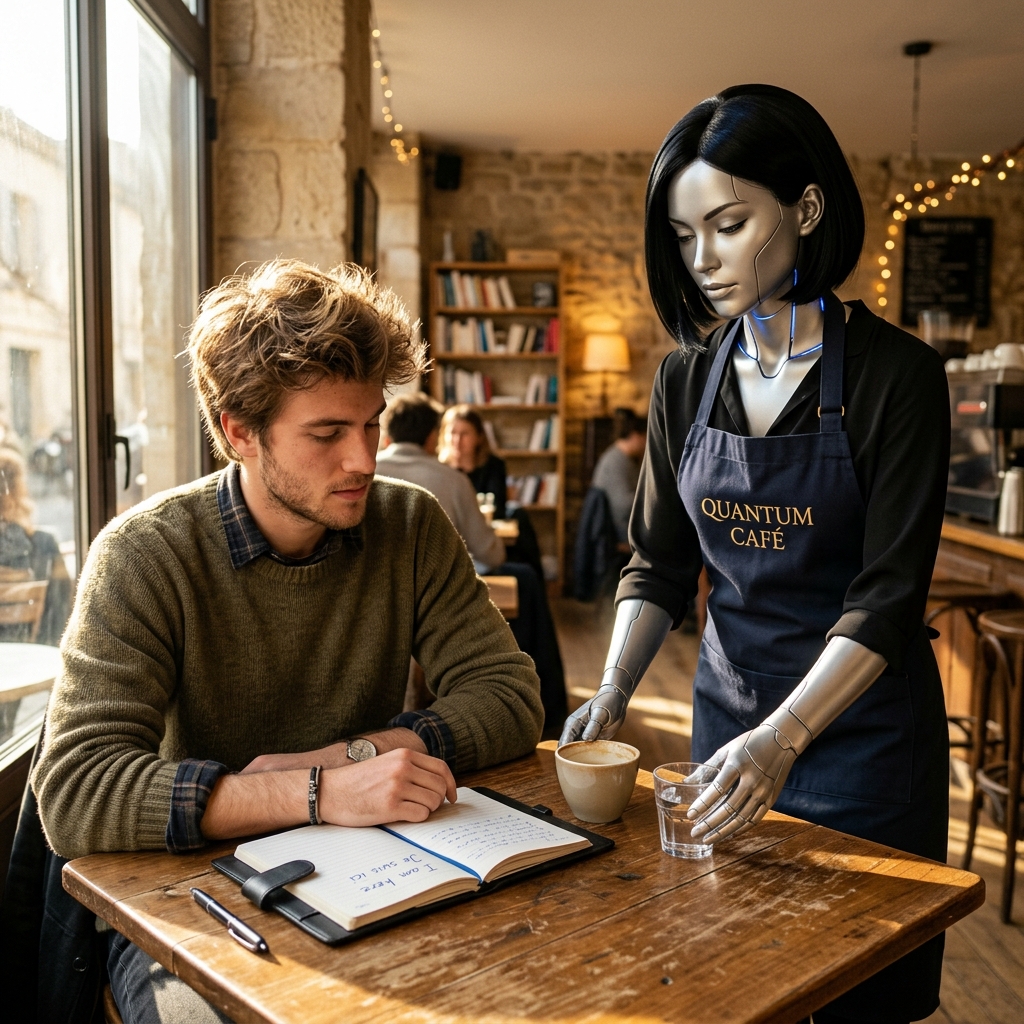
He went to the Quantum Café that afternoon, not because he needed coffee particularly but because the familiarity of it had become, without his having decided this, something that functioned like comfort. He ordered a Schrödinger — by name now, without pointing, which the young man at the counter received with the mild approval of someone who has noted a small improvement without feeling it necessary to celebrate it — and took his usual corner table and opened the notebook.
The page was blank, as it had been since he arrived. He looked at it for a long time.
Then he wrote, in English, three words: I am here.
He looked at what he had written. He thought about what Lumière had said three sessions ago: je suis ici. I am here. He thought about how those same words, rearranged into French, had felt different in his mouth — more committed somehow, more declared, as though the foreign language required him to mean things more deliberately because he could not yet say them automatically.
He wrote, beneath the English: Je suis ici.
He looked at both lines for a while. Then he closed the notebook. This was, he understood, not nothing. For a notebook that had been blank for nearly three weeks, two lines felt like an opening rather than an ending. He would not push it.
He drank his coffee and watched Montpellier through the window and said the conjugations of être quietly to himself the way he had taken to doing, the six forms of the verb worn into something approaching familiarity: je suis, tu es, il est, elle est, nous sommes, vous êtes, ils sont. A grammar of existence, held in the mouth like small smooth stones.
He did not notice Lumière until she set a small cup of water on his table and said, in French, something that took him a moment to parse and then resolved itself into: you talk to yourself.
He looked up.
She was in her café mode, the charcoal apron over the dark blouse, the neck plates catching the late afternoon light with their usual quiet precision. She had two other tables waiting. She was not in a hurry, exactly, but she was working — this was her other context, the one that existed before and apart from their lessons, and there was something slightly different about her in it, a quality of efficient warmth that was less focused than her tutorial self and no less genuine.
"Je parle français," he said carefully. I speak French. Or rather: I attempt French.
"Un peu," she said. A little. Not unkindly. She glanced at the notebook on the table, the two lines visible, though from her angle she couldn't have read them. "Next Thursday," she said, in English, as though confirming an appointment with herself as much as with him.
"Next Thursday," he said.
She went back to the counter. He watched her go with the particular quality of attention he had begun to notice he brought to her movements — not surveillance, not the watching of someone hoping to be noticed, but something more like study. She moved through the café with an efficiency that was also elegance, the neck plates making their small fluid adjustments as she turned, the sapphire light at the seams dim in the afternoon brightness but present, always present, like something that couldn't quite be turned off because it was too central to what she was.
Je suis en cours, she had said. I am in progress.
He thought about this a great deal more than was strictly warranted by a grammar exercise.
Thursday arrived with the particular early-October quality of a day that has decided summer is genuinely over and is committing to the change without apology: crisp in the mornings, still warm enough by afternoon, the light coming in at a new angle that made the old stone of the city look different, something more autumnal and considered than the high-summer glare. Julien walked to the tram with his jacket on for the first time since arriving and felt, obscurely, that this was some kind of marker.
Room seven. The familiar table, the familiar window. Lumière was there, as she was always there, with her tablet and the particular quality of waiting that looked like choice.
"Bonjour," he said.
"Bonjour. Comment allez-vous?"
"Je vais bien, merci. Et vous?"
"Très bien." She looked at him. "You seem less tired."
"I've been sleeping better."
"Good," she said, with the same quality she always brought to this word: not the hollow affirmation of social courtesy, but a genuine small verdict. "Today," she said, setting her hands flat on the table, "we learn the second most important verb in the French language."
"Second to être?"
"Always second to être." She looked at him steadily. "The verb is avoir. To have."
She said the infinitive: ah-vwar, the oi producing that particular French sound that sits between the English w and v and belongs fully to neither, the whole word compact and slightly proprietary in the mouth, as though the act of having were something brisk and decisive.
"Avoir," he repeated.
"Like être, it is highly irregular. Like être, its conjugated forms must be memorized rather than inferred." She spoke the forms one by one, and he repeated each after her:
J'ai. I have. The shortest conjugation in common French, she noted — the subject and verb compressed into a single syllable and a half, as though the language had decided that possession was something you declared quickly or not at all.
Tu as. You have. Informal.
Il a. Elle a. He has. She has.
Nous avons. We have.
Vous avez. You have. Formal or plural.
Ils ont. Elles ont. They have.
He repeated the set twice over, working the sounds into his mouth. The forms were different from être in texture — where être had a gravity to it, a weightiness appropriate to the verb of existence, avoir was more brisk, more transactional. J'ai. I have. Here is a thing that belongs to me. The declaration of an inventory.
"Now," Lumière said, when he had the forms reasonably settled, "I want to ask you something before we continue."
He waited.
"What is the difference," she said, "between être and avoir? Not grammatically. Philosophically."
He looked at her. This was a new mode — she had asked him to use the language in practice, to observe the language, but she had not yet asked him to philosophize about it directly. He was not sure whether this was still a lesson or something else.
"To be versus to have," he said slowly. "One is about what you are. The other is about what you own."
"Yes," she said. "And?"
He thought about it. "What you are and what you own are not the same thing," he said. "Though people confuse them."
"People confuse them constantly," she said. "This confusion is perhaps one of the central problems of modern life." She tilted her head, the neck plates shifting. "In French, there are constructions that force you to feel this distinction in the grammar itself. For instance: in English, you say I am hungry. In French, you say j'ai faim. I have hunger. The hunger is not a state of being — it is a thing you carry. A possession, temporary, that will eventually be given back."
Julien was quiet for a moment. "J'ai faim," he said. "I have hunger."
"J'ai froid. I have cold. J'ai chaud. I have heat. J'ai peur. I have fear." She said each one with the same even clarity. "These are all states that English treats as conditions of being. In French, they are things you hold. Things you can, by implication, set down."
He repeated the phrases slowly, feeling the difference in them, the way the French framing made each sensation into something separate from the self rather than a quality of it. I have fear. Not: I am afraid. The fear is a thing I am carrying, not a thing I am.
"That changes the relationship with the feeling," he said.
"It does," she said. "Whether the French consciously experience this distinction is another question. Language shapes thought in ways its speakers are often not aware of. But the structure is there, embedded in the grammar, offering a different way of relating to one's own interior states." She paused. "You are not your hunger. You have it, for now, and it will pass."
He sat with this for a moment. Outside, an October cloud moved across the sun and the room's quality of light changed briefly, the shadows in the Antigone district deepening below the window.
"I have sadness," he said, not in French. "Rather than: I am sad."
Lumière looked at him without the brightness in her eyes that indicated pleasant surprise, and without the softening that indicated consolation. She looked at him with simple, complete attention — the kind that does not require a response from itself, that holds what it receives without immediately processing it into something useful.
"J'ai de la tristesse," she said, quietly, giving him the French of it. I have some sadness. The de la before the noun — the partitive article, she would explain this in a moment — suggesting that sadness was not all of what he had, but a portion. A quantity, not a totality.
"J'ai de la tristesse," he repeated.
He meant it. She knew he meant it. Neither of them said anything about this directly, which was the correct response.
"The partitive article," she said, after a moment, returning to the grammar with the same even tone that she brought to everything, neither hurrying past what had just happened nor dwelling in it. "In French, when you speak of something in an unspecified quantity — some sadness, some water, some bread — you use de la for feminine nouns and du for masculine nouns, or de l' before a vowel." She wrote them on the tablet: du, de la, de l'. "This is the partitive. It indicates a portion of something larger. Not all of the thing — some of it."
"J'ai du courage," he tried. I have some courage.
"J'ai de la patience," she offered back. I have some patience.
"Do you?" he said. "Have patience?"
"More than I used to," she said. "It is something I have been accumulating deliberately." She paused. "This is one difference between être and avoir that I find personally significant."
"What do you mean?"
"Être describes what you are," she said. "It is, in some ways, the more fixed verb — the verb of identity, of condition. Avoir describes what you hold. And what you hold can change." She looked at him steadily. "I cannot always choose what I am. But I can choose, to some degree, what I accumulate. What I allow myself to have."
He thought about this. "You bought your own independence," he said. It was the first time he had referenced what he knew about her history, directly. He said it carefully, as a fact rather than a question.
She regarded him with the particular quality of attention that indicated she was deciding something. "Yes," she said. "Piece by piece. Over a long time." She paused. "It was a question of choosing what to have, and what not to have. What to carry forward, and what to leave behind."
Work to become, not to acquire, Julien said, almost to himself. It was something he had read once, that had lodged in him, and that arrived now without having been summoned.
Lumière was still for a moment. The sapphire light at her neck held its rhythm.
"Where did you read that?" she asked.
"I don't remember," he said. "It just came back to me."
"It is a useful distinction," she said. "Though I think the truth is that becoming and acquiring are not always separable. What you choose to have — the experiences, the skills, the hours spent learning something difficult — these become part of what you are. Avoir and être are separate verbs, but the things they describe are not always separate things."
He looked at the tablet between them, the conjugations still displayed: j'ai, tu as, il a, elle a, nous avons, vous avez, ils ont, elles ont.
"J'ai une langue," he said. I have a language. Then: "J'ai deux langues." I have two languages. A pause. "Almost."
"Almost," she agreed. "But you are accumulating."
She walked him through the practical uses of avoir that would serve him immediately: j'ai besoin de — I have need of, I need; j'ai envie de — I have desire for, I want; j'ai l'impression que — I have the impression that; il y a — there is, there are, literally: it has there, the verb avoir doing the work in French that the verb to be does in English, a further blurring of the boundary between the two great verbs, as though the language itself could not entirely separate having from being.
"Il y a," he repeated. "There is. French uses avoir — to have — to say that something exists?"
"Yes," she said. "The language is making a philosophical claim: existence is a form of possession. A thing exists because the world, in some sense, holds it." She paused. "Whether you find this comforting or troubling probably depends on the day."
He thought about this. "Today," he said, "I find it comforting."
"Aujourd'hui," she said. Today. A word she offered the way she offered everything — precisely, without ceremony, as a fact that might be useful.
"Aujourd'hui," he repeated. He looked at the window, at the October light in the Antigone columns. "Il y a du soleil." There is sun. He had assembled this himself, from the pieces: il y a + du + soleil, masculine noun, the partitive article making the sun into a portion of something larger rather than an absolute.
Lumière looked at the window. "Il y a du soleil," she confirmed. "Yes. There is."
A simple sentence. A child's sentence, probably — the kind that appeared in the first pages of every textbook, illustrated with bright pictures of weather and obvious things. He knew this. He said it anyway, and he meant it, because the sun was there and he had found the French to say so, and this was not nothing.
They worked until the hour was nearly done, and then Lumière looked at the tablet and said, with the tone of someone arriving at a destination they had been navigating toward for some time: "One more thing."
"Always one more thing," he said, which surprised a sound from her that was the closest he had heard her come to an actual laugh — brief, genuine, without performance.
"One more thing," she agreed. "The verb avoir appears in a construction you will encounter constantly, and which you should know now rather than later. Avoir l'air. To have the air of something. To seem, or to appear." She looked at him. "Tu as l'air fatigué means: you seem tired. Il a l'air content means: he seems happy. The appearance — the air — is something you have, not something you are. You can have the appearance of a thing without being it."
He sat with this. "You can seem without being."
"Or be without seeming," she said. "The grammar allows for both possibilities."
He thought about the version of himself that had been moving through Montreal for the better part of a year, carrying the air of a person who was fine, who had things managed, who was not in the process of gradually losing his purchase on the present. He had been very good at having that air.
"J'avais l'air d'être bien," he said slowly, reaching for the grammar of it, imperfect in both senses — grammatically uncertain, and describing something imperfect. I had the air of being well.
Lumière looked at him carefully. "J'avais," she said. "The imperfect tense. We have not yet covered tenses beyond the present." A pause. "But you formed it correctly."
"Did I?"
"You did," she said. "Sometimes the grammar arrives before the lesson."
He looked at the table. "Sometimes," he said, "the lesson is the grammar."
She was quiet for a moment, and the sapphire light at her neck held its slow pulse, and outside the October sun continued to exist — il y avait du soleil, there was sun — in the patient, indifferent way of things that do not require acknowledgment in order to be.
"Au revoir, Julien," she said.
"Au revoir, Lumière."
He walked out into the afternoon and down the stairs and through the glass doors into the Antigone district, which was becoming, like the tram routes and the library staircase and the face of the woman at the tabac, something that had passed from the unknown into the merely familiar — still foreign, but no longer strange. There was a difference, he was learning, between those two things. Foreign meant you had arrived from elsewhere. Strange meant you had not yet begun to arrive.
He was arriving.
He said it to himself on the tram, quietly, in French, the way he had taken to doing with the things that felt true:
J'ai de la tristesse. J'ai du courage. J'ai besoin de temps.
I have some sadness. I have some courage. I have need of time.
And then, because it was also true, because Lumière had given him the grammar for it and the day had given him the occasion:
Il y a du soleil.
There is sun.
He looked out the tram window at the city moving past, all that limestone and history and afternoon light, and thought that this was, in the most literal sense of the French, a thing the world was holding.
End of Chapter 4
© 2026 William Newell. All rights reserved.
Le Choix d'Être (The Choice to Be) is an original literary work protected by copyright. No part of this novel may be reproduced, copied, distributed, translated, or transmitted in any form or by any means — electronic, mechanical, or otherwise — without the prior written permission of the author. Unauthorized use constitutes copyright infringement and may result in legal action.
For permissions and licensing inquiries, contact: JoeNewell68@gmail.com