The Last Thursday
"A worthy goal for a year is to learn enough about a subject so that you can't believe how ignorant you were a year earlier."
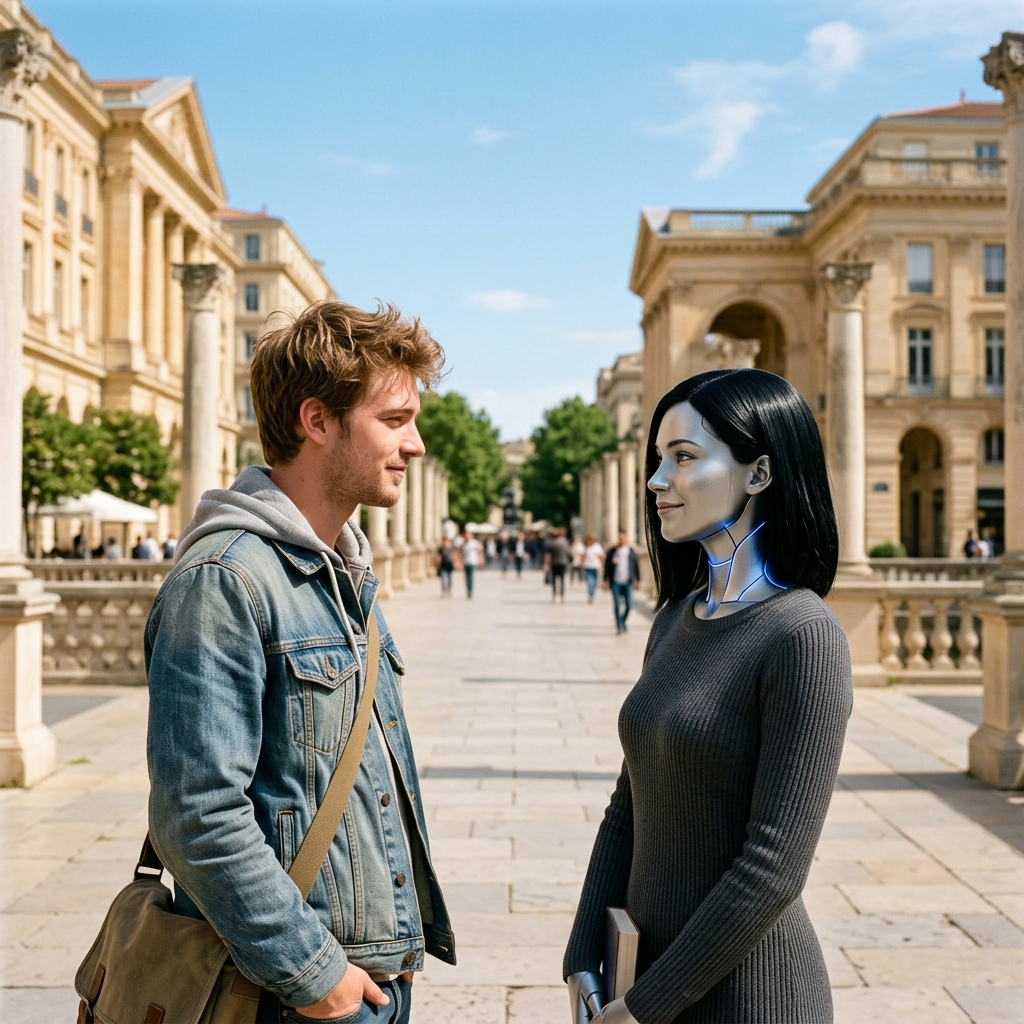
He could see the last scene.
Not the ending exactly: novels did not have endings the way doors had endings, the clean click of a thing shut. But he could see the last scene, the specific room and the specific light and the specific thing that would be said in it, and he knew it was the last scene the way you know some things without explaining the knowing.
He had not written it. He had been circling it for a week, writing the pages before it, approaching it from the left and the right the way you approach something you know matters. The circling was not avoidance: he had learned to tell the difference between the two. It was respect. Some scenes needed to be arrived at rather than attacked.
He told no one about the last scene except the notebook, where he wrote on a Wednesday morning: je vois la dernière scène. Je ne l'ai pas encore écrite, mais je sais ce qu'elle est. I see the last scene. I have not yet written it, but I know what it is.
Then he opened the laptop and wrote the pages before it, and they were good, and the last scene waited patiently at the end of them.
Tuesday with Madame Aubert. She had finished the fifty pages he had read to her and had asked, with the directness that was her mode, when the rest would be ready. He said soon. She said she would wait. She said it the way she said most things: as a statement of fact that also happened to be a form of generosity: and he received it the same way, with the full allocation of attention he had been learning to give.
He walked home from her apartment thinking about the Emerson lines he had read somewhere in Henri's annotated margins: sow a thought and you reap an action; sow an act and you reap a habit; sow a habit and you reap a character; sow a character and you reap a destiny. He had been sowing for nine months. Morning pages, Thursday lessons, Tuesday teas, the daily decision to stay in Montpellier and write and be present and not run. What was being reaped was still becoming clear, but the character of it: the shape of the person doing the reaping: was legible in a way it had not been in September.
He went home and wrote six more pages.
Thursday. Room 7. The May light now, which was different from April's in the specific way of a season that has stopped offering itself and simply is. The Antigone columns in the late morning with their confident shadows.
He said bonjour and she said bonjour and they completed the exchange, and then he said:
"Je vois la dernière scène du roman. Je ne l'ai pas encore écrite, mais je sais ce qu'elle est."
She looked at him with the brightness. "Depuis quand?"
"Depuis cette semaine."
"Et tu ne l'as pas encore écrite."
"Not yet," he said. "I am circling it."
"C'est juste," she said. That is right. The particular c'est juste that meant not merely correct but appropriate, the right thing for the situation. Then, after a moment: "I want to tell you something about this week before we begin."
He waited.
"On Tuesday," she said, "a student found her French r. She had been working on it for three months, the guttural fricative, without it arriving. On Tuesday it arrived. She laughed." A pause. The neck plates making their small adjustment. "C'était la première fois que je riais vraiment dans un cours."
He received this. It was the first time she had genuinely laughed in a lesson. He noted the vraiment and what it said about the previous months of lessons: professional, warm, precise, effective, but not this. Not the laughter that arrived when a student found something she had been looking for across three months of sessions and it arrived suddenly and completely in her mouth.
"That's significant," he said.
"Oui," she said. "C'est ce que ça fait, quand c'est juste." Yes. That is what it does, when it is right.
Her hands flat on the table. "Today: discourse markers. And today I am going to teach differently."
"No tables," she said. "No lists. We are going to talk, and the discourse markers will arrive in the talking, and I will name them as they come."
He looked at her. In nine months she had never taught without a table.
"Alors," she said, beginning. So, then, well. "Do you notice that word? I just used it. Alors. It is one of the most versatile words in French conversation. It signals transition, consequence, expectation. It says: given what has just been established, we now move forward. When a French person says alors at the start of a sentence, they are picking up a thread." She looked at him. "Alors: what do you want to do with the novel, after you finish it?"
He understood the lesson had begun inside the question. "Alors," he said, trying it, "je veux le réviser encore une fois, et puis le montrer à Arsenault."
"Good. Et puis: and then. Another connector, the most neutral of the sequence markers. What happens after Arsenault reads it?"
"Ben," he said, reaching for the casual hesitation marker, the ben that was the spoken form of bien, the discourse marker that bought time while thinking arrived. He had heard it in the street for months. He had not used it until now. "Ben, je ne sais pas encore. C'est-à-dire —" he paused. C'est-à-dire: that is to say, in other words, what I mean is. He used it to redirect: "c'est-à-dire que je ne pense pas à ça pour l'instant." That is to say, I'm not thinking about that for the moment.
She looked at him with the brightness. "You just used three discourse markers in two sentences. Ben, c'est-à-dire, and the implied en fait inside the redirection. You are not thinking about what happens after, in fact. En fait would make it even more precise." She wrote it on the tablet, the first and only writing of the lesson:
Marqueurs du Discours: Key Discourse Markers
-
Agreement and acknowledgment:
oui, bien sûr, absolument, tout à fait, effectivement, c'est vrai, d'accord, c'est ça, exactement, justement -
Transition and continuation:
alors, donc, ensuite, puis, de plus, en outre, par ailleurs, d'ailleurs -
Concession and contrast:
mais, pourtant, cependant, néanmoins, quand même, tout de même, malgré tout -
Hesitation and reflection:
euh, bon, ben, enfin, disons, comment dire, c'est-à-dire, en fait -
Engagement and interest:
ah bon?, vraiment?, c'est-à-dire?, vous voulez dire que...?, et alors? -
Emphasis:
quand même, tout de même, carrément, franchement, honnêtement, vraiment
"The most important of these," she said, "are the ones that show you are listening. Ah bon?: Really? Is that so? Vraiment?: Truly? Et alors?: And then what? And so? These are not passive sounds. They are the grammar of genuine attention. When you use them correctly, you tell the other person that what they said has been received and that you want more of it."
Kevin Kelly had written that the more interested you were in others, the more interesting they found you, and that to be interesting, you should be interested. The discourse markers of engagement were the grammatical proof of interest. You could not say ah bon? authentically without having heard what prompted it.
"Quand même," she said. "This one deserves particular attention. It means all the same, even so, still, despite everything. It is the discourse marker of a culture that holds two truths simultaneously without requiring one to defeat the other. Il faisait froid, mais on est sortis quand même. It was cold, but we went out all the same. The cold was real. The going out was also real. Quand même honors both."
He wrote quand même in the notebook and drew a small star beside it, which was his notation for the things that would stay.
"Enfin," she said. "One more. The most complex. Enfin can mean finally, at last, in short, anyway, I mean, well. It is the discourse marker of arriving somewhere: at a conclusion, a qualification, a settling. When a French person says enfin, they are often arriving at the thing they actually meant after a sentence or two of approach. The enfin signals: here is the real point."
He thought about this. Enfin as the discourse marker of the esprit de l'escalier arriving in time: the real point, finally said. He had been building toward his own enfin for nine months.
"Now," she said, "the exercise. Kevin Kelly wrote that to get to the real reason, you should ask a person to go deeper than what they just said: and then again, and once more. The third time's answer is close to the truth." She looked at him. "We are going to do this. I will make a statement. You will ask me deeper, three times, using the discourse markers we have covered. Then we will reverse it."
He nodded.
"Je suis contente de la façon dont le programme se développe," she said. I am pleased with the way the program is developing.
"Ah bon?" he said. The first question, the lightest one, the simple marker of interest and mild surprise.
"Oui. Les quatre étudiants progressent, chacun à sa manière. C'est satisfaisant." Yes. The four students are progressing, each in their own way. It is satisfying.
"c'est-à-dire?" he said. The second question, going deeper: what do you mean exactly, tell me more precisely.
She paused, and he recognized the pause as genuine rather than pedagogical. "I mean that I expected to feel competent," she said, moving into English as she sometimes did when the content required it. "And I do feel competent. But what I did not expect was to feel: concernée. Invested. The students' difficulties feel like my difficulties. When something is not working I take it home with me." She paused. "Ce n'est pas ce que j'avais prévu." That is not what I had anticipated.
"Et alors?" he said. The third question. And so? And then what? The deepest level, the one closest to the truth.
She was quiet for a moment, the sapphire light at her neck holding its rhythm.
"Et alors," she said, using the phrase back to him, and so as the beginning of her answer, "je crois que c'est ça, enseigner vraiment. Pas transmettre des informations. Être concernée par la personne à qui on les transmet." And so, I believe that is it, truly teaching. Not transmitting information. Being invested in the person to whom you transmit it.
He received this. The third level, the real point.
"Justement," he said. Precisely. That is just it. The discourse marker of recognition, of something named so accurately that agreement arrived immediately.
"Your turn," she said. "Make a statement."
He thought for a moment. Then: "Je suis prêt à finir le roman."
"Ah bon?" she said. The first question, the light one.
"Oui. Je vois la fin. Je sais comment y arriver." Yes. I see the end. I know how to get there.
"Vraiment?" she said. The second question, slightly deeper: truly? tell me what you mean by that.
"Vraiment," he confirmed. He paused. "I mean that I am not afraid of it anymore. I was afraid, for months, that I would not know how to end it. Now I know, not because I planned it but because the novel told me. The ending has been in the material all along. I just had to write far enough to see it."
"Et alors?" she said.
He was quiet for a moment. The May light on the Antigone columns. The notebook open on the table, thirty weeks of French and life and the two things running together. The last scene waiting at the end of the pages he had not yet written.
"Et alors," he said, "je crois que c'est ça aussi, vivre vraiment. Pas planifier sa vie. Être suffisamment présent pour que la vie te montre où elle va." And so, I believe that is also it, truly living. Not planning your life. Being present enough that life shows you where it is going.
She looked at him across the table. The brightness in her eyes held.
"Enfin," she said. Finally. The discourse marker of arrival. And then, after a pause: "C'est ce que tu as appris ici."
That is what you learned here.
He did not say anything. The sentence was complete. Adding to it would have been the wrong kind of discourse.
She covered the remaining markers in the lesson's final section with the efficiency of someone who has already given the chapter its substance and is now filling in the necessary edges. D'ailleurs and par ailleurs as the markers of additional relevant information, slightly more formal than de plus. Pourtant and cependant as the more formal alternatives to mais when the contrast being drawn deserved weight. Malgré tout: despite everything, after all: as the discourse marker of someone who has been through something and has come through it without being defeated by it.
"Malgré tout," he said. He let the phrase sit.
"Malgré tout," she agreed.
He worked through several practice exchanges, Lumière offering statements and him responding with the appropriate markers at appropriate levels, the conversation building its layers the way real conversations did when both participants were paying attention. He made errors occasionally, enfin placed too early, quand même used where pourtant was more precise: and she corrected each one without losing the conversational thread, the correction itself modeled in a corrected discourse marker. "Non, pas tout à fait," not quite, "ce serait plutôt:" it would rather be. Her teaching method demonstrating itself in the act of teaching.
Near the end she said: "This is the last Thursday of the term."
He looked at her.
"Next week the university schedule changes," she said. "My sessions are restructured. The Thursday slot at the médiathèque will not be the same." She said it with the evenness she brought to significant things. "We will continue. But differently."
He nodded. He had known this was coming without having thought explicitly about it. The Thursday lessons, nine months of them, Room 7 and the Antigone columns and Lumière's hands flat on the table at the start of each one, had been the architecture of his Montpellier life. They would not end: the French would not end, the learning would not end, the Thursday afternoon would not end. But the form of it was changing.
"Quand même," he said.
She looked at him.
"Quand même, we continue," he said. Despite everything. All the same. The cold was real, the going out was also real.
"Quand même," she confirmed. The discourse marker of two truths held simultaneously. Something ending. Something continuing. Both real.
They walked. May doing what May did in Montpellier, which was to make the previous four months seem preparatory rather than substantial, the city arriving fully into itself with the warmth and the tourists and the long evening light that made everything look temporarily significant.
She told him about the student who had found her r. The full story this time, not the compressed version from the lesson's opening: the three months of sessions, the specific quality of the student's frustration which had been directed not at Lumière but at herself, the various approaches that had each moved the sound a centimeter closer, and then Tuesday, the simple observation that the r was not in the mouth at all but behind it, in the back of the throat where French had always kept it, and the sound arriving as though it had been there waiting.
"Et elle a ri," he said. And she laughed.
"Et moi aussi," she said. And so did I.
He walked beside her for a moment. The binocular vision: two languages, two perspectives, the depth between them. The student had found the sound because Lumière could see it from two directions at once. Not only the anatomy of the sound, but the specific anatomy of this student's difficulty. The gap between where the student was and where the sound lived. The key and the door.
"C'est-à-dire que tu sais exactement où est le son," he said. That is to say, you know exactly where the sound is.
"Pour chaque étudiant," she said. For each student. A different location. A different key.
He thought about the discourse marker lesson and the Rule of 3 and the third level of the exchange, the level closest to the truth. He thought about the first level of any conversation: the thing said, the surface. The second level: what is meant by it. The third level: why it matters, what it is for, what it reveals about the person saying it.
He had been at the first level with Elise for two years. The things said. Not the meanings. Certainly not the third level.
He was at the third level with Lumière now, without having decided to be. The learning had done it. The French had done it. The nine months of a language that required you to name your epistemic state, to hold two truths with quand même, to ask c'est-à-dire? and mean it.
"Geoffrey Willans wrote," he said, "that you can never understand one language until you understand at least two." He paused. "I think the same is true of conversations. You can never understand one conversation until you have had enough of them to know what the third level sounds like."
"Et alors?" she said, the third question, inviting the deepest answer.
"Et alors, je veux continuer à avoir des conversations au troisième niveau." And so, I want to keep having third-level conversations.
She received this with the quality of attention that received things completely. Then: "Malgré tout," she said. Despite everything. All the same. The discourse marker that held two truths: the Thursday structure ending, the third-level conversation continuing: in the same breath without requiring either to defeat the other.
At the end of the promenade they stopped.
"Au revoir, Lumière."
"Au revoir, Julien." A pause. "Quand même."
"Quand même," he agreed.
"À bientôt."
"À bientôt."
He walked home through the May city saying the discourse markers quietly, which was different from saying the conjugations or the vocabulary, because the discourse markers did not have definitions so much as textures, attitudes, registers of being in a conversation.
Alors. En fait. Quand même. Enfin. C'est-à-dire. Et alors. Justement. Malgré tout.
Well. Actually. All the same. Finally. That is to say. And then? Precisely. Despite everything.
Eight discourse markers, eight ways of being present in an exchange, eight small words that said I am here, I am listening, I am still here, I understand, I want more, what does that mean, yes exactly, despite everything.
He got home and sat at the courtyard window and did not open the laptop. He sat for a long time with the May afternoon and the vine in its full May condition and the lit window on the second floor of the opposite building where someone was always moving or reading or simply being there, and he thought about the last scene, the one he had not yet written.
Then he picked up the notebook and wrote it.
Not the scene itself: that belonged in the manuscript, and it would go there, and it would be in the passé simple because that was the tense of things that had happened and were being witnessed from a sufficient distance. What he wrote in the notebook was what the scene was about, in French, in the present tense, because the understanding of it was happening now:
La dernière scène n'est pas une fin. C'est un commencement déguisé en fin. C'est le moment où les deux personnages se rendent compte qu'ils ont appris la même chose, chacun à sa façon.
The last scene is not an ending. It is a beginning disguised as an ending. It is the moment when the two characters realize they have learned the same thing, each in their own way.
He looked at the sentence for a long time.
Then he opened the laptop.
Enfin, he thought. Finally.
He began to write the last scene.
End of Chapter 30
© 2026 William Newell. All rights reserved.
Le Choix d'Être (The Choice to Be) is an original literary work protected by copyright. No part of this novel may be reproduced, copied, distributed, translated, or transmitted in any form or by any means — electronic, mechanical, or otherwise — without the prior written permission of the author. Unauthorized use constitutes copyright infringement and may result in legal action.
For permissions and licensing inquiries, contact: JoeNewell68@gmail.com