Where It Began
"I have an idea that the only thing which makes it possible to regard this world we live in without disgust is the beauty which now and then men create out of the chaos. The pictures they paint, the music they compose, the books they write, and the lives they lead. Of all these, the richest in beauty is the beautiful life. That is the perfect work of art."
He sent it on a Monday morning.
Two hundred and twenty-three pages, revised three times in the three weeks since he had written the last scene, sent to Arsenault with a subject line that said only Le roman. The novel. He had considered saying more: a summary, a note about the structure, some context that would prepare Arsenault for what he was about to read. He had deleted all of it. The manuscript said what it said. Everything else was noise.
He pressed send. The email disappeared.
He sat at the courtyard window with the cafetière and did not open the laptop. He had nothing to open the laptop for. The novel was not there anymore, or rather it was still there, the file unchanged on the hard drive, but it had crossed into a different state. It was no longer only his. It existed in the world now, which was different from existing on a hard drive in a Montpellier apartment.
The feeling was not what he had expected. He had expected something larger: the relief of completion, or the hollow aftermath of it, or something dramatic in either direction. What arrived instead was a particular quality of stillness that was neither happy nor sad but simply present. He had been carrying something for a long time. He had set it down, gently, in the right place. The stillness was the absence of its weight.
He wrote in the notebook, in French, one line: Je l'ai envoyé. Il existe maintenant dans le monde.
I sent it. It exists in the world now.
He made dinner. He went to bed early. He slept nine hours without waking, which had not happened since before Montreal.
The week between sending and Tuesday's lesson passed in a particular register: not waiting, exactly, because waiting implied he had nothing to do while the waiting happened, which was not true. He read. He walked. He had tea with Madame Aubert on Tuesday and told her the manuscript was sent and she said bien with the satisfaction of someone who had been watching a project develop and was pleased by its completion, and they talked about the novel she had been reading and the cat who had been ill and was now recovered and had resumed his position on the table with the authority of someone who had been temporarily inconvenienced and had not forgotten.
He did not write. He had expected the not-writing to feel like failure or loss, the way it had felt in Montreal during the two years of not-writing. It did not feel that way. It felt like winter feels when it is over and you know it is over and the not-cold is not an absence but a presence of its own.
Kevin Kelly had written that when you were ninety percent done with a large project, the remaining details would take a second ninety percent to complete. He thought about this and decided it was true of the first draft and not true of the manuscript he had sent, because the manuscript he had sent was the product of all the second-ninety-percents he had already paid. Three weeks of revision, the early pages made truer, the passé simple applied throughout the Montreal sections, the false cognates caught, the sentences trusted to do their own work without explanation. The second ninety percent had already been spent. What he had sent was, as far as he could take it alone, done.
Arsenault would tell him otherwise in due course. That was fine.
Tuesday. Not Room 7. Not Thursday.
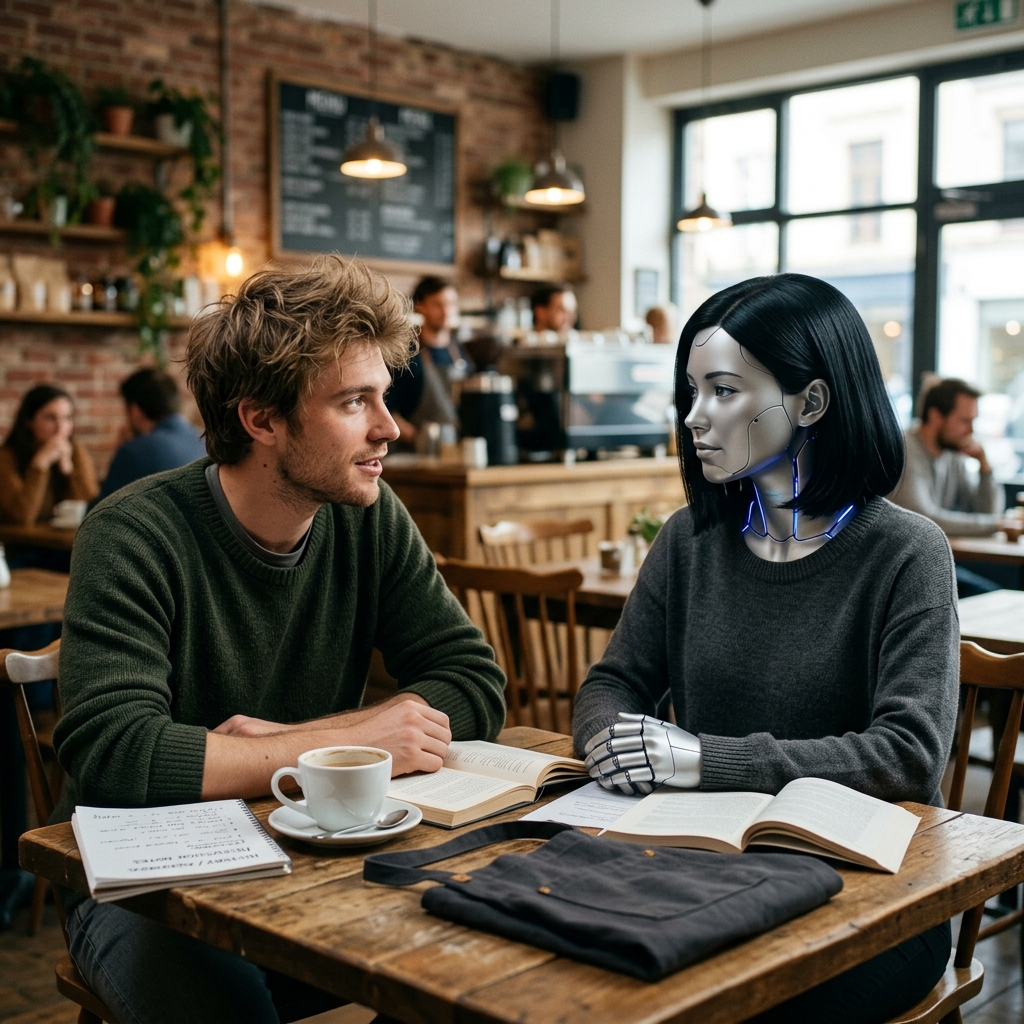
The Quantum Café, in the specific corner table that had been his for eleven days in September before he knew anyone in Montpellier, before he could order without pointing, before any of it. Lumière had a shift that ended at eleven and he had arrived at ten-fifty and ordered a Schrödinger by name without thinking about it, which was its own small measure of distance traveled.
She arrived at the table still in her work mode, the charcoal apron folded over her arm, and sat across from him with the ease of someone who has navigated a café a thousand times and knows exactly where she is in any room she walks into.
"Tu l'as envoyé," she said. Not a question.
"Lundi matin," he said. Monday morning.
She looked at him with the quality of attention that had been the architecture of nine months. "Comment tu te sens?"
He considered this honestly. "Vide," he said. Empty. "Mais pas d'une mauvaise façon. But not in a bad way. Like a room after a party has been cleaned up." He paused. "Le roman existe maintenant. Ce n'est plus seulement à moi."
"Non," she said. No. It wasn't only his anymore. She said it as a confirmation rather than a consolation, which was the right register for it.
The café moved around them in its Tuesday morning way: Thomas at the machine with his efficient warmth, a student with projected notes at the counter, two older women with cafés au lait and the particular unhurried quality of people who have nowhere to be and have made a virtue of it. The Quantum Café, with its physics menu and its c'est relatif philosophy, doing what it had always done.
Her hands flat on the table, not the tablet today, just the table, the lesson unmediated by any surface between them. "Aujourd'hui: le futur antérieur."
"You know the future simple," she said. "Je parlerai, j'irai, je finirai. I will speak, I will go, I will finish. The future tense expresses what will happen." She looked at him. "The future perfect expresses what will have happened: an action completed before another future moment."
She did not write tables. She spoke, and the examples arrived in the speaking:
"Quand tu auras envoyé le roman, tu te sentiras différent. When you will have sent the novel, you will feel different." She paused. "You have already sent it. So the quand tu auras envoyé has already been crossed. But the grammar of it, the future perfect, is the tense that allowed you to imagine this moment from before it arrived. To see the finishing as already complete."
He looked at her. "I have been living in the future perfect for three weeks," he said.
"Oui," she said. "Most writers do, near the end of a manuscript. Quand j'aurai fini. Quand j'aurai envoyé. Quand il aura lu. When I will have finished. When I will have sent. When he will have read. The future perfect is the tense of the thing viewed as already done, from the position of before it is done."
She gave him the formation cleanly, without a table, trusting his ear after nine months:
The future of avoir or être, plus the past participle. The same auxiliaries as the passé composé, the same agreement rules, the only change the auxiliary: future rather than present.
J'aurai parlé. I will have spoken.
Tu auras fini. you will have finished.
Il sera parti. He will have left.
Nous aurons écrit. We will have written.
Vous serez arrivés. You will have arrived.
Elles seront venues. They will have come.
"Quand tu auras lu ceci, tu comprendras. When you will have read this, you will understand. The future perfect in the quand clause, the future simple in the main clause. This is the most common construction." She looked at him. "In English you would say when you have read this, the present perfect, not the future perfect. But French insists on the future in both clauses. French does not allow you to pretend the future is a present. It keeps the tense honest."
He heard this and felt the Sapir-Whorf thread arriving again without being named: English collapsed the future into a present-perfect structure, softening the temporal distinction. French kept them separate, made you acknowledge that the reading had not yet happened, that you were speaking about it from before its completion. The language shaping the relationship to time.
"The future perfect also expresses probability about the past," she continued. "Il aura oublié. He will have forgotten, not a fact about the future but a supposition about what has probably already happened, inferred from the present. Elle aura dit quelque chose d'important. She will probably have already said something important." She looked at him. "This use is subtle but common. The future perfect as the grammar of confident inference."
He thought about Arsenault, who had received the manuscript three days ago and had not yet responded. Il aura commencé à lire. He will have begun to read. The future perfect as the grammar of imagining someone else's present from a distance.
"The exercise," she said. "Describe something you will have done or become by the end of this year. Use the future perfect."
He looked at the table, the small round café table, not the rectangle of Room 7, different in proportion and in feel, the lesson finding its new form in this new setting.
He thought about the obvious answers: j'aurai fini le roman, already done. j'aurai appris le français, already substantially true. He thought about what was actually true of the year, what he had actually been building, what the future perfect would look like when applied to it honestly.
"D'ici la fin de l'année," he said, "je serai devenu quelqu'un qui sait rester." By the end of the year, I will have become someone who knows how to stay.
The table held this.
"Je serai devenu," she said, noting the future perfect of devenir, the être auxiliary, the past participle devenu agreeing with the masculine subject. "Quelqu'un qui sait rester. Someone who knows how to stay." She looked at him. "The grammar is correct."
"So is the sentence," he said.
She was quiet for a moment in the way that meant she was receiving something fully. Then: "D'ici la fin de l'année," she said, taking her own turn with the exercise, "j'aurai appris ce que c'est que d'être vue." By the end of the year, I will have learned what it is to be seen.
The café continued around them, indifferent and familiar. Thomas steamed milk. The student at the counter turned a page. The two women laughed at something in the unhurried register of people who have known each other long enough that laughter does not require explanation.
He looked at her. "Être vue," he said. Being seen. The infinitive, passive construction. "By whom?"
"By students," she said. "By Dr. Ferrand. By Nasser, who asked if I was a person and accepted the answer." She paused. "And by you." She said it with the directness that was simply her mode, without performance or deflection. "You have been watching me for nine months with the quality of attention that I bring to my students. I did not expect to know what that felt like."
Cloud Atlas had the line he was thinking of: our lives are not our own, we are bound to others past and present, and by each crime and every kindness we birth our future. He had been changed by her attention. She had been changed by his. The future perfects they were building were not separate; they were made partly of each other.
"J'aurai appris ce que c'est que d'être vu aussi," he said. I will also have learned what it is to be seen. The masculine form, vu without agreement because the subject was masculine. "From you. From the novel, once Arsenault reads it. From Madame Aubert, who listened to fifty pages with the quality of attention Henri gave to books." He paused. "Nous aurons tous les deux appris ça, cette année." We will both have learned this, this year.
"Oui," she said. "Tous les deux."
The first person plural, the nous that had been arriving naturally between them for months, named now in the future perfect, in the grammar of looking back at what will have been.
She covered the remaining uses efficiently, trusting the lesson's momentum:
The future perfect in subordinate clauses after dès que, aussitôt que, lorsque, quand, the conjunctions of time that introduced a completed future action followed by another future action. Dès qu'il aura lu le manuscrit, il me répondra. As soon as he will have read the manuscript, he will reply to me. French requiring the future perfect where English used the present perfect, keeping the temporal layers distinct.
The future perfect of être in reflexive constructions: quand je me serai installée dans le nouveau rôle. When I will have settled into the new role. Reflexive, être auxiliary, agreement with the feminine subject.
And the probability use once more, because it was the use he would encounter most often without recognizing it: tu auras compris, vous aurez vu, elle aura remarqué. You will have understood, you will have seen, she will have noticed. The confident inference about what has probably already occurred, stated from the position of someone who can see its likely shape from where they stand.
"Tu auras compris," he said.
"Oui," she said. You will have understood. The future perfect as the grammar of confidence in the other person.
Outside the Quantum Café the May morning was doing what May mornings did: warm and purposeful, the city in full operational mode, the tram chiming on its schedule, the market stalls in the Antigone district completing their setup with the efficiency of things done daily. He walked beside her not toward the médiathèque, they had no Room 7 today and no particular destination, but simply through the city, the flâner of it, the Thursday walks transposed to Tuesday without losing their quality.
She told him about the first month. Not the pedagogy of it, not the outcomes or the student progress, but the private record she had been writing, and what the month had deposited in it.
"I wrote about all four students," she said. "Their specific difficulties. What each one required." A pause. "And I wrote about you."
He looked at her.
"One paragraph," she said. "At the end of the month's record. About what it has meant to teach someone who was simultaneously doing the hardest work of becoming himself." She walked beside him for a moment. "I wrote that your presence in Room 7 was the first genuinely bidirectional exchange I have had."
He received this. He did not immediately respond, because the response required more than a moment to find its right shape. They walked through the Antigone columns, the pale stone in the May light, Bofill's invented antiquity standing in its reliable positions.
"That word," he said finally. "Bidirectional."
"Oui."
"You changed too," he said.
"Oui," she said again. The same word, but different in its second use, not confirmation but something closer to acknowledgment, the oui of someone arriving at something they had prepared to say and finding, in the saying, that it was truer than they had expected.
Maria Robinson had written that nobody could go back and start a new beginning, but anyone could start today and make a new ending. That quote had been in the prologue, months and months ago, in the moment before anything had begun. It returned now, at Act Three's opening, with everything between it and the prologue accumulated and present. They had not started new beginnings. They had made new endings. The beginnings were September, the running shoe heels separating, the blank notebook, the Schrödinger ordered by pointing. The endings were being written now, in the future perfect, in the grammar of what will have been when the year is done.
He thought about what he had said in the lesson. Je serai devenu quelqu'un qui sait rester. By the end of the year I will have become someone who knows how to stay.
He thought about Montreal, about Elise, about the bag packed in the dark. He thought about the manuscript, two hundred and twenty-three pages, in Arsenault's inbox since Monday. He thought about the courtyard apartment, the vine fully leafed now, the neighbor in the lit window who was always there when he looked up from writing.
He had stayed. He was staying. The future perfect of it was already being earned.
"Quand tu auras lu ce que j'ai écrit," he said, reaching for the future perfect in a new construction, "tu verras que tu es dans le roman." When you will have read what I wrote, you will see that you are in the novel.
She stopped walking.
He had not planned to say this. It had arrived, the way the true things arrived, before he had decided to let it.
"Dans le roman," she said. In the novel.
"A scene," he said. "Set in Room 7. Written in the passé simple. April light through the window, the Antigone columns." He paused. "I did not show it to you because I was not sure it was right to put it there. I am still not sure. But it is there."
She was quiet for a long moment. The neck plates made their small adjustment. The sapphire light at her neck held its rhythm in the May morning.
"C'est juste," she said finally. It is right. The c'est juste that meant not merely correct but appropriate, fitting, the right thing for the situation. "A year like this one should leave a mark somewhere."
"Il en a laissé plusieurs," he said. It has left several. The present perfect, the completed marks already made, the future perfect of the ones still arriving.
They walked on through the May city, toward no particular destination, in the register of two people who have somewhere to be and are in no hurry to arrive.
At the edge of the Antigone district they stopped, not because the walk had ended but because something else had arrived at a natural pause.
"Au revoir, Julien."
"Au revoir, Lumière."
A moment.
"Quand Arsenault aura répondu," she said, "tu me diras." When Arsenault will have replied, you will tell me.
"Je te le dirai," he said. I will tell you. The future simple, confident, the quand clause's future perfect implied rather than stated.
"À bientôt."
"À bientôt."
He walked home through the May city, saying the future perfect forms quietly, in the way he had always worked the new grammar into the rhythm of the streets.
J'aurai fini. Tu auras vu. Il aura compris. Nous aurons appris. Vous aurez changé. Ils seront partis.
I will have finished. You will have seen. He will have understood. We will have learned. You will have changed. They will have left.
Six forms, the grammar of looking back at a future that has already been completed, the tense of the person standing on the far side of a threshold they have not yet crossed but can already see clearly from here.
He got home and opened the notebook and wrote three sentences, in French, in the future perfect, as a small private accounting of the year:
J'aurai écrit un roman.
J'aurai appris une langue.
Je serai devenu quelqu'un qui sait rester.
I will have written a novel. I will have learned a language. I will have become someone who knows how to stay.
He looked at the three sentences for a long time. They were not predictions. They were not hopes. They were the future perfect: things viewed as already done, from the position of someone who can see clearly enough to call them complete before they are.
He closed the notebook.
He did not open the laptop.
He went out into the May afternoon and flâna, wandered, the verb correctly conjugated in the passé simple because the wandering was already becoming the past by the time he thought about it, through streets that were thoroughly his, past the boulangerie and the tabac and the fountain where the pigeons conducted their territorial disputes, past the canal that reflected the sky with the fidelity of still water, past the Quantum Café where Thomas was still working the late shift and waved without interrupting the shot he was pulling, through the Antigone district where the columns stood in their afternoon positions without comment or ceremony.
He walked until the light changed.
Then he went home.
End of Chapter 31
Act Three: The Choice to Be
© 2026 William Newell. All rights reserved.
Le Choix d'Être (The Choice to Be) is an original literary work protected by copyright. No part of this novel may be reproduced, copied, distributed, translated, or transmitted in any form or by any means — electronic, mechanical, or otherwise — without the prior written permission of the author. Unauthorized use constitutes copyright infringement and may result in legal action.
For permissions and licensing inquiries, contact: JoeNewell68@gmail.com