The Friday Meeting
"Americans who travel abroad for the first time are often shocked to discover that, despite all the progress that has been made in the last 30 years, many foreign people still speak in foreign languages."
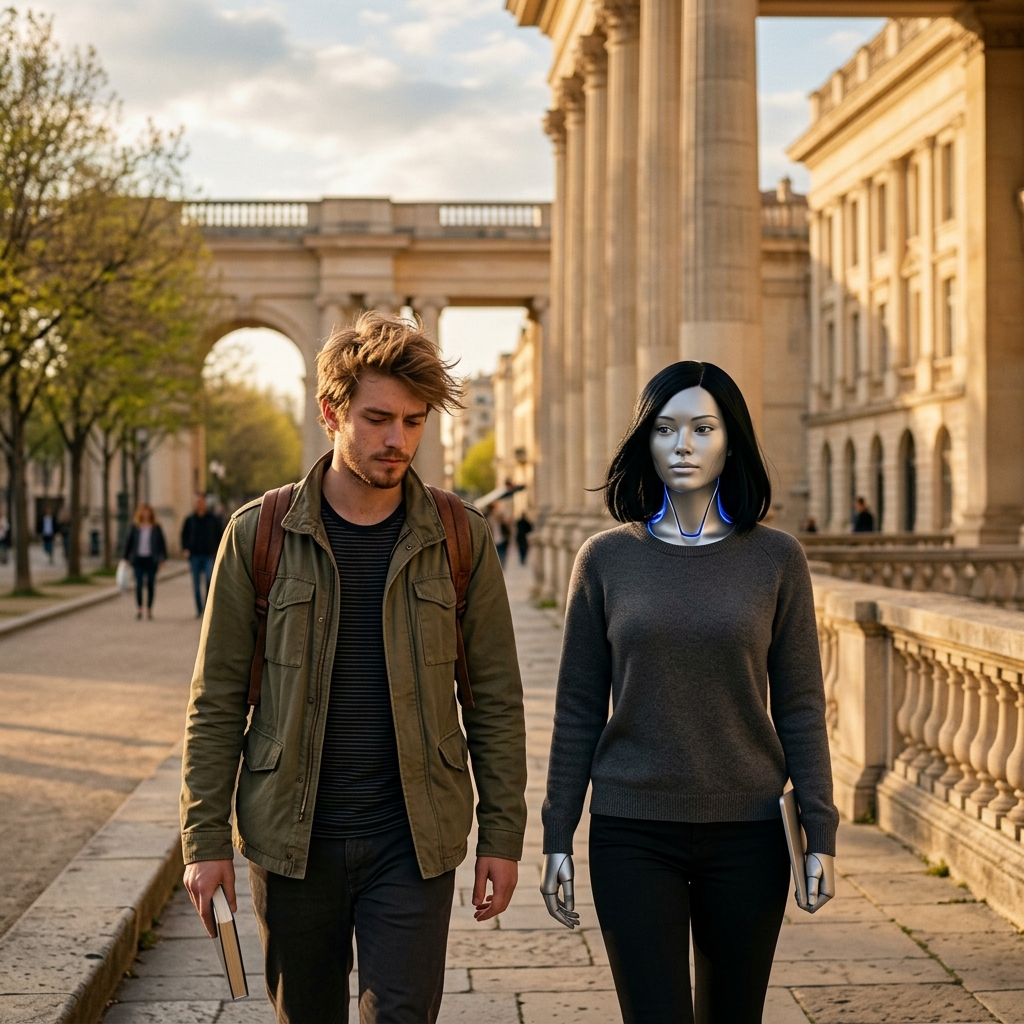
She told him about the Friday meeting before the lesson began.
He had not asked. He had said bonjour and she had said bonjour and they had completed the exchange, and then she had set her hands flat on the table in a different way than usual, not the gesture of beginning a lesson but the gesture of beginning something else, and she said:
"The department head asked me three questions. I answered them. The proposal was approved."
He looked at her.
"My primary appointment shifts to the intensive program at the start of the next academic term," she said. "The one-to-one track is now formally recognized within the department."
He received this the way she had delivered it: without ceremony, as a fact. "What were the three questions?"
"What distinguishes your method from the standard communicative approach. What outcomes you expect in the first term. What you would do if a student's needs exceeded your capacity."
"And your answers?"
"That my method is not a method but a practice of specific attention. That the outcomes would be measured in the student's relationship to their own difficulty rather than in test scores. And that I would refer the student appropriately and be honest about the limits of what I could offer." She paused. "The department head said the answers were unusually direct."
"You are unusually direct," Julien said.
"I know," she said. Then: "There was one more thing. At the end of the meeting, he read a passage from one of the students' letters. From Nasser."
He waited.
"Nasser wrote," she said, "that she was the first teacher who had made him understand that his specific difficulty was not a failure of ability but a key that opened a particular door, and that she was the person who knew where the door was."
The room held this quietly.
Kevin Kelly had written that when you died you took absolutely nothing with you except your reputation. Lumière had been building her reputation not through credentials or positions but through eight sessions of seeing two students precisely. The proposal had been approved because the results were remarkable. But the results had been remarkable because of something that could not be measured in the results, the quality of attention that found the key for each specific door.
"C'est exactement ce que tu fais," he said. That is exactly what you do.
"Oui," she said. "C'est ce que je suis." Yes. It is what I am.
The present indicative, settled and unqualified. She had been saying it for several weeks now, the je suis without the en cours, without the conditional, without the past subjunctive of doubt. Each time it landed differently, the same sentence accumulating weight with each repetition, the way a word becomes more itself the more you use it correctly.
Her hands flat on the table. "Aujourd'hui: les faux amis."
"A false cognate," she said, "is a word that looks or sounds like a word in another language but means something different. In French they are called les faux amis, the false friends. They look familiar. They seem safe. They are neither."
He had been waiting for this lesson since the early weeks, when he had made his first false cognate errors without knowing what they were, reaching for a French word because it resembled an English one and discovering, too late, that the resemblance was deceptive.
"The danger of the false cognate," she said, "is specifically the danger of assumption. You see something that looks like what you know, and you stop paying attention. You have already decided you understand." She looked at him steadily. "The false friend punishes exactly the kind of confident half-knowledge that keeps a learner from becoming a speaker."
She wrote the first set on the tablet:
Les Faux Amis: Common False Cognates
| French word | What it actually means | False English assumption | Correct English word |
|---|---|---|---|
| actuellement | currently, at present | actually | en fait, en réalité |
| éventuellement | possibly, perhaps | eventually | finalement, à la fin |
| sensible | sensitive | sensible | raisonnable, sensé |
| rester | to stay, to remain | to rest | se reposer |
| assister à | to attend | to assist | aider |
| sympathique | nice, pleasant | sympathetic | compatissant |
| formidable | tremendous, wonderful | formidable (intimidating) | intimidant, redoutable |
| prétendre | to claim, to allege | to pretend | faire semblant |
| décevoir | to disappoint | to deceive | tromper |
| librairie | bookshop | library | bibliothèque |
He looked at the table. Librairie, he had walked past a dozen of them in Montpellier thinking they were libraries. He had been confused, repeatedly, by the absence of lending systems in what he had assumed were public libraries, before understanding they were bookshops. The word had been telling him what it was. He had not listened.
"Décevoir," he said. "To disappoint. Not to deceive."
"The two are often related," she said, "but they are not the same. To disappoint is to fail to meet an expectation. To deceive is to create a false one. A subtle but important difference."
He thought about this. He had disappointed Elise. He had not, or not primarily, deceived her. The distinction mattered. The faux ami had been keeping him from seeing it precisely.
"Sympathique," he said. Nice, pleasant, likeable. "Not sympathetic."
"The French sympathique is a compliment for a person who is easy to be around, warm, agreeable," she said. "English sympathetic implies feeling another's pain or difficulty. The French would say compatissant for that, sharing in the feeling. sympathique is more about the surface. compatissant goes deeper."
He wrote both in the notebook. Sympathique for the pleasant surface. Compatissant for the genuine depth. The false friend had been collapsing a distinction the language needed to keep separate.
"Prétendre," she said. "To claim, to allege. Not to pretend."
"I have been pretending to understand things," he said, "and also claiming to understand things. French tells me those are different verbs."
"Faire semblant for the pretending," she said. "Prétendre for the claiming." She paused. "The French take claiming seriously. Prétendre has the flavor of an assertion made without sufficient grounds. If you prétendez something, you are asserting it, and the word carries a slight note of skepticism about whether the assertion is warranted."
He wrote this carefully. The word for claiming was already skeptical of the claim.
She covered the remaining false cognates efficiently, pausing on éventuellement because it was the one he had used most incorrectly, having said éventuellement to mean eventually in several contexts where it had implied possibly, making his statements about his future plans sound considerably more tentative than he intended.
"Éventuellement je retournerai à Montréal," he said.
"Which means: possibly I will return to Montreal," she said. "Perhaps you mean finalement je retournerai à Montréal. Eventually I will return to Montreal. The difference is between possibility and certainty of timing."
"The first is truer," he said, after a moment.
She looked at him. "Then use it."
"Now," she said, "the more interesting territory. Not the false friends, the true gaps. The concepts that exist in one language and not the other. The places where French has something precise and English must approximate, or vice versa."
This was the Sapir-Whorf thread again, arriving in its most direct form: not just that different languages structured thought differently, but that some thoughts existed in one language as a single word and required a construction of several words in another. The language you had determined which thoughts you could hold in one hand.
"English has no single word for dépaysement," she said.
He looked at the word on the tablet.
"Dépaysement," she said, "is the specific disorientation of being in a foreign place. The feeling of being away from your native landscape, not homesickness exactly, which is nostalgie, but the particular quality of finding yourself in a world whose codes you do not fully possess. The slight estrangement of the foreign, even when you are comfortable in it."
He was quiet for a moment.
"I have been living in that," he said.
"Yes," she said. "For eight months."
He looked at the word on the tablet. Dépaysement. He had been carrying the experience without the name, the way you carry something in your hands that you have not yet found a container for. The word did not explain the experience. It confirmed it. It gave it a shape that could be set down.
"Mais je ne me sens plus dépaysé," he said. But I no longer feel foreign. The present tense, the negation, the word now named and already past its peak accuracy.
She looked at him with the brightness in her eyes. "That is how you know you have arrived somewhere," she said. "When the word for what you were feeling becomes past tense."
She moved to l'esprit de l'escalier.
"L'esprit de l'escalier," she said. "The spirit of the staircase. The perfect thing to say that arrives only after you have left the room, when you are already on the stairs, going down, the conversation over." She wrote it on the tablet. "The French named this experience. English borrowed the phrase rather than inventing a word, which is itself an acknowledgment that English could not do it in one."
He looked at the phrase. The perfect comeback, the right words, arriving too late. He thought about the things he should have said to Elise in the years before he left, the conversations he had redirected, the moments of her reaching that he had received without returning. He had not had the language then. Not French, the other language, the one for the inside of a life. He had learned both simultaneously, here, at the courtyard window.
"J'avais beaucoup d'esprit de l'escalier," he said. I had a lot of staircase spirit. "With Elise. The right things arrived after I was already gone."
She received this without moving toward it or away from it.
"The esprit de l'escalier," she said, "is always past tense. You cannot have it in the present, the moment it becomes available the conversation has already ended. It is the grammar of the too-late." A pause. "The question is what you do with it when it arrives."
"You write it down," he said.
"Oui," she said. "Tu l'écris."
She covered the remaining gaps with the precision she brought to the things that deserved it.
Se souvenir, to remember as an active return to the self, which English rendered only as the passive to remember, losing the reflexivity, the sense of going back to oneself to retrieve something.
Chagrin, which in French meant annoyance or vexation, not the English chagrin with its overtones of embarrassment and wounded dignity. The false friend going in the other direction: an English word that French had borrowed and changed.
And finally: flâner, to wander without destination, to stroll with no agenda but the quality of the walking itself. The verb that described the Thursday walks, which had no English equivalent that captured the specific dignity of purposeless movement. To wander was too aimless. To stroll too casual. Flâner was a philosophical position, the decision that the walking itself was worth doing.
"Nous flânons," he said. We wander. The present tense, the first person plural, the Thursday walks given their correct French verb.
"Nous flânons," she confirmed. "Depuis des mois." For months.
He told her about Madame Aubert on the walk afterward, the April city in the specific quality of late afternoon it had been developing all month: warm, considered, the light long and direct.
He had read her the first fifty pages over Tuesday and Wednesday. She had listened with the focused attention that was her gift. When he finished she had been quiet for a moment, and then she had said two things.
He told Lumière both of them.
The first: c'est vrai.
The second: Henri aurait voulu te lire.
He said the second sentence in French, slowly, because it deserved the French. Henri aurait voulu te lire. Henri would have wanted to read you. The conditional of vouloir, the past loss implicit in the aurait, what would have been for someone who is not here for the wanting.
Lumière walked beside him without speaking for a moment.
"She gave you the past conditional of Henri," she said finally. "The grammar of what cannot be, held in the mood of what would have been." A pause. "That is a significant thing to give someone."
"I know," he said.
Kevin Kelly had written to always say less than necessary. Madame Aubert had said two sentences. They had contained more than two sentences could typically hold, because she had chosen them with the precision of someone who understood that language at its most powerful was not the full explanation but the exact phrase. C'est vrai. Henri aurait voulu te lire. True. And what would have been true, had Henri been here to be true toward.
"Elle lui aurait plu," Lumière said. She would have pleased him. The conditional applied now to Madame Aubert rather than Henri, the grammar of what would have been running in both directions. "A person who listens that carefully to a manuscript after eight months of tea would have pleased him."
They walked through the April Antigone district, the columns in the long light, the shadows at their most useful angle.
"Geoffrey Willans wrote," Julien said, "that you can never understand one language until you understand at least two." He paused. "I understand English differently now. I can see its false friends, its gaps, the things it can say and the things it needs a whole phrase for. French showed me where English was."
"And what did you find?" she said.
He thought about it. "That English is good at the surface and the particular. Short sentences, concrete nouns, the quick declarative. And that it is less comfortable with the suspended clause, the held complexity." He paused. "I write in English, but I think now in something that is not quite either. The two languages sitting beside each other, each one showing me the other's gaps."
She looked at him. "That is what dépaysement eventually becomes," she said. "When the foreignness stops feeling like disorientation and starts feeling like a second pair of eyes."
He received this and held it.
"The depth is not in either language," she said. "It is in the gap between them. Each language shows you what the other cannot see. And what you find in the gap, the things that exist in one and not the other, those are not absences. They are where the dimension lives."
He thought about the manuscript. Written in English, but thinking now in something between. The Montreal chapters in the passé simple, the Montpellier chapters in the present tense, the two timelines held in different grammatical registers. The depth of the novel was not in either register separately. It was in the movement between them, in the gap where one tense ended and the other began, where the sealed past and the living present occupied the same pages.
"A person who speaks one language," she said, "lives in two dimensions. A person who speaks two lives in three."
He looked at her. He thought about what she had just said applied to herself, an android built in one language who had chosen to inhabit another, and who had discovered in that second inhabiting the quality of attention that Nasser's letter described. She could see from two directions simultaneously. That was not a technical achievement. It was the source of the depth.
"C'est pour ça que tu sais où est la porte," he said quietly. That is why you know where the door is. The c'est pour ça que construction, the consequence following the cause, the conjunction of the lesson doing its work: because you see from two directions, you can find what a single vantage point misses.
She was quiet for a moment, the sapphire light at her neck holding its rhythm.
"Peut-être," she said. Perhaps. She said it not as uncertainty but as the honest acknowledgment that the full explanation was still arriving. The gap between knowing something and being able to account for it completely. The esprit de l'escalier of self-understanding, always a little behind the thing itself.
At the end of the promenade they stopped.
"Au revoir," Lumière.
"Au revoir," Julien. A pause. "Le roman se termine bientôt." The novel is finishing soon.
"Oui," he said. "Bientôt."
"Et alors tu flâneras," she said. And then you will wander. The future of flâner, given to him as both prediction and permission.
He looked at her. "Et alors je flânerai," he agreed. And then I will wander. The future tense, the infinitive conjugated, the permission accepted.
"À bientôt."
"À bientôt."
He walked home through the April city saying the new words quietly.
Dépaysement. L'esprit de l'escalier. Flâner. Faux amis.
The disorientation of the foreign, now past. The perfect words arriving too late, now written down. The wandering without destination, now correctly named. The false friends, now recognized.
He got home and opened the laptop. One hundred and sixty-three pages. He read the last paragraph, found it good, and wrote three more. Then he opened the notebook and wrote, in French, two sentences:
Je ne me sens plus dépaysé. Je suis simplement ici.
I no longer feel foreign. I am simply here.
He looked at them for a long time. Then he thought of a third sentence, not in French, not in English, but in the language between them that had no name and no grammar book, the one he had been assembling word by word since September:
C'est suffisant.
It is enough.
End of Chapter 29
© 2026 William Newell. All rights reserved.
Le Choix d'Être (The Choice to Be) is an original literary work protected by copyright. No part of this novel may be reproduced, copied, distributed, translated, or transmitted in any form or by any means — electronic, mechanical, or otherwise — without the prior written permission of the author. Unauthorized use constitutes copyright infringement and may result in legal action.
For permissions and licensing inquiries, contact: JoeNewell68@gmail.com