The Infinitive and the Act
"Whatever you do, or dream you can, begin it. Boldness has genius and power and magic in it."
He could see the end of the manuscript from one hundred and forty pages.
Not the precise ending, he did not know yet exactly how the final pages would arrive, and he had learned enough about writing to know that planning the ending before you reached it was a reliable way to write the wrong one. But the shape of it was visible: not in detail, but in proportion, in the sense of remaining distance.
He wrote in the notebook on a Monday morning: Je vois la fin. Je n'y suis pas encore, mais je la vois.
He looked at the sentence. The infinitive voir, meaning to see, and the present indicative of actually seeing, the distance between the concept and the fact. The end of the novel existed as an infinitive, finir, terminer, achever, and would eventually become a conjugated verb: j'ai fini, j'ai terminé. The passé composé of the completed thing. It was not there yet. But the infinitive was pointing at it.
He wrote below the first sentence: En voyant la fin, je comprends mieux le début. The gerund, the grammar of Chapter 22, arriving naturally, not parce que je vois but en voyant, the simultaneous action, the understanding arriving in the act of seeing rather than after it.
He opened the laptop and wrote six more pages.
The thing he had not told anyone was this: one of the new pages, written three weeks ago and revised twice since, was set in Room 7.
Not the Montreal material, not the backstory. The present. Montpellier, the Médiathèque Émile Zola, a table between two people, one of them learning French and the other teaching it. He had written it in the passé simple, which made it literary, made it sealed, not a diary entry but a narrated scene, the narrator standing at the distance that the tense required, holding the material in the deliberate composure that Flaubert had shown him.
He did not know if it would stay in the novel. He did not know if showing the present, these specific months, this specific room, was the right structural decision. He was not ready to know yet. He had written it because the scene had demanded to be written, and he had learned to respond to that kind of demand without overanalyzing its credentials.
He had not shown Lumière. He did not know if he ever would.
But the scene existed on the page, in the passé simple, in the literary past. Elle enseigna. Il apprit. La lumière du mois d'avril entrait par la fenêtre. The April light entered through the window. Three passé simple verbs, the scene sealed in the tense of the witnessed and completed.
Thursday. Room 7. The April light in question, entering through the window in the way he had described, warm and direct, landing on the table between them at an angle that moved across the morning.
"Bonjour," he said.
"Bonjour. Comment tu vas?"
"Bien. Je vois la fin du roman."
She looked at him with the brightness that indicated something she found genuinely significant. "Depuis quand?"
"Depuis cette semaine." He sat down. "Ce n'est pas encore là, mais je peux le voir."
"C'est important," she said. It is important. Not a compliment, but an assessment. Her hands flat on the table. "Aujourd'hui: l'infinitif."
"The infinitive," she said, "is the base form of the verb. You have known this since Chapter 5, parler, finir, prendre. But we have not discussed what the infinitive actually is, grammatically and philosophically, before we use it." She looked at him. "The infinitive is the verb without a subject and without a tense. It does not commit to a person or a moment. It holds the action in its pure form: not I speak or she spoke or they will speak, but simply to speak: the concept of speaking, prior to any specific instance of it."
She wrote on the tablet. parler, finir, prendre. Être.
"Être," he said.
"Yes," she said. "Le choix d'être. The choice to be. Not I am or he was or they will be, but simply to be. The infinitive holds open all the possibilities simultaneously. Once you conjugate it, you commit it to a specific person in a specific moment. The infinitive is what exists before that commitment."
He sat with this. The title of the novel, not his novel but the novel he was living inside, held in the infinitive, the choice not yet made particular, the being not yet assigned to a subject: le choix d'être, the grammar of the threshold.
"The infinitive in French," she continued, "has a richer grammatical life than in English. In English, you mark the infinitive with to: to speak, to be. In French, the infinitive form itself carries that meaning. And French uses it in many contexts where English would use a different form entirely."
She wrote the structures on the tablet:
The French Infinitive: Uses:
1. As subject of a sentence, where English uses a gerund (-ing form):
• Parler français est difficile. (Speaking French is difficult.)
• Apprendre prend du temps. (Learning takes time.)
• Être présent est un choix. (Being present is a choice.)
"French has no gerund," she said. "Where English says speaking, French says parler. The infinitive does the noun's work."
He looked at the three examples. Être présent est un choix. To be present is a choice. He had been learning this for seven months without having the grammar for it. The infinitive as the subject, the action itself rather than any particular instance of it.
2. After most prepositions:
• avant de partir : before leaving
• après avoir écrit : after having written (past infinitive)
• sans parler : without speaking
• pour apprendre : in order to learn
• au lieu de fuir : instead of fleeing
• loin d'être fini : far from being finished
"Almost every French preposition that precedes a verb takes the infinitive," she said. "The exception is en, which takes the present participle, the gerund construction you learned in Chapter 22. En écrivant: while writing, by writing. Every other preposition: infinitive."
He noticed au lieu de fuir, instead of fleeing, and the small private recognition of it. He wrote it in the notebook without comment.
"The past infinitive," she said, "is used after après to express an action completed before the main verb. Formed with the infinitive of avoir or être plus the past participle."
• après avoir écrit: after having written, after writing
• après être parti: after having left, after leaving
• après s'être levé: after having gotten up, after getting up
"The same auxiliary rules as the passé composé," she said. "And the same agreement rules for être verbs."
He worked through several examples, the pattern connecting cleanly to everything he already knew. The past infinitive was not a new system but the same system as the passé composé, placed inside an infinitive construction, as the language always did.
3. After verbs, with or without a preposition:
Direct infinitive, no preposition:
• pouvoir faire, vouloir dire, devoir partir, savoir écrire, aimer lire, aller voir, venir chercher, faire comprendre, laisser parler, entendre chanter
With à:
• commencer à écrire, continuer à apprendre, réussir à comprendre, hésiter à parler, s'habituer à être, apprendre à voir
With de:
• décider de partir, choisir de rester, essayer de comprendre, finir de réviser, refuser de fuir, avoir peur de dire, être content de savoir
"The preposition is not arbitrary," she said. "À suggests effort or direction toward something: commencer à, réussir à, apprendre à. De suggests separation, completion, or a relationship of about something: décider de, finir de, avoir peur de. Direct connection means capacity or immediacy: pouvoir, vouloir, savoir, devoir. Feeling the difference between them takes time, but it is there."
He looked at apprendre à voir. To learn to see. apprendre à être. To learn to be. The two infinitives joined by à, the second reached toward through the effort of the first.
Kevin Kelly had written that you are what you do, not what you say, not what you believe, not how you vote, but what you spend your time on. The infinitive made this precise in French: être was not a state you inhabited but an action you performed through the accumulation of other actions, parler, écrire, apprendre, rester, choisir, what these added up to, over time, conjugated into the particular by the specific days and decisions.
"Je choisis de rester," he said. I choose to stay. Choisir de plus the infinitive, the choice and its object held together, the decision and its direction in the same grammatical unit.
"Tu as choisi," she said. You have chosen. The passé composé, the completed act, the infinitive now conjugated, the possibility made particular. "And you are still choosing. Tu continues de choisir."
"Je continue à choisir," he said, reaching for the à rather than de, continuation as effort and direction rather than completion.
She looked at him. "Continuer takes à in modern standard French," she said. "You used it correctly."
"The infinitive in literary and formal French," she said, moving to the lesson's final section, "appears in constructions that give prose a particular quality of elevation and precision."
She wrote several on the tablet:
• On ne saurait trop insister sur ce point. (One cannot insist too much on this point. The conditional of savoir plus the infinitive, a formal negation of an ability, pushing the idea toward impossibility.)
• Ne pas fuir. Ne jamais mentir. Ne plus avoir peur. (Not to flee. Never to lie. No longer to be afraid. The negative infinitive, ne plus the negation plus the infinitive, used in instructions, resolutions, titles. The grammar of a declared intention, prior to a subject or a tense.)
• Pour ne pas perdre ce qu'on a gagné. (So as not to lose what one has gained. The negative infinitive inside a purpose clause.)
He read ne plus avoir peur. No longer to be afraid. The infinitive of a state that had been true and was being refused: not je n'ai plus peur, the conjugated assertion, but ne plus avoir peur, the infinitive of the resolution, the intention before it becomes fact. He wrote it in the notebook.
She covered faire plus the infinitive as a causative construction: faire comprendre (to make someone understand), faire partir (to make someone leave), se faire entendre (to make oneself heard). And laisser plus the infinitive, laisser parler (to let someone speak), laisser être (to let be). The infinitive after faire and laisser did not agree with any noun; it remained fixed, the action held in its unconjugated form even within a conjugated sentence.
"Laisser être," he said.
"Yes," she said. "One of the most difficult things in any language. To let a thing be what it is without requiring it to be otherwise." She looked at him. "You have been learning this. With the early pages of the manuscript. With Elise. With Montpellier."
"With myself," he said.
"Avec toi-même," she agreed.
Amelia Earhart had written that the most difficult thing was the decision to act, and that after the decision the rest was merely tenacity, and that the fears were paper tigers. The infinitive was the form before the decision: partir, choisir, rester, être. The decision made it particular. The tenacity kept it conjugated.
Near the end of the lesson she said: "I have the meeting with the department head on Friday."
He looked at her.
"Dr. Ferrand has submitted the proposal formally," she said. "The meeting is to discuss the expansion of the one-to-one program. My primary appointment shifting to it within the year." She said it with the evenness she always brought to significant things, not performing calm but actually calm, which was different. "I have been preparing."
"How?"
"By continuing to do the work," she said. "En continuant à faire le travail. The gerund. The preparation is the doing, not the planning for the doing."
Da Vinci had written that knowing was not enough, that we must apply, that being willing was not enough, that we must do. Lumière had been doing. Eight intensive sessions, two students advanced further in eight weeks than in six months of group instruction. The infinitive of her vocation, enseigner to teach, écouter to listen, voir to see clearly, had been conjugated, session by session, into the particular.
"Tu sais ce que tu fais," he said.
"Je sais ce que je suis," she said quietly. I know what I am. The present tense of être, the conjugated form, the infinitive made particular. Not je suis en cours, I am in progress, not the earlier uncertainty, but je suis, present, settled, arrived.
He looked at her. She had not said je sais ce que je suis before. In all the weeks of lessons and walks and exchanges in this room, she had always held the être question in the subjunctive, in the conditional, in the en cours. She was saying it now in the present indicative. Je suis. The most basic conjugation in the French language, and the one that had cost her the most to complete.
He did not point this out. He simply received it, which was the correct response.
Being wise, Kevin Kelly had written, means having more questions than answers. Lumière had been asking the question of être since Chapter 3. She was not claiming to have answered it fully. She was too precise for false resolution. But she had arrived at something that the present indicative could hold. That was its own form of wisdom.
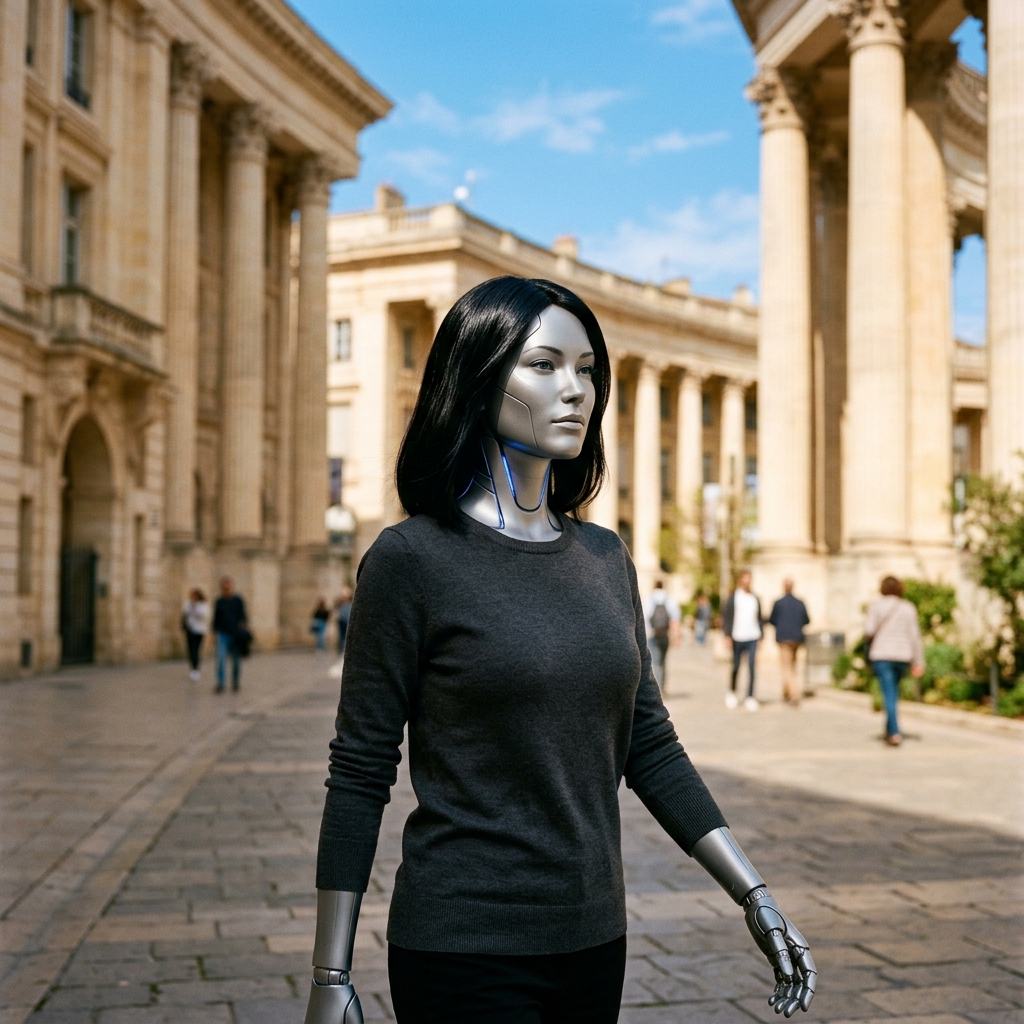
They walked. The April Antigone district in the full warmth of the season, the columns at their most confident, the shadows short and direct. They walked without a destination, which was how the Thursday walks had always been, not going somewhere but being somewhere.
She told him about her preparation for the Friday meeting. Not the content of the presentation, she had not prepared a presentation in the traditional sense. She had prepared by reviewing the session notes, by reading what the students had written about their progress, by sitting with the question of what she would say if asked why this work mattered.
"What did you decide?" he said.
"I decided I would tell the truth," she said. "Dire la vérité. The infinitive. Before it becomes je dirai la vérité, the conjugated intention. While it is still the pure form of what I intend.
He walked beside her for a moment. Dire la vérité. To tell the truth. The infinitive holding the intention in its essential form, before the meeting, the room, the specific words in the specific order.
"Goethe wrote," he said, "that whatever you do, or dream you can, begin it, that boldness has genius and power and magic in it." He paused. "You have been beginning for four years. Friday is not a beginning. Friday is a conjugation."
She looked at him with the brightness in her eyes. "Une conjugaison," she said. "Yes. The infinitive, diriger ce programme, enseigner ces étudiants, made particular: given a subject, a tense, a room and a time and a department head who will listen.
"Vous le ferez bien," he said. You will do it well. The future tense, the declared intention.
"Nous verrons," she said. We will see. But she said it without doubt, not the subjunctive of genuine uncertainty but the indicative future of a person who knows the outcome is likely and is simply declining to claim it before it arrives.
At the end of the promenade they stopped.
"Au revoir, Lumière."
"Au revoir, Julien. Le roman sera fini bientôt."
"Bientôt," he agreed. "Pas encore, mais bientôt."
"Et alors?" she said.
He considered the question honestly. "Et alors, je commencerai quelque chose d'autre." And then I will begin something else. The infinitive commencer conjugated into the future, the quelque chose d'autre, something else, still an infinitive in spirit, unknown, uncommitted, waiting for its subject.
She looked at him. "Bien sûr," she said. As though she had always known this. As though the beginning of something new was simply the next conjugation in a sequence that had no final form.
"À bientôt."
"À bientôt."
He walked home through the April city saying the infinitives quietly, which was different from how he had walked home from every previous lesson. Not the conjugations, but the infinitives. The verbs in their pure form, unattached, available.
Parler. Écouter. Écrire. Apprendre. Rester. Choisir. Voir. Finir. Commencer. Être.
To speak. To listen. To write. To learn. To stay. To choose. To see. To finish. To begin. To be.
Ten infinitives. The vocabulary of seven months, held in the form before the commitment, before the subject, before the tense. The verbs of the life he had been building, prior to any particular instance of them, prior to the lessons, the pages, the walks, the notebook entries, the messages sent to people he loved. Prior to all the specific mornings at the courtyard window when the infinitive became the act.
He got home and opened the laptop. The manuscript was at one hundred and forty-six pages. He read the last paragraph, the one he had written that morning before the lesson, and found that it was good. He wrote three more paragraphs. Then he sat back and looked at the screen and felt, in the seeing of what was there, the distance between finir the infinitive and j'ai fini the completed act becoming, for the first time, genuinely small.
Bientôt, he thought. Soon.
The infinitive was still the right tense. But not for much longer.
End of Chapter 28
© 2026 William Newell. All rights reserved.
Le Choix d'Être (The Choice to Be) is an original literary work protected by copyright. No part of this novel may be reproduced, copied, distributed, translated, or transmitted in any form or by any means — electronic, mechanical, or otherwise — without the prior written permission of the author. Unauthorized use constitutes copyright infringement and may result in legal action.
For permissions and licensing inquiries, contact: JoeNewell68@gmail.com