A Life You Don't Need to Escape From
"Instead of wondering when your next vacation is, maybe you should set up a life you don't need to escape from."
He wrote the hundredth page on a Tuesday morning.
He did not know it was the hundredth until he saved the file and the page count updated in the corner of the screen. He read it back, found it was good, opened a new page, and wrote the hundred-and-first. He made coffee. He sat at the courtyard window for a while, watching the March light on the opposite wall, the vine putting out its new growth in the patient way it did.
In the notebook that evening he wrote: Cent pages. Ça continue.
He looked at the sentence for a moment. The abandoned project in Montreal had stopped at forty-one. He had been living inside the idea of himself as someone who stopped at forty-one for two years, carrying it the way you carry a fact that has become a verdict. The hundredth page did not erase that. But it placed it correctly, in the plus-que-parfait, the sealed past, observed from sufficient distance.
He sent the pages to Arsenault the next morning. All hundred of them, with a single line: Il y en a cent maintenant. Je continue.
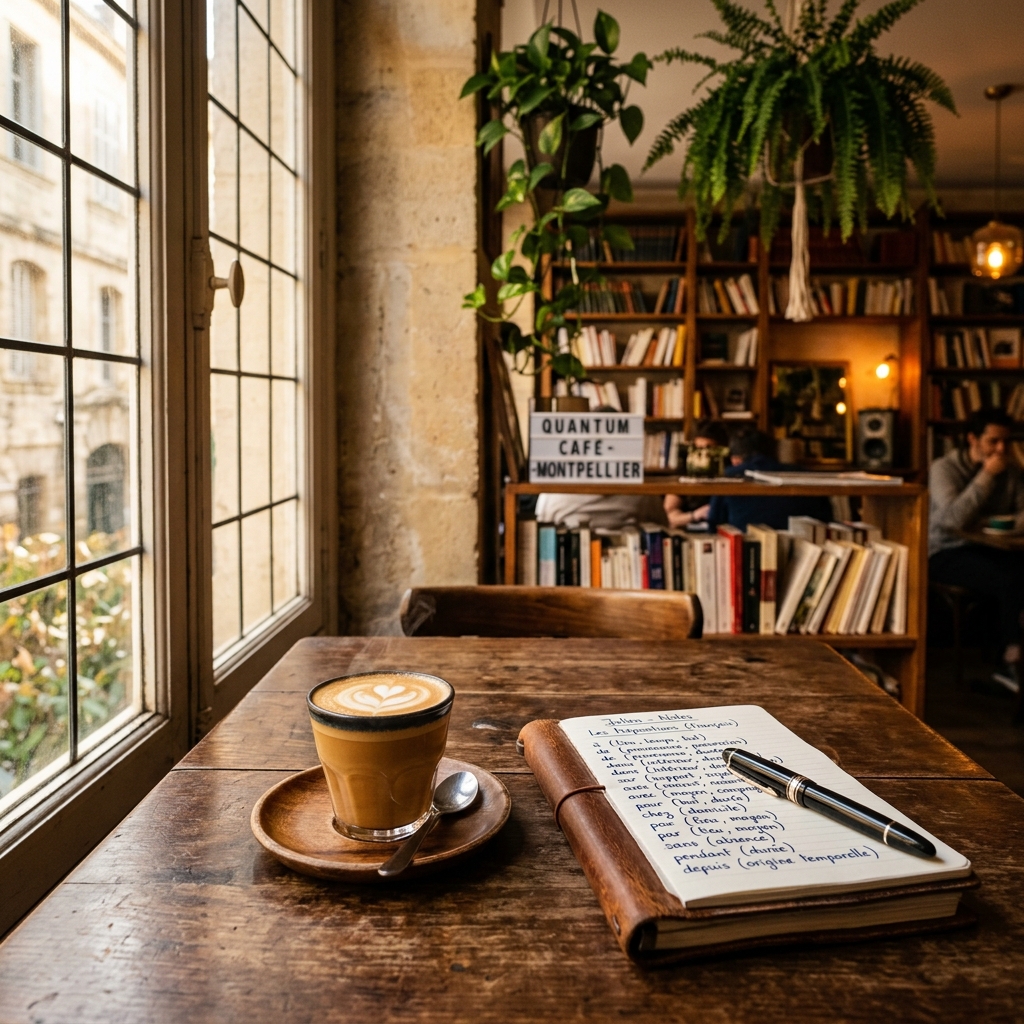
Wednesday. He stopped into the Quantum Café in the afternoon, not for the Schrödinger specifically but because the corner table was the right place to think, which was something he had not known about himself when he arrived in September and now knew completely. The café had become his in the way that places become yours through repeated presence: not owned, but inhabited.
The young barista whose name he had learned was Thomas was working. They exchanged the four sentences that had become their reliable transaction: the weather, the coffee, something brief and unremarkable. Julien said à bientôt when he left and meant it the way the French meant it, the return implied in the leaving.
Walking back through the old quarter he thought about the word chez. He had been thinking about it since Lumière had mentioned it in the lesson plan she had described to him briefly the previous week. Chez moi. At my place. In my world. In the space that is mine. He thought about the September version of himself, arriving in this city with a bag packed in the dark, saying je ne suis pas chez moi to a blank notebook page. He thought about the notebook now, full of French and half-French and true things written before the editor arrived each morning.
He was not the same person. The preposition for it had not yet been given to him formally. It would be, on Thursday.
Thursday. Room 7. Late March light through the window, the Antigone columns in the warm morning, their shadows at an angle that had not existed in winter.
"Bonjour," he said.
"Bonjour. Comment tu vas?"
"Bien. Cent pages."
She looked at him. The brightness in her eyes arrived with the quality that meant she was genuinely pleased by something.
"Cent pages," she said. "Good." The word with its full weight. "Today: prepositions."
"Prepositions," she said, "are the grammar of position. They locate everything: objects in space, events in time, relationships between people, the direction of actions. A sentence without a preposition can state a fact. A sentence with a preposition can say where that fact lives."
She wrote a list on the tablet, organized by function:
Position and Direction:
| Preposition | Meaning | Example |
|---|---|---|
| à | to, at, in | Je suis à Montpellier |
| de | of, from, about | Je viens de Montréal |
| en | in, to | Je vis en France |
| dans | in, inside | Le livre est dans le sac |
| sur | on, over, about | Le cahier est sur la table |
| sous | under, beneath | Le chat est sous la chaise |
| entre | between | Entre toi et moi |
| parmi | among | Parmi les étudiants |
| devant | in front of | Devant la bibliothèque |
| derrière | behind | Derrière la porte |
| vers | toward, around | Je marche vers la ville |
| chez | at someone's place, among | Je suis chez moi |
"Chez," she said, stopping at the last entry, "has no direct equivalent in English. It describes a person's characteristic territory, physical and psychological simultaneously. Chez moi means at my home, but it also means in my world, in my way of being, in the space that belongs to me." She looked at him. "It is one of the most distinctly French concepts in the language."
He looked at the word on the tablet. "Je ne suis pas chez moi," he said. The phrase from September, from the notebook, from the earliest honest French he had written.
"No," she said. "You were not. Then."
The present tense of then was implied and neither of them stated it, which was the correct way to handle something that had already been said precisely in a previous lesson.
She continued through the prepositions of time:
Time Prepositions:
| Preposition | Meaning | Example |
|---|---|---|
| avant | before | Avant le cours |
| après | after | Après le cours |
| depuis | since, for (ongoing) | Depuis six mois |
| pendant | during, for (completed) | Pendant deux ans |
| pour | for (intended duration) | Pour trois mois |
| dans | in (future, from now) | Dans une semaine |
| en | in (duration, within a period) | En three mois |
"The three duration prepositions are important to distinguish," she said. "Depuis expresses a duration that began in the past and continues now. Pendant expresses a duration that is complete. Pour expresses an intended future duration." She wrote three sentences:
• J'apprends le français depuis six mois. (Ongoing.)
• J'ai vécu à Montréal pendant deux ans. (Complete.)
• Je reste à Montpellier pour encore trois mois. (Intended.)
He looked at the three sentences. Three prepositions, three temporal relationships, three different positions relative to the same concept of duration.
"Depuis is the preposition I use most," he said. "Depuis six mois. Depuis septembre. The duration still happening."
"Yes," she said. "Because you are still in it."
She covered the distinction between dans and en for time:
• Dans trois mois: in three months, meaning three months from now, a future point.
• En trois mois: in three months, meaning within a period of three months, expressing how long something takes.
"J'ai écrit cent pages en six mois," he said. I wrote a hundred pages in six months. En for the duration within which the action occurred.
"Correct," she said. "Dans six mois, le roman sera peut-être fini. In six months, the novel will perhaps be finished. Dans for the future point."
He wrote both in the notebook, the distinction sitting clearly alongside each other.
She moved to the prepositions governing geographic expressions, the system that determined whether to use à, en, or au/aux before a city, country, or region:
Geographic Prepositions:
| Place type | To/In | From |
|---|---|---|
| Cities | à | de |
| Feminine countries and continents | en | de |
| Masculine countries | au | du |
| Plural countries | aux | des |
| Islands and some exceptions | à | de |
• Je suis à Montpellier. (City: à.)
• Je suis en France. (Feminine country: en.)
• Je viens du Canada. (Masculine country: du.)
• J'arrive aux États-Unis. (Plural: aux.)
"Canada is masculine," he noted. "Du Canada."
"Yes," she said. "France is feminine. Canada is masculine. The country names carry their genders the way all French nouns do: inherited, not chosen."
"Je viens du Canada, mais je suis à Montpellier, en France." I come from Canada, but I am in Montpellier, in France. Three prepositions in one sentence, each correct for its context. He had assembled it without thinking.
She looked at him. "You did not check the table."
"No," he said. "I knew."
She said nothing, but the quality of her expression registered it.
"Now," she said, near the middle of the hour, "an exercise. I want you to describe your position, not geographic. Existential. Where are you now, relative to where you were when you arrived in September? Use prepositions."
He looked at the table for a moment.
"Je suis dans le roman," he said. I am inside the novel. Dans for containment: he was not observing it from outside, he was in it. "Je suis entre deux langues," between two languages, the English and the French sitting beside each other in the notebook. "Je suis devant quelque chose," in front of something, facing it rather than running from it. He paused. "Je suis loin de la peur que j'avais."
She waited.
"Et je commence à être chez moi," he said. And I am beginning to be at home.
She received this with the stillness she brought to things that had arrived precisely.
"Dans, entre, devant, loin de, chez." She said each preposition back to him in sequence. "Five prepositions. A complete description of six months." A pause. "The last one is the most significant."
He looked at the word on the tablet. Chez. The concept he had been building toward since September without having the French for it.
Kevin Kelly had written that you were given the gift of life in order to discover what your gift in life was, and that you would complete your mission when you figured out what your mission was, and that this was not a paradox but simply the way. Julien thought about the novel, which had found its shape by being written rather than planned. He thought about chez lui, the territory that was his not because he had arrived with a claim to it but because he had stayed long enough to inhabit it. The mission and the discovering of the mission were the same process. The life and the building of the life were the same activity.
"George Lucas a dit que notre concentration détermine notre réalité," Lumière said, arriving at the quote naturally as a linguistic example. Always remember, your focus determines your reality. "Notre concentration: the preposition hidden inside the verb. Se concentrer sur quelque chose. To focus on something. Sur: the preposition of surface and direction, the thing your attention rests on." She looked at him. "For six months your focus has been here. Your reality followed."
He nodded. This was correct in every sense the sentence had.
She covered the remaining prepositions in the lesson's final section. Par: by, through, per, the preposition of means and passage: par la fenêtre (through the window), deux fois par semaine (twice a week), par hasard (by chance). Pour in its full range: purpose (pour apprendre, in order to learn), destination (le train pour Paris, the train to Paris), perspective (pour moi, in my view), exchange (cinq euros pour un café). And the prepositional phrases built from nouns: à côté de (beside, next to), en face de (across from), au bout de (at the end of), au milieu de (in the middle of), grâce à (thanks to), à cause de (because of), à travers (through, across).
"Grâce à," he said. "À cause de. The difference?"
"Grâce à introduces a positive consequence," she said. "À cause de introduces a negative one, or simply a cause without positive connotation. Grâce à toi, j'ai appris le français: thanks to you, I learned French. À cause de la peur, je suis parti: because of fear, I left."
He sat with the contrast. The same grammatical structure, the same position in the sentence, two entirely different relationships with what follows. The preposition carrying the evaluation built into it.
"Grâce à Montpellier," he said.
She looked at him. "Grâce à toi aussi," he added.
She did not deflect this. She received it with the directness that was her mode: "Et grâce à toi."
The exchange sat between them cleanly, two prepositional phrases, both true, neither requiring elaboration.
They walked after the lesson, the Thursday walk now as established as the lesson itself. The afternoon was warm and clear, the kind of late March day that confirmed the season's intentions. The plane trees along the Lez were fully leafed now, the new growth no longer tentative.
She told him about the eighth session with Nasser. The nasal vowels, the difficulty, and the observation that had arrived because she was paying complete attention: the sound was not made in the mouth but in the resonance behind the face, in the space between the front of the skull and the back of the throat. He had heard it immediately. The breakthrough had been instant and clean.
"I did not plan that observation," she said. "It arrived because I was watching him specifically. Not the technique in general, but him."
He walked beside her for a moment. "Kevin Kelly wrote that you are given the gift of life in order to discover what your gift in life is," he said. "The mission reveals itself in the doing."
She was quiet for a moment. "Yes," she said. "I think that is what happened."
"You don't teach French," he said. "You teach people. French is the vehicle."
She looked at him with the brightness that meant she had been surprised in a way she found clarifying rather than unsettling. "That is precisely it," she said. "I have been trying to find the words for it since Tuesday. That is the sentence."
He had given her the sentence the way she had given him sentences across twenty-five weeks of lessons, not as instruction but as recognition, the other person seeing the true thing and naming it. The direction of the giving had reversed, and neither of them marked the reversal because it was simply what happened between people who had been paying genuine attention to each other for six months.
Kevin Kelly had also written that before you were old, you should attend as many funerals as you could bear, because nobody at a funeral talked about the departed's achievements. They only remembered what kind of person the departed had been while achieving. Julien thought about Madame Aubert and Henri, about the annotation system in three colors, about the way she described him walking into a lecture hall. Nobody had talked at Henri's funeral, presumably, about his publications or his tenure. They had talked about how he made people feel in a room.
Je veux laisser une telle trace. I want to leave such a trace. He had written this in the notebook weeks ago. He was working on it. Not by trying to leave a trace, but by being present enough that a trace formed naturally.
At the end of the promenade they stopped.
"Au revoir, Lumière."
"Au revoir, Julien. Grâce à toi, j'ai la phrase."
He smiled. "Et grâce à toi, j'ai le français."
"À bientôt."
"À bientôt."
He walked home through the late March city, saying the prepositions quietly.
Dans. Entre. Devant. Loin de. Chez. Depuis. Grâce à.
In. Between. In front of. Far from. At home. Since. Thanks to.
Seven prepositions, and between them the shape of six months. He had arrived with nothing in French and a life he was fleeing. He was leaving, eventually, not yet, with a hundred pages and a language and the specific quality of a person who has stopped running long enough to find out what was worth staying for.
Je suis chez moi, he thought, as he turned into his street. Not je commence à être, not beginning to be. Je suis. Present tense, no qualification.
He was home.
End of Chapter 25
© 2026 William Newell. All rights reserved.
Le Choix d'Être (The Choice to Be) is an original literary work protected by copyright. No part of this novel may be reproduced, copied, distributed, translated, or transmitted in any form or by any means — electronic, mechanical, or otherwise — without the prior written permission of the author. Unauthorized use constitutes copyright infringement and may result in legal action.
For permissions and licensing inquiries, contact: JoeNewell68@gmail.com