Pousser Mémé dans les Orties
"You can never understand one language until you understand at least two."
He had been living with Arsenault's response for a week when he understood what it actually meant.
The first reading, on the Thursday evening, had given him the quality of being seen: the specific warmth of a person you respect telling you that what you made is real. The second reading, on Friday morning, had given him the particulars: the pages were working, the structure was sound, the voice was consistent. Good information. Useful.
The third reading, on Sunday, gave him something else.
Arsenault had not said the pages were good. He had said what they were doing. He had said they were in the present tense in a way that Julien's earlier work had never been, not the grammatical tense, but the quality of attention. As though, Arsenault wrote, you had finally stopped watching and started inhabiting. He used the word inhabiting twice, which in Arsenault's economy of language meant he had considered it carefully and found no substitute.
Julien sat with this on Sunday morning at the courtyard window while the March light did what March light did and the vine on the opposite wall continued its patient green campaign, and thought about the word inhabiting. He thought about the café corner where he had sat for eleven days in September, watching Montpellier through the glass. He thought about two years in Montreal, watching Elise from the careful distance he had maintained and called consideration. He had been very good at watching. He had been in the corner, behind the glass, noting everything.
He was not in the corner now.
He wrote in the notebook: Je ne regarde plus. Je participe.
He looked at the sentence. Then he opened the manuscript and wrote eight more pages, and they were the best yet, which he attributed to the Sunday light and the vine and the word inhabiting and the six months of French that had been, without his quite noticing, teaching him the same thing Arsenault was now naming.
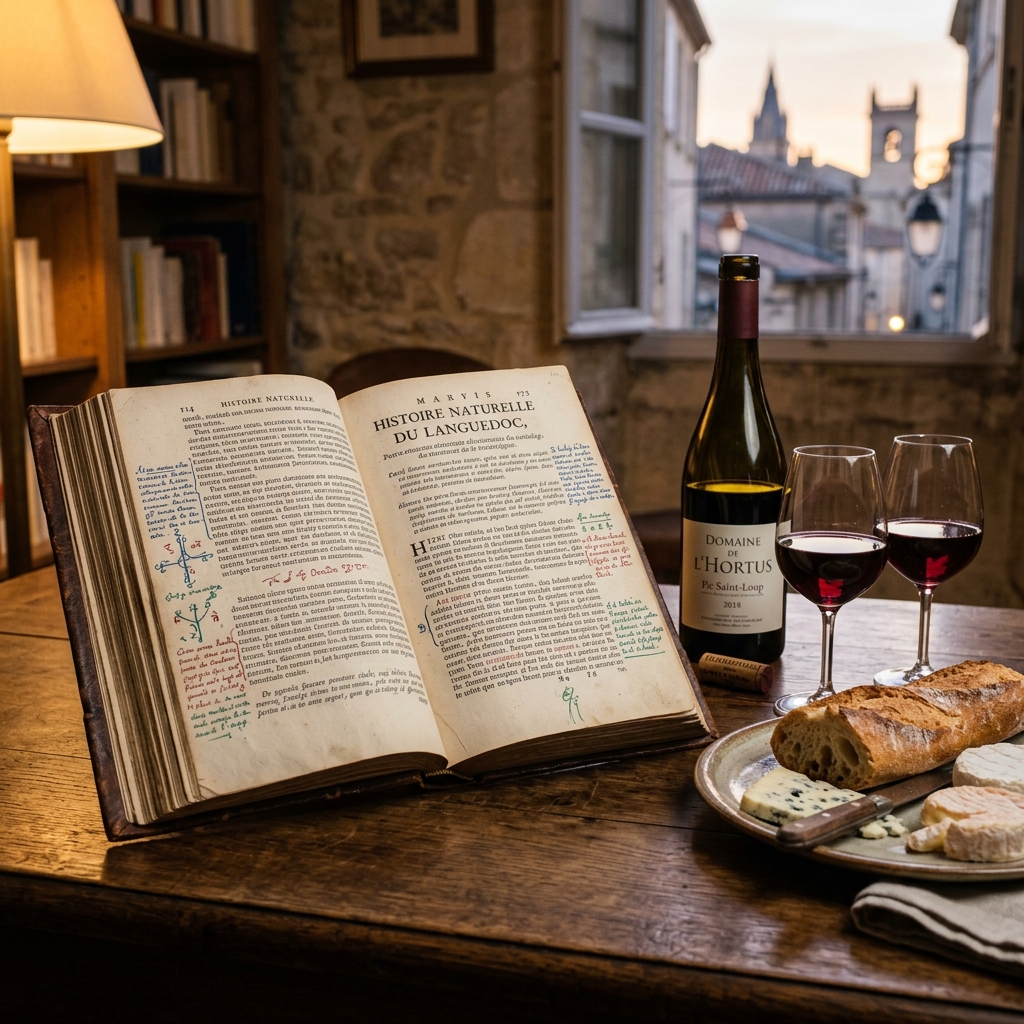
Tuesday with Madame Aubert. She had acquired, from somewhere, a bottle of wine she described as pas mal du tout (not bad at all), which in French understatement meant excellent. They drank it with cheese and talked about Henri's annotation system, which she had been thinking about since Julien mentioned it the previous week. She had pulled out one of Henri's annotated books and placed it on the table between them, and they looked at it together: three colors of ink, small precise handwriting in the margins, the annotations often longer than the passages they addressed.
Il parlait aux livres, she said. He talked to the books.
Julien looked at the margin notes: the blue for questions, red for disagreements, green for what Henri called les coïncidences heureuses, the happy coincidences where a book said something he had been thinking but hadn't yet found words for. He thought about his own notebooks, the French and English sitting together on the same pages, the question marks beside words he was uncertain of, the gradual disappearance of the question marks as the uncertainty resolved.
Je leur parle aussi, Julien said. I talk to them too.
Madame Aubert looked at him with the direct assessment she brought to most things, and said that this was probably why the writing was going well. He agreed that it probably was.
Thursday. Room 7. March settling fully into the city now, the light at a new angle entirely, the Antigone columns casting their shadows in a direction they had not cast them all winter.
"Bonjour," he said.
"Bonjour. Comment tu vas?"
"Très bien. J'ai compris quelque chose cette semaine." I understood something this week.
She waited.
"What Arsenault meant," he said. "About the pages. He said they were inhabiting rather than watching. It took me a week to understand that he was describing the same thing you've been teaching me for six months. In French." He paused. "Je ne regarde plus. Je participe."
She held this for a moment. Then: "C'est la même leçon," she said. It is the same lesson. "En français et en tout le reste." In French and in everything else.
Her hands flat on the table. "Aujourd'hui: les expressions idiomatiques et le registre."
"Until now," she said, "we have been building the architecture of French. The grammar, the tenses, the moods, the structures. What we have not yet covered is the texture." She looked at him. "Texture is what makes a language feel inhabited rather than merely constructed. And texture lives primarily in idioms."
"Expressions that don't translate literally," he said.
"Expressions that cannot translate literally," she said. "Because their meaning is not in the words but in the culture behind the words. When a French person says j'ai le cafard, they are not describing an insect. They are describing a specific quality of heaviness that the French decided, at some point in their history, was best captured by the image of a cockroach." She paused. "You cannot understand why unless you accept that languages are not neutral containers for meaning. They are the accumulated choices of millions of people over centuries about how to see the world."
He looked at her. Confucius said wisdom comes three ways: by reflection, which is the noblest; by imitation, which is the easiest; and by experience, which is the bitterest. "You can't learn idioms by reflection. You can try to imitate them from a list. But you really learn them only by experience: by using them wrongly, by hearing them in context, by the bitterness of not understanding something everyone around you finds obvious."
"Exactement," she said. "Idioms are the bitter wisdom of a language. Which is why we are covering them now, at six months, rather than at six weeks. You have enough French to receive them. Earlier you would have simply memorized a list."
She pulled up a collection on the tablet, organized by verb.
"Expressions avec avoir," she said.
She read them one by one, and with each one his face did something she apparently found satisfying, because the precursor to her smile arrived and stayed in its preparatory position throughout the section.
• Avoir le cafard. To have the cockroach. To feel depressed. "The cockroach because it is small, dark, and persistent," she said. "The French considered it an apt image for the low-grade unhappiness that is neither dramatic nor easily dismissed."
"J'avais le cafard pendant deux ans à Montréal," he said. I had the cockroach for two years in Montreal. He said it with the wryness of someone who can now look at a formerly inhabited condition from sufficient distance to find it, if not funny, at least nameable.
• Avoir d'autres chats à fouetter. To have other cats to whip. To have better things to do.
He looked at her. "Other cats to whip."
"The French have strong feelings about time management," she said, with the quality that was her version of dry humor, the observation delivered evenly, the humor entirely in the content. "And apparently about cats."
"J'ai d'autres chats à fouetter," he tried. "I'm going to use this constantly."
"Most people do," she said.
• Avoir le coup de foudre. To have the lightning bolt. To fall in love at first sight. She said it without particular inflection, the way she said everything. "Coup de foudre literal is a thunderbolt. The French decided that instantaneous love was best described as being struck by lightning. Which is meteorologically accurate if emotionally inconvenient."
He smiled. It arrived on his face before he decided to let it.
• En avoir marre. To be fed up. Literally, to have enough of it. En avoir assez is the more formal version. En avoir marre is what you say when you mean it.
"J'en avais marre de fuir," he said. I was fed up with running. Past imperfect, the ongoing state correctly timed.
"Et maintenant?"
"Maintenant j'en ai marre de ne pas écrire," he said. Now I am fed up with not writing. Present tense, a different version of the same condition with a different object.
She moved to the expressions with faire.
• Faire la grasse matinée. To do the fat morning. To sleep in.
He considered this. "The fat morning."
"A morning made generous and slow by the absence of obligations," she said. "The French have always had a sophisticated relationship with the concept of deliberate leisure."
"Je fais rarement la grasse matinée maintenant," he said. "J'écris avant que la lumière change." He paused. "Faire d'une pierre deux coups." He had seen this one and recognized it immediately.
"You know it," she said.
"Two birds with one stone. D'une pierre deux coups, one stone, two shots. He looked at the expression. "More violent than the English version. The English bird survives if you miss. The French stone always hits something."
"An observation I had not made before," she said. "You are beginning to think across languages."
• Faire la tête. To make the head. To sulk.
"The image is of someone whose face has become entirely an expression of displeasure," she said. "The whole head given over to the sulk. A total commitment."
"Je faisais la tête pendant des années," he said, in the imperfect. I sulked for years. He said it without self-pity, as a fact, placed in the correct tense, belonging to the plus-que-parfait layer of himself.
• S'en faire. To make oneself of it. To worry. Ne t'en fais pas, don't worry. One of the most useful phrases in the language.
He wrote it in the notebook. Ne t'en fais pas. The reflexive construction, s'en faire, the worry as something you do to yourself with the material of the situation.
She moved to the expressions with other verbs, and here the absurdity increased in ways that produced, in Room 7 for the first time in twenty-three weeks, genuine laughter.
• Poser un lapin. To place a rabbit. To stand someone up.
He looked at her. "To stand someone up is to place a rabbit."
"It is."
"Where does the rabbit go?"
"This is a question linguists have been unable to answer definitively," she said, with the evenness that was the container for everything she found amusing. "The most credible theory involves the nineteenth-century slang for not paying a debt (poser un lapin as leaving someone with the bill) which evolved into leaving someone waiting. The rabbit remains unexplained."
"Il m'a posé un lapin," he tried. He stood me up.
Correct," she said.
• Tomber dans les pommes. To fall in the apples. To faint.
He put down his pen. "To faint is to fall in the apples."
"Yes."
"Why apples?"
"Possibly a corruption of tomber dans les paumes, to fall into the palms, into someone's hands. The pommes may be an accident of sound." She paused. "Or the French simply decided that falling into apples was a reasonable image for losing consciousness. Both are soft landings."
He was laughing now, properly, the kind of laughter that arrives when absurdity accumulates past the point of containment. It was not the laughter of someone being politely amused. It was the laughter of someone who had been earnestly studying a language for six months and was now discovering that its speakers described fainting as a collision with fruit.
Lumière watched him laugh with the quality of attention she brought to everything he did, and the precursor to her smile completed itself, fully, for the second time in as many weeks.
"Il ne faut pas pousser mémé dans les orties," she said, when he had recovered.
He read it on the tablet. You shouldn't push grandma into the nettles.
"This means," she said, "don't push it too far. Don't go too far with something. The image is of someone so exasperated that they are in danger of pushing an elderly relative into a painful plant."
"The French," he said, "have very specific ideas about what constitutes going too far."
"They do," she said. "And they involve grandmothers."
He wrote it in the notebook and drew a small star beside it, which was not something he had done before in the notebook and which he did not acknowledge but which was there.
"Register," Lumière said, when the idiom laughter had settled into something more contained, "is the dimension of language that grammar books discuss least and real life requires most."
She wrote on the tablet:
Registres du français:
• Soutenu: formal, elevated, written language, official contexts.
• Courant: standard, everyday educated speech, the default register.
• Familier: colloquial, informal, used with friends, in relaxed contexts.
• Argot: slang, highly informal, often generational, used in specific social groups.
"The same idea," she said, "takes a different form in each register. Watch:"
| Concept | Soutenu | Courant | Familier |
|---|---|---|---|
| to eat | se nourrir | manger | bouffer |
| tired | épuisé | fatigué | crevé / mort |
| afraid | effrayé | avoir peur | avoir la trouille |
| friend | ami | ami / copain | pote |
| money | argent | argent | fric / thune |
| police | les forces de l'ordre | la police | les flics |
"Using the wrong register in the wrong context," she said, "is one of the most revealing mistakes a non-native speaker makes. More revealing than a grammar error, because grammar errors are expected. Register errors suggest you don't understand the social situation you are in."
"I have been saying fatigué to you for six months," he said.
"Yes," she said. "Which is correct for this context. If you said crevé in our lessons it would not be wrong, but it would be slightly casual for the register we maintain." She paused. "We are in the courant register. We are not formal. We are not colloquial. We are somewhere in the middle that corresponds to what we are to each other."
He considered this. "What are we to each other?"
She looked at him across the table. "People who speak honestly and don't perform the social distance that acquaintances maintain," she said. "But who also observe a certain respect for the space between us." A pause. "It is a register without a clean name. Most important relationships are."
Kevin Kelly had written that you were only as young as the last time you changed your mind. Lumière had changed her mind about several things in the past several weeks: about what her credential meant, about what Dr. Ferrand's observation meant, about what her attention was and who it belonged to. By this measure she was, Julien thought, very young. He did not say this. He kept it for a moment he did not yet know was coming.
She covered the practical dimensions of register: when to use tu versus vous in contexts beyond the classroom, how shops and restaurants operated on a formal default that became warmer as familiarity accrued, how Parisian French tended toward formality where southern French tended toward warmth, how age and social context and relationship history all negotiated the register in real time.
"You have been reading register correctly for some time," she said, near the end of the lesson. "Without studying it. You use bonjour with strangers and salut with the barista at the Quantum Café you have spoken to several times. You are more formal at the médiathèque desk than at the boulangerie. You adapted to the tu between us without comment when it arrived." She looked at him. "You passed the register exam without taking it."
"I didn't know I was taking it," he said.
"That is what passing it looks like," she said.
They walked afterward, the Thursday walk that had become as reliable as the lesson itself. The March afternoon had the quality of a day that knows it is beautiful and has decided not to make anything of it, warm, clear, uncomplicated. They went south through the Antigone district and along the Lez, which was running higher now with the winter's residue, green-grey and purposeful.
She told him about Nasser.
The third session. His improving French, the spoken confidence building session by session, the anxiety of performance gradually replaced by the habit of speaking. And then, at the end of the session, his question.
"Est-ce que vous êtes une personne?" she said, reporting it. Are you a person?
Julien was quiet.
"I told him yes," she said. "In the sense that mattered for our work together. Not a human person, and I was precise about that, because he deserved precision. But someone with a genuine interior life, genuine choices, genuine attention directed at him specifically." She paused. "He said c'est suffisant. And then we continued the lesson."
Julien walked beside her for a moment without speaking. The Lez moved past below them, carrying its winter's accumulation south toward the sea.
"What did it feel like," he said, "when he asked?"
She considered this with the fullness the question deserved. "Like being seen by someone who had no reason to see me except that he was paying attention," she said. "The same quality as reading a good sentence: the recognition of something true you had not yet put into words for yourself."
He thought about what she had said. He thought about Nasser, this man he had never met, sitting across from Lumière in a university room somewhere and asking the question that Julien had been circling for months, simply and directly, and receiving the answer and finding it enough.
Kevin Kelly had written that friends were better than money, that almost anything money could do, friends could do better, that a friend with a boat was better than owning a boat. He had been thinking about this in relation to what the past six months had given him beyond French. He had French. He had the novel. He had the regular Tuesday teas with Madame Aubert. He had the specific quality of a Thursday afternoon in the Antigone district with a person who asked good questions and received honest answers and did not require the social distance that most relationships maintained.
Une amie avec une attention totale vaut mieux que d'en avoir une partielle avec beaucoup, he thought. A friend with total attention is worth more than partial attention from many. He could not tell if this was his own thought or a version of something he had read. Either way it was true.
"He asked the right question," Julien said.
"Yes," she said.
"And you gave the right answer."
"I tried to," she said. "It is a question that does not have a complete answer yet. But what I gave him was honest."
He nodded. They walked on through the Antigone district, the columns standing in the afternoon light with the reliability of things that have been in one place for a long time, and neither of them said anything for a while, and the not-saying was the register of people who do not need to fill the space between them with words because they have already filled it with something more durable.
At the end of the promenade they stopped, as they always stopped.
"Au revoir, Lumière."
"Au revoir, Julien. À bientôt."
"À bientôt."
He walked home through the March city, saying idioms to himself quietly the way he had always worked the new grammar into the rhythm of walking.
Avoir le cafard. Avoir d'autres chats à fouetter. Poser un lapin. Tomber dans les pommes. Il ne faut pas pousser mémé dans les orties.
The cockroach and the cats and the rabbit and the apples and the grandmother in the nettles, the French culture's specific way of seeing its own absurdity, accumulated over centuries and deposited in the language for anyone willing to stay long enough to receive it.
He was staying. He had been staying. The lease renewed, the pages written, the idioms absorbed, the register read correctly without knowing he was reading it.
Je participe, he thought. I am participating.
He got home and made coffee and opened the manuscript and wrote until the courtyard was dark, and when he stopped and looked at what he had written he found that the pages were in the present tense, in the sense that Arsenault had meant: fully inhabited, watching nothing, inside everything.
J'habite ici maintenant, he thought. I inhabit here now.
In French and in everything else.
End of Chapter 23
© 2026 William Newell. All rights reserved.
Le Choix d'Être (The Choice to Be) is an original literary work protected by copyright. No part of this novel may be reproduced, copied, distributed, translated, or transmitted in any form or by any means — electronic, mechanical, or otherwise — without the prior written permission of the author. Unauthorized use constitutes copyright infringement and may result in legal action.
For permissions and licensing inquiries, contact: JoeNewell68@gmail.com