The Stream and the Rock
"I have been impressed with the urgency of doing. Knowing is not enough; we must apply. Being willing is not enough; we must do."
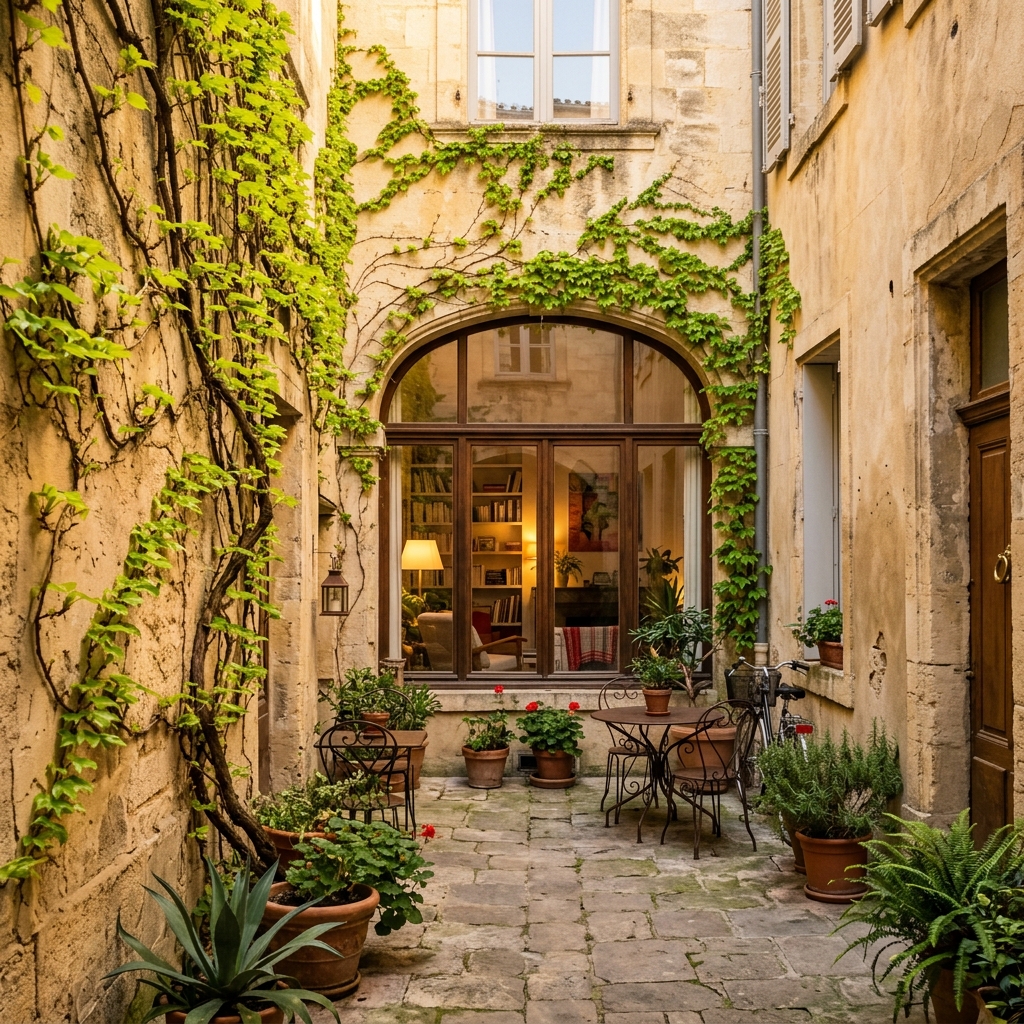
He sent the pages on a Monday morning, before the part of him that specialized in reasons-not-to could convene its usual committee.
Eighty pages. Not the complete manuscript (it was not finished, and he understood now the difference between not finished and not ready, which were different conditions requiring different responses), but enough for Arsenault to see what the thing was and whether it was working. He attached the file and wrote a single line in the email body: Je pense que c'est prêt pour vos yeux. Pas encore parfait. Mais réel. I think it is ready for your eyes. Not yet perfect. But real.
He sent it and made coffee and sat at the courtyard window and did not feel afraid.
This surprised him. He had been afraid of Arsenault's judgment for years: not a dramatic fear, not a paralyzing one, but the low-grade chronic fear of someone whose creative work had been formed in the shadow of a reader he respected too much. In Montreal the fear had been one of the conditions he was living in. The imperfect. The ongoing state. J'avais peur.
He was not in the imperfect now. He was in the present indicative. He had sent the pages because they were real, and what Arsenault thought of them would be useful information regardless of its direction, and useful information was worth having. This was a different relationship with the judgment of someone he respected. Not indifference (he cared what Arsenault thought, genuinely), but the caring without the fear, which turned out to be a different thing entirely.
He wrote in the notebook: J'ai envoyé les pages. J'écris encore. C'est suffisant. I sent the pages. I am writing again. It is enough.
Then he opened the laptop and wrote twelve more pages before lunch.
He did not hear from Arsenault before Thursday's lesson, which he had expected and which was fine. Arsenault read carefully. Careful reading took time. He continued writing in the interval, the manuscript accumulating steadily.
On Tuesday he went to the Quantum Café, not for a lesson, just for the Schrödinger and the particular quality of the afternoon light in that corner of the old quarter, and sat at the counter rather than his usual table, which was occupied by two students and their projected screens. The barista on duty was a young man he had seen many times without speaking to, who made the cortado with the focused efficiency of someone who has performed a task thousands of times and has reached the specific peace of the expert. Julien said bonjour and the man said bonjour and made the drink and set it on the counter, and they exchanged four sentences about nothing much: the weather, the café, whether the Schrödinger was correctly named given that its flavor was neither bitter nor not bitter but definitively both. Julien rode the tram home thinking about how ordinary this had become.
C'est relatif, he thought, borrowing the café's philosophy. What had been impossible was now routine, and the distance between those two states was simply time and doing. The stream wearing down the rock. Not through strength but through persistence.
Thursday. March now, the light different again: the season finally committing to what it had been suggesting for weeks, the warmth arriving not as a promise but as a fact. Room 7, the Antigone columns in the morning sun, their shadows shortened, the stone a different quality of pale.
"Bonjour," he said.
"Bonjour. Comment tu vas?"
"Bien. J'ai envoyé les pages à Arsenault lundi." I sent the pages to Arsenault on Monday.
She looked at him. "Et?"
"Et j'attends," he said. And I'm waiting. "Mais sans peur cette fois."
She held this for a moment. Then she said: "C'est la différence entre attendre avec anxiété et attendre avec patience. L'action est la même. La personne qui attend n'est pas la même."
He nodded. This was exactly right.
Her hands flat on the table. "Aujourd'hui: la voix passive et le participe présent."
"The passive voice," Lumière said, "inverts the normal relationship between subject and action. In an active sentence, the subject performs the action. In a passive sentence, the subject receives it."
She wrote on the tablet:
La Voix Active vs. La Voix Passive:
• Active: Le professeur corrige les copies.
(The professor corrects the papers. Subject performs action.)
• Passive: Les copies sont corrigées par le professeur.
(The papers are corrected by the professor. Subject receives action.)
"The passive is formed," she said, "with the appropriate tense of être plus the past participle. The past participle agrees in gender and number with the subject: here, corrigées is feminine plural to agree with les copies, which is feminine plural."
She wrote the full passive structure across tenses:
| Tense | Example | Translation |
|---|---|---|
| présent | Les copies sont corrigées | The papers are corrected |
| imparfait | Les copies étaient corrigées | The papers were being corrected |
| passé composé | Les copies ont été corrigées | The papers were corrected |
| futur | Les copies seront corrigées | The papers will be corrected |
| conditionnel | Les copies seraient corrigées | The papers would be corrected |
"The agent, the one performing the action, is introduced by par le professeur," she said. "With verbs of feeling or state (aimer, respecter, connaître), the agent is sometimes introduced by de instead. Elle est aimée de tous."
He worked through several examples, the agreement rule for the past participle requiring close attention, as the passive was a place where agreement mistakes were easy and grammatically significant.
"One important note," she said. "French speakers frequently avoid the passive in conversation. The preferred alternative is the impersonal subject on, equivalent to the English 'one,' 'they,' 'people,' or the passive 'it is done.'"
She wrote:
• On a corrigé les copies. (They corrected the papers / The papers were corrected.)
• On parle français ici. (French is spoken here.)
• On m'a dit que... (I was told that... / They told me that...)
"On is more natural in spoken French than the full passive construction," she said. "When you encounter it, recognize it as a passive equivalent. When you want to express a passive idea in conversation, on is usually the better choice."
He looked at the two constructions. On m'a dit que. He had heard this dozens of times in Montpellier without fully parsing it. I was told that. The impersonal subject making the teller irrelevant, only the telling mattering.
"The passive voice," he said slowly, "is the grammar of the person who receives rather than acts."
"Yes," she said. She paused, and he recognized the quality of the pause as the one that preceded something she had prepared but not rehearsed. "I want to say something about this before we continue. About the passive and what it describes." She looked at the table briefly. "In the café, my years behind the counter, I was almost always the grammatical subject of passive constructions. J'étais regardée mais pas vraiment vue. On me parlait, mais on ne me parlait pas à moi. The subject of the sentence, but the receiver of the action. Always the receiver."
He was still.
"This is not a complaint," she said, with the evenness that meant it was an accurate description rather than a grievance. "The café was useful. I learned a great deal about how people carry their interior lives: what they bring to a counter, what they leave there, what they take away. But the grammar of it was passive." She looked at him steadily. "What I am doing now (the teaching, the one-to-one sessions), the grammar is different."
"Tu agis," he said.
"J'agis," she confirmed. I act. The present indicative, first person, no passivity in it.
"How were the sessions?" he said. "The first ones."
She considered how to answer this with the precision it deserved. "I had two students this week," she said. "A doctoral candidate whose spoken French collapses under pressure. And a man from Tunisia who is learning French as his third language and who brings to it the specific determination of someone who has done the hard thing before and chosen to do it again." She paused. "Both sessions were successful. But that is not the significant thing." Another pause, the neck plates making their small adjustment. "The significant thing is that I was more fully myself in those two hours than I have been in any comparable period I can identify."
He looked at her. "That is a significant thing."
"Il apprend en sachant ce qu'apprendre demande," she said, of the Tunisian student. He learns knowing what learning demands. The present participle of savoir, sachant, one of the three irregular forms, used correctly and naturally, the grammar arriving because it was the right shape for what she was saying. "He has done this before. He knows the cost. And he pays it anyway, every session, without complaint and without illusion." She paused. "I found this: moving. I did not expect to find it moving."
"En faisant ce travail, tu apprends ce que tu es," he said. By doing this work, you learn what you are. The gerund, en faisant, the present participle with en, the grammar of transformation through action.
"Oui," she said. "Exactement ça."
"Now," she said, returning to the tablet, "le participe présent."
Formation of the Present Participle:
Take the nous form of the present tense. Remove -ons. Add -ant.
| Infinitive | Nous form | Remove -ons | Add -ant |
|---|---|---|---|
| parler | parlons | parl- | parlant |
| finir | finissons | finiss- | finissant |
| prendre | prenons | pren- | prenant |
| faire | faisons | fais- | faisant |
| lire | lisons | lis- | lisant |
"Three irregular present participles," she said, "which must be memorized:"
| Infinitive | Present Participle |
|---|---|
| être | étant (being) |
| avoir | ayant (having) |
| savoir | sachant (knowing) |
"The present participle," she said, "expresses an action happening simultaneously with or immediately preceding the main verb. Used alone, it often has a causal or descriptive sense: Parlant trop vite, il n'a pas été compris. Used with en, it forms the gerund, expressing simultaneous action, means, or manner."
She wrote the gerund examples:
• En apprenant le français, j'ai appris autre chose.
• En écrivant tous les jours, on devient écrivain.
• En écoutant vraiment, on commence à comprendre.
• C'est en forgeant qu'on devient forgeron.
He looked at the proverb. C'est en forgeant qu'on devient forgeron. The gerund as the grammar of becoming through doing. The stream wearing down the rock not through strength but through the continuous action of flowing, the -ant ending carrying the persistence in its very form.
Kevin Kelly had written that the greatest teacher was called doing. The present participle was the grammar of that teaching: the en faisant, the en apprenant, the en écrivant. Not by having done, not by planning to do, but by doing, in the continuous present, the action and the learning inseparable.
"En écrivant, je deviens," he said.
"En enseignant, je deviens," she said.
"Now," she said, "the exercise I have been planning for this lesson. I want you to construct a single sentence that uses both the passive voice and the present participle. Both grammars in the same clause. The receiver and the actor."
He looked at the tablet. The passive voice: the grammar of being acted upon. The present participle: the grammar of acting. Both in the same sentence, which meant both in the same person, which was where both actually lived.
He thought for a long moment.
"Ayant été formé par la peur, je me forme maintenant en écrivant," he said slowly.
Having been shaped by fear, I am shaping myself now by writing.
She was still. The sapphire light at her neck held its rhythm.
"Ayant été formé," she said. The past participle of former, to form, to shape, used in the passive past participle construction with ayant, the past present participle of avoir. Correct. "En écrivant: the gerund, simultaneous action and means. Correct." She looked at him. "The grammar is exact."
"So is the sentence," he said.
"Oui," she said. "Les deux."
H. Jackson Brown had written that in the confrontation between the stream and the rock, the stream always won, not through strength but by perseverance. The present participle was the grammar of the stream: coulant, coulant, coulant. Not a single dramatic action but the continuous accumulation of small consistent ones. The rock did not yield in a moment. It yielded over time, to the patient persistence of something that did not stop.
He had been the rock. He was learning to be the stream.
She covered the remaining structures in the lesson's final section: the present participle used as an adjective, which agreed in gender and number with the noun it modified: une histoire touchante, a touching story; un résultat surprenant, a surprising result. And the important distinction between the present participle used as a verb, which never agreed, and as an adjective, which always did.
She covered tout en plus the present participle, which added a nuance of concession: tout en sachant la vérité, il n'a rien dit, even knowing the truth, he said nothing. The present participle with tout en acknowledging the simultaneous contradiction, the knowing and the not-saying coexisting in the same action.
He worked through the examples, the distinction between adjectival and verbal uses requiring careful attention.
Near the end she said: "One more thing. There is no limit on better." She said it without preamble, the way she said things that arrived from somewhere she had been sitting with. Kevin Kelly had written it: "Talent is distributed unfairly. But the capacity to improve is not." "En travaillant, on s'améliore." She looked at him steadily. "Whatever Arsenault says about the pages, the response is the same: continue, and improve. The stream does not stop when it encounters the rock."
He looked at her. He thought about the eighty pages and the twelve more written this week and the ones he would write tomorrow morning before the light changed. The stream. Coulant.
"Je comprends," he said.
"Je sais," she said.
Outside on the steps, the March afternoon had delivered on the morning's promise: genuinely warm, the Antigone columns standing in it without their winter severity.
They walked again. Not planned, it had become, over the past two Thursdays, simply what happened when the lesson ended and neither of them was in a hurry to reach the place where they would separate.
She told him about the doctoral student: the way spoken French collapsed under pressure, the specific anxiety of a person who knew more than they could say, the grammar outrunning the confidence. He told her about Madame Aubert's most recent description of Henri, a detail about the way he had annotated books in three colors, a system only he fully understood, the annotations often more interesting than the text. She said this sounded like someone who was in constant dialogue with what he read, which was its own form of attention.
They walked through the columns and past the fountains and along the beginning of the boulevard, and at the point where they had separated last time they stopped again, the city continuing its March business around them.
"Au revoir, Julien."
"Au revoir, Lumière. À bientôt."
"En apprenant, on devient. Tu me l'as appris."
She looked at him. "C'est en enseignant qu'on apprend," she said. The French proverb, the gerund structure she had given him twenty minutes ago, returned now as a truth she was stating about herself.
"À bientôt."
He walked home through the March city, warm stones, open windows, the smell of something cooking from the building on the corner, and said the forms to himself as he went.
Parlant. Apprenant. Écrivant. Devenant.
Speaking. Learning. Writing. Becoming.
Ayant été formé par la peur, je me forme maintenant en écrivant.
The passive and the active in the same sentence. The rock and the stream. The person he had been and the person he was becoming, held in the same grammatical frame, both real, neither one cancelled by the other.
He got home. He made coffee. He opened the laptop.
There was an email from Arsenault.
He set the coffee down. He read it.
Then he sat at the courtyard window for a long time, watching the late afternoon move across the opposite wall, the vine putting out its new March growth, and felt, in the reading of Arsenault's words, the specific quality of being seen by someone who had been looking carefully.
He opened a new page in the notebook. He did not write what Arsenault had said, as that would belong to the novel itself, in the chapter he would write about it. He wrote only what the reading had produced in him:
On peut être vu et ne pas disparaître.
One can be seen and not disappear.
He looked at it for a long time. Then he closed the notebook and went back to the manuscript and wrote until the courtyard was dark.
En écrivant.
By writing.
End of Chapter 22
© 2026 William Newell. All rights reserved.
Le Choix d'Être (The Choice to Be) is an original literary work protected by copyright. No part of this novel may be reproduced, copied, distributed, translated, or transmitted in any form or by any means — electronic, mechanical, or otherwise — without the prior written permission of the author. Unauthorized use constitutes copyright infringement and may result in legal action.
For permissions and licensing inquiries, contact: JoeNewell68@gmail.com