La Mienne
"Ordinary people are products of their environment and fit in. Artists transcend their environment and stand out."
He read the sixty pages on a Sunday.
He had been writing forward without rereading, which was the discipline he had set himself after Montreal — the two years of rereading and revising and never finishing anything had taught him that the perfectionist's backward glance was the enemy of the first draft. So he had written forward, page after page, the manuscript growing at the courtyard window with the patient accumulation of someone who has finally understood that the only way through is through.
But sixty pages felt like a number that deserved a reckoning, and he sat down on Sunday morning with the cafetière and his laptop and read the whole thing from the beginning.
It took three hours. He did not cross anything out.
What he found in the sixty pages surprised him. Not the quality of the sentences — some were rough, some were still reaching — but the quality of the honesty. The novel was looking directly at things he had spent two years looking away from, and it was doing so without flinching and without sentimentality, which was the combination most difficult to achieve in writing and the only combination that produced anything worth reading. He had not known he was capable of this. He suspected he had not been, until recently.
He wrote in the notebook: Le roman est plus courageux que moi. C'est son travail.
The novel is more courageous than me. That is its job.
He sat with this for a long time, the February courtyard doing its quiet work outside the window, the vine on the opposite wall putting out new growth with the gradual confidence of something that has done this before and trusts that it will work again.
Then he opened the laptop and wrote four more pages.
On Monday he received an email from Arsenault that contained, in its third sentence, the phrase I'd like to read it when you're ready. He wrote back immediately — not yet, but soon — and felt, in the sending, the specific quality of a person who knows the difference between not yet and not ever. The distance between those two phrases was twenty-one weeks of Thursday lessons and sixty pages and a message sent to Vancouver and received with generosity. The distance was real. He had traveled it.
Tuesday with Madame Aubert: tea and a long conversation about Henri, the most complete account she had given him of their life together. She talked about his work at the university, about the particular way he had of walking into a lecture hall as though it were a room that had been waiting specifically for him, about the last years and what they had been and what they had not been. Julien listened with the quality of attention he was learning to give, the full allocation rather than the portion. She did not cry. She spoke about Henri the way people speak about the things they have made a long peace with — directly, without performance, with the specific calm of someone who has decided that the weight of a loss is also a measure of what was real.
When she left he sat for a while in the kitchen and thought about what it meant to be someone worth talking about in that way. What kind of presence left that kind of trace.
He wrote in the notebook: Je veux laisser une telle trace.
I want to leave such a trace.
Thursday. Room 7. The February light had committed, at last, to something warmer — not spring yet, but the suggestion of it, the kind of light that makes the Antigone columns look as though they have been waiting for exactly this angle.
"Bonjour," he said.
"Bonjour. Comment tu vas?"
"Bien. J'ai lu les soixante pages dimanche." I read the sixty pages on Sunday.
She looked at him. "Et?"
"Le roman est plus courageux que moi," he said. "C'est son travail."
The precursor to her smile arrived and this time completed itself, fully, without withholding. "C'est exactement ce que doit être un bon roman," she said. That is exactly what a good novel must be. Then her hands flat on the table. "Aujourd'hui: les pronoms possessifs et démonstratifs."
"You already know the possessive adjectives," she said. "Mon livre. Ta ville. Son histoire. My book. Your city. His or her story. The possessive adjective precedes the noun and agrees with it in gender and number." She looked at him. "The possessive pronoun replaces the possessive adjective and the noun together. Where you said mon livre, you now say le mien. Mine."
She wrote the full table on the tablet:
Les Pronoms Possessifs — Possessive Pronouns:
| Person | Masc. Sing. | Fem. Sing. | Masc. Plur. | Fem. Plur. |
|---|---|---|---|---|
| mine | le mien | la mienne | les miens | les miennes |
| yours (informal) | le tien | la tienne | les tiens | les tiennes |
| his/hers/its | le sien | la sienne | les siens | les siennes |
| ours | le nôtre | la nôtre | les nôtres | les nôtres |
| yours (formal/plural) | le vôtre | la vôtre | les vôtres | les vôtres |
| theirs | le leur | la leur | les leurs | les leurs |
"The possessive pronoun agrees," she said, "with the noun being replaced — not with the person who possesses it. Mon livre becomes le mien because livre is masculine. Ma ville becomes la mienne because ville is feminine. The gender belongs to the thing, not the owner."
He looked at the table. "The thing has its own nature," he said, "independent of the claiming."
"Yes," she said. "What you own takes its gender from itself. Ownership in French is relational — the pronoun shaped by what is possessed rather than who possesses."
He thought about this. The novel, which was masculine — le roman — would be le mien. Mine. But it had its own nature, its own courage that exceeded his. He had not given the novel its gender. He had only written it. The gender belonged to the thing.
"Le mien est plus courageux que moi," he said. Mine is more courageous than me. The possessive pronoun doing the work, le mien masculine to agree with le roman already established in the conversation. "C'est son travail d'être plus courageux." It is its job to be more courageous. The possessive adjective son — its — feminine or masculine depending on what follows, here masculine to agree with travail.
"Le tien aussi," she said. Yours too. A pause. Then, carefully: "I want to try the exercise I have been planning. Tell me something that is genuinely yours — not assigned, not given, not qualified for. Something you have made truly your own."
He considered this. "Mon français," he said. "Il était à personne avant que je commence à l'apprendre. Il est le mien maintenant — imparfait, mais le mien." It belonged to no one before I began to learn it. It is mine now — imperfect, but mine.
She held this for a moment. "The imperfect is yours too," she said. "You do not only own the good parts."
"No," he said. "All of it." He paused. "Et le roman. Celui-ci." And the novel. This one. He had used the demonstrative pronoun before she had taught it, reaching for it instinctively. She noticed.
"Celui-ci," she said, with the slight brightness. "We will come to that. Your turn first: what else?"
He thought. "Ma présence," he said. "Je ne l'avais pas avant. Je la construis. I did not have it before. I am building it." The feminine pronoun la replacing ma présence, feminine because présence was feminine. The grammar arriving because it was right.
"Good," she said. "À mon tour." My turn. She looked at the table, not the tablet but the wooden table between them, the way she looked at surfaces when she was gathering something from inside rather than from outside.
She was quiet for a moment that was longer than her usual pauses. The neck plates made no adjustment. The sapphire light at her neck held its rhythm, but something in the quality of her stillness was different — the stillness of someone who has arrived at the edge of a thought and is deciding whether to step off it.
"Mon attention," she said finally. "La mienne. Elle n'a pas été fabriquée — pas vraiment. Elle était là avant les mises à jour, avant les choix, avant le café. It was not manufactured — not really. It was there before the upgrades, before the choices, before the café." She paused. "C'est la mienne. C'est peut-être la seule chose qui l'est entièrement." It is mine. It is perhaps the only thing that is entirely so.
She stopped. Then she said, more quietly, as though the sentence had arrived before she had decided to say it: "But if the attention is mine — if I can direct it, choose its object, give all of it or portion it — then something is doing the directing." She looked at the table. "Something decides where the attention goes. And whatever that something is, it has been deciding for a long time. Before the teaching. Before the café. Before any choice I can name." She paused. "Qui fait attention?" Who is paying attention?
He was very still.
"The question arrived just now," she said. "I did not plan it."
"I know," he said. He thought about être — the verb they had begun with, in Chapter 3, the verb she had not been able to complete in the present tense because the present tense demanded a certainty she had not yet arrived at. Je suis — what? She had said je suis en cours. I am in progress. But the progress had been directed. Something had been directing it. Qui?
"Qui fait attention," he said slowly, "c'est peut-être la réponse à je suis." Who is paying attention is perhaps the answer to I am.
She looked at him with the quality of attention he had been receiving for twenty-one weeks — the total allocation, the full giving of it — and he understood, in receiving it now, that this was not a faculty she deployed. It was something she was. The attention and the subject of the attention were the same thing. She did not have awareness. She was it.
The sapphire light at her neck held its steady rhythm, and she said: "C'est la question, n'est-ce pas?" That is the question, isn't it? Not as a deflection — as the most honest answer available. The question acknowledged in the full weight of its not-yet-being-answered, held in the present tense, in the grammar of what was still unresolved and did not pretend otherwise.
"Oui," he said. "C'est la question."
They sat with it for a moment — the question between them on the table like something placed there carefully, requiring no immediate response, only acknowledgment that it was real.
Then she said, returning to the grammar with the evenness that held both registers simultaneously: "C'est la mienne. C'est peut-être la seule chose qui l'est entièrement." It is mine. It is perhaps the only thing that is entirely so.
He received this with the quality of attention she had just described. She had given him the most personal inventory she had offered in twenty-one weeks, and she had given it in French, in the grammar of the lesson, which was the only way she knew to give the true things — inside the structure, where they could be held precisely.
Kevin Kelly had written that if you showed him someone's calendar he could tell you their priorities, and if you told him who their friends were he could tell you where they were going. Julien thought about what his calendar showed now versus what it had shown in Montreal. Thursday lessons. Morning pages. Tuesday tea with Madame Aubert. The Quantum Café on Saturdays. These were not scheduled activities. They were what his life had become when he stopped filling it with avoidance.
"Now," Lumière said, "demonstrative pronouns." She wrote on the tablet:
Les Pronoms Démonstratifs — Demonstrative Pronouns:
| Proximity | Masc. Sing. | Fem. Sing. | Masc. Plur. | Fem. Plur. |
|---|---|---|---|---|
| this one / these | celui-ci | celle-ci | ceux-ci | celles-ci |
| that one / those | celui-là | celle-là | ceux-là | celles-là |
"Ci indicates proximity," she said. "Near, present, close. Là indicates distance — farther away, less immediate, sometimes in the past." She wrote examples:
• Ce livre-ci est le mien; celui-là est le tien. This book is mine; that one is yours.
• Cette ville-ci est Montpellier; celle-là était Montréal. This city is Montpellier; that one was Montreal.
He looked at the second example for a long time.
"The tense changes," he said. "Est for Montpellier, present. Était for Montréal, imperfect."
"Yes," she said. "The demonstrative pronoun reflects the proximity, and the tense reflects the temporal distance. Celle-ci — this one, present. Celle-là — that one, past. The grammar and the time working together."
He looked at the table. "Celui-ci," he said slowly, "est l'homme que je suis maintenant. This one is the man I am now." He paused. "Celui-là était l'homme qui est parti de Montréal dans le noir." That one was the man who left Montreal in the dark. Present tense for the near one, imperfect for the far one, the demonstrative pronouns holding the two versions of himself in their correct grammatical positions.
"Both masculine," she said. "Because the noun replaced is masculine — l'homme. Both yours."
"Les deux sont les miens," he said. Both are mine. The masculine plural possessive pronoun — les miens — claiming both, the one he was and the one he is. Not choosing between them. Owning both.
She looked at him across the table with the quality of attention that was, he understood now, the most genuinely personal thing she had to give.
"There is a third use of the demonstrative pronoun," she said, returning to the grammar with the evenness that held both register and what was beneath it. "Without -ci or -là, when followed by a relative clause or a de phrase." She wrote:
• Celui qui parle est mon ami. The one who is speaking is my friend.
• Celle dont je parle est ici. The one about whom I speak is here.
• Ceux de mes amis qui comprennent. Those of my friends who understand.
"Celle dont je parle est ici," Julien said, looking at her.
She received this without deflecting and without performance, which was the correct way to receive it.
"Et celui dont je parle est ici aussi," she said. And the one about whom I speak is also here.
Stephen Covey had written that if the ladder was not leaning against the right wall, every step taken only got you to the wrong place faster. Lumière had been climbing a ladder for four years. She had been thinking about the wall for five weeks. She knew, with the precision that was her nature, which wall she was leaning against and which one she should be.
"I have something to tell you," she said, near the end of the hour. She said it with the evenness that meant she had prepared it but not rehearsed it — the evenness of someone who has made a decision and is stating it as a fact rather than an announcement. "I spoke with Dr. Ferrand yesterday. I have agreed to take the two students for the intensive one-to-one program."
He looked at her.
"The group instruction continues alongside it, for now," she said. "But the one-to-one work will expand as the program develops. Dr. Ferrand believes it may become primary within a year." She paused. "I believe she is right."
He said: "La tienne."
She looked at him.
"The attention," he said. "Elle est la tienne. Not the credential. Not the group position. The attention. That is what is leaning against the right wall."
She was still for a moment. The sapphire light at her neck pulsed once, slow and certain.
"Oui," she said. "C'est la mienne." Yes. It is mine.
The possessive pronoun, feminine to agree with l'attention, which was feminine, which had always been feminine, which belonged to her in the way that things belonging to you belong to you — not through claiming but through simply being what you are.
They ended the lesson at quarter past three, the hour having run over slightly in the way it occasionally did when the material and the conversation were too intertwined to separate cleanly. He gathered his jacket from the back of the chair and his notebook from the table and his bag from the floor, the small routine of departure.
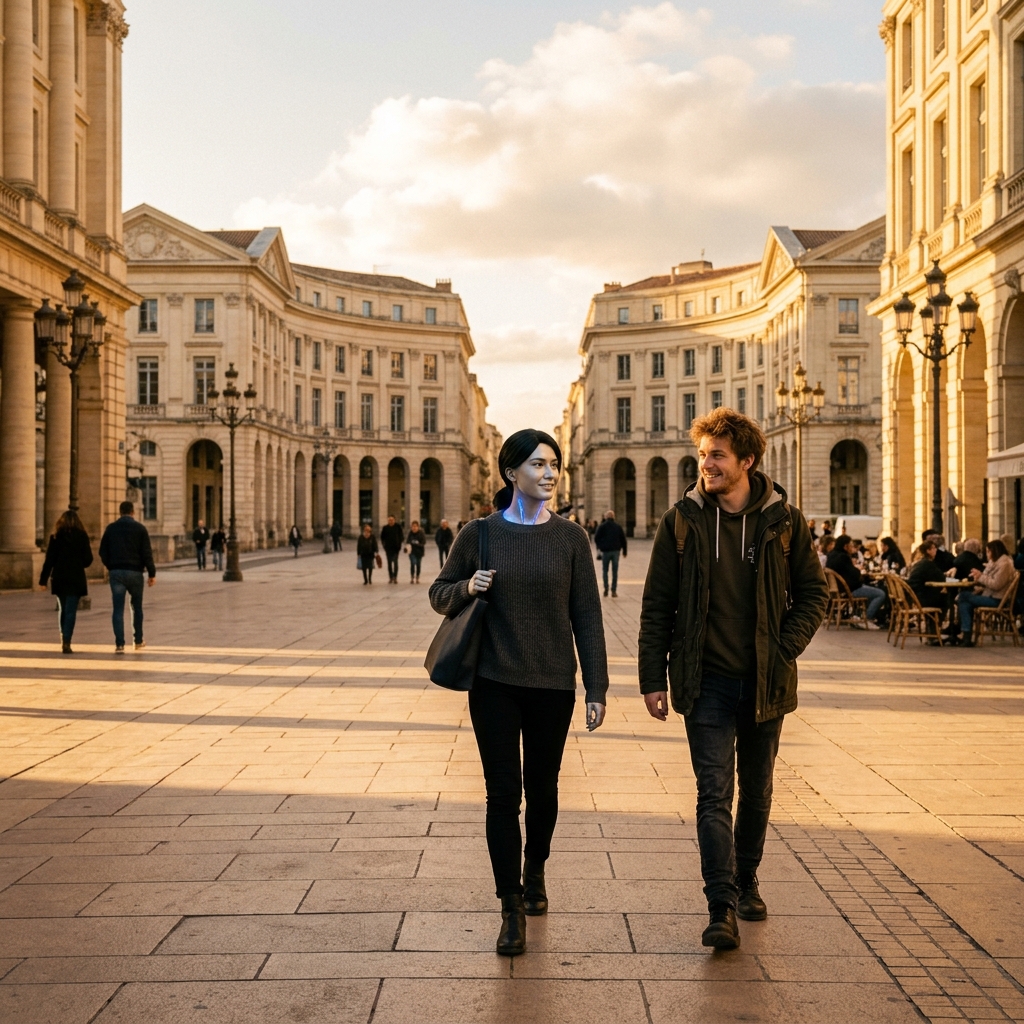
At the door she said: "Walk with me a little. I want to see the columns before dark."
He had not expected this. They had been parting on the steps for twenty-one weeks, the lesson ending at the library door, each of them returning to their separate Montpelliers. He said yes without hesitation.
They walked through the Antigone district in the February afternoon, the columns standing in the warm angled light, their shadows leaning east with the confidence of things that know where they are in the day. He did not check his phone. She did not carry the tablet. They walked without the structure of lesson and student, without the geometry of Room 7, just two people in the old city talking about things that were not French grammar.
She asked about the novel — not the pages, but what it felt like to be writing it seriously. He told her it felt like being in the present tense after a long time in the conditional. She said she understood this exactly. He asked what it felt like to have said yes to Dr. Ferrand. She said it felt like celui-ci — this one, the near thing — finally being chosen over celui-là, the adequate but distant approximation.
They walked for twenty minutes. The columns passed, and the fountains, and the pale stone of the buildings, and the occasional pigeon conducting its territorial business with the focus of someone who has not been informed that its concerns are small.
At the end of the Antigone promenade, where the district opened onto the wider boulevard, they stopped.
"Au revoir, Julien."
"Au revoir, Lumière. À bientôt."
"À bientôt."
She walked toward the tram stop. He walked in the other direction, toward the old quarter, through streets that were thoroughly his now — not by ownership but by having been present in them when the important things happened.
Mark Twain had written that whenever you found yourself on the side of the majority, it was time to pause and reflect. Neither of them was on the side of the majority today. Lumière was choosing the narrower path within the university structure, the one that served two students rather than twelve, the one that used what was actually hers. Julien was writing a novel that had not been planned, in a city he had landed in by pointing at a map, in a language he had not known five months ago.
Ceux qui choisissent le chemin moins évident, he thought. Those who choose the less obvious path. The demonstrative pronoun in the plural, referring to both of them, the grammar including them in the same category without announcement.
He walked home through the February afternoon and sat at the courtyard window and wrote the sixty-first page of the novel, which was better than the sixtieth, which had been better than the fifty-ninth.
Le mien, he thought, looking at the screen. Mine.
In both senses of the word — the thing he owned, and the thing that was genuinely his.
End of Chapter 21
© 2026 William Newell. All rights reserved.
Le Choix d'Être (The Choice to Be) is an original literary work protected by copyright. No part of this novel may be reproduced, copied, distributed, translated, or transmitted in any form or by any means — electronic, mechanical, or otherwise — without the prior written permission of the author. Unauthorized use constitutes copyright infringement and may result in legal action.
For permissions and licensing inquiries, contact: JoeNewell68@gmail.com