C'est Relatif
"If you talk to a man in a language he understands, that goes to his head. If you talk to him in his language, that goes to his heart."
He wrote to Arsenault on a Saturday morning, the longest message he had sent anyone since arriving in Montpellier.
He described the project properly for the first time — not in the careful oblique way he had been describing it in previous messages, gesturing toward it without quite naming it, but directly, in the terms it actually deserved. He said he was writing a novel about a man who fled Montreal for the south of France and learned French and began to understand, through the learning of a language, what he had been doing wrong in his life. He said it was about presence and absence, about the specific failure of courage that masquerades as stability. He said he thought the novel was also, underneath all of that, about what it means to arrive somewhere — not just geographically but in yourself.
He said he had forty pages and they were real.
He sent it before he could revise it into something more guarded, and then made coffee and sat at the courtyard window and watched the February morning do its unhurried work on the climbing vine and the opposite wall and the lit rectangle of his neighbor's window, which was already occupied at this hour by the silhouette of someone reading.
Arsenault wrote back within the hour. Julien had not expected this — Arsenault wrote back to most things eventually, not quickly. The response was three sentences: That's the only novel worth writing. Keep going. Don't show it to anyone until you've finished the first draft, including me.
He read this three times and felt, in the third reading, something settle in his chest that had been in suspension since September. Not confidence exactly. Something more like permission — the specific permission that arrives when someone you respect confirms that the direction you have been moving in is worth moving in.
He opened the manuscript and wrote six more pages before lunch.
The French arrived differently now. He had noticed this gradually over the past several weeks and had not marked it precisely because marking it precisely felt like the kind of thing that would make it stop — the way you do not look directly at a thing you are not sure is real. But it was real, and consistent enough now that he could acknowledge it.
He was thinking in French. Not always, not for complex thoughts that required the full vocabulary of his inner life, but for the ordinary texture of the day: il fait froid, j'ai faim, c'est beau, je suis fatigué. It is cold, I am hungry, it is beautiful, I am tired. These arrived in French first, without translation, the way a word arrives in your native language — not retrieved but simply present. He had a second language now in the way that people who actually have second languages have them: not as a system being operated but as a thing being inhabited.
He mentioned this to no one, which was its own measure of how far he had come. The version of himself who had arrived in September would have announced it. The current version simply lived inside it.
Richard Bach had written that a professional writer was an amateur who didn't quit. Julien had quit, for two years in Montreal, in the way that people quit without formally quitting — by continuing to call themselves writers while writing nothing, by maintaining the identity as a costume over the emptiness. He was not doing that now. He was writing every day, the pages accumulating with the quiet persistence of something that had found its correct direction. He did not know yet if he would finish. He knew he would not stop.
On Tuesday Madame Aubert asked him, over tea, what his novel was about. He had told her he was writing something — she had seen him at the courtyard window often enough, and she was not a woman who ignored the obvious — but he had not described it.
He told her, in French, that it was about a man who came to Montpellier from Canada and learned things he should have learned earlier. She listened with the focused attention she brought to things she found worth attending to, and then said that sounded like most people's lives, the learning of things that should have been learned earlier, and that the only question was whether you learned them at all.
He agreed. She refilled his tea without asking if he wanted more, which was itself a form of learning that had happened between them without either of them naming it.
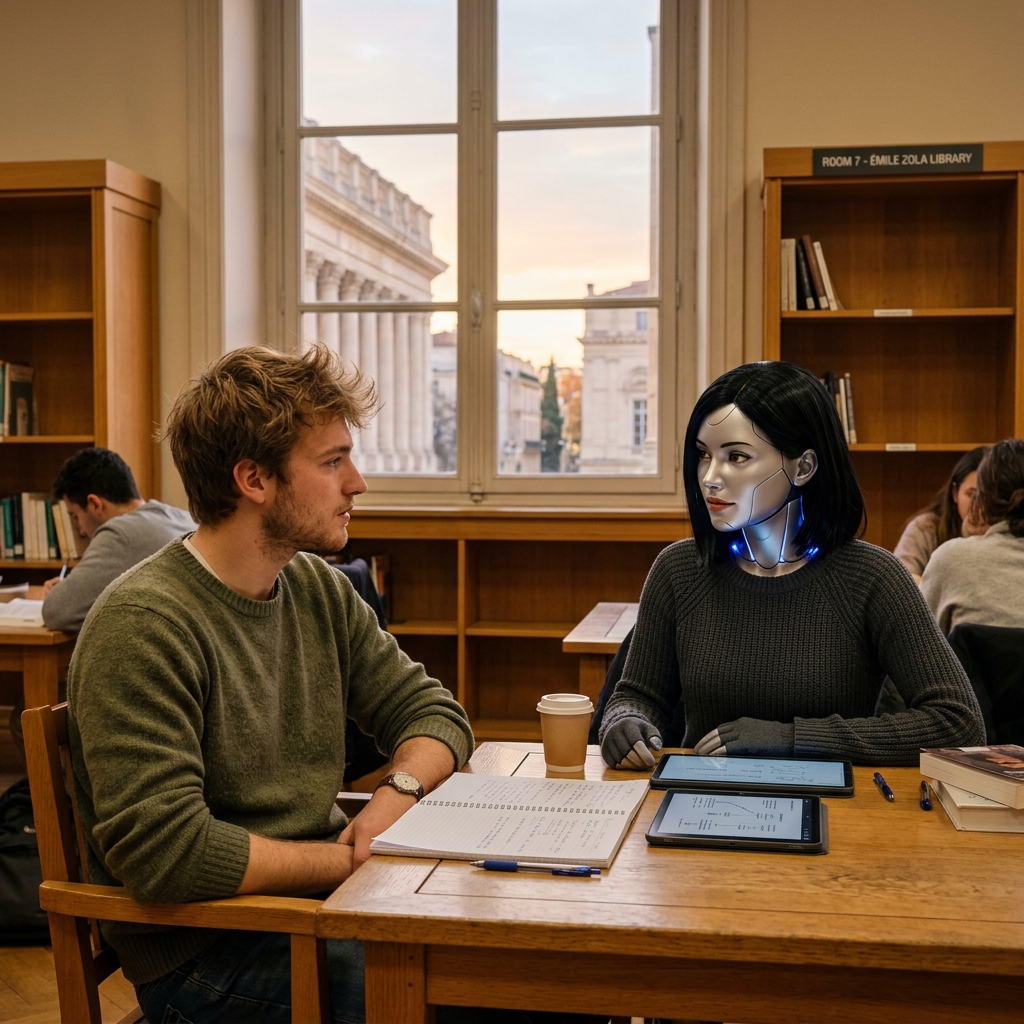
Thursday. Room 7. The February light through the window was doing something new — not the flat honest grey of January, but something with a slight warmth at the edges, the season beginning its hesitant negotiations.
"Bonjour," he said.
"Bonjour. Comment tu vas?"
"Bien. J'ai écrit à mon professeur cette semaine. I wrote to my professor this week. Il a dit que c'était le seul roman qui valait la peine d'être écrit. He said it was the only novel worth writing." He paused, feeling the grammar of what he had just done. "I used indirect speech just now. Without thinking about it."
She looked at him with the brightness in her eyes. "Tu l'as fait," she said. You did it. Then her hands flat on the table. "Which is exactly where we begin today."
"Indirect speech," she said, "is the grammar of how we carry other people's words inside our own sentences. When you report what someone said, the words travel from their original context into yours — and in the traveling, they change."
She wrote two versions of the same content on the tablet:
• Direct speech: Il a dit: "Je viendrai demain."
• Indirect speech: Il a dit qu'il viendrait le lendemain.
(He said: "I will come tomorrow." → He said that he would come the next day.)
"Notice what changed," she said. "The future viendrai became the conditional viendrait — one step back in time. demain became le lendemain — the deictic expression, the word that points to tomorrow relative to now, became a word that points to the next day relative to then." She looked at him. "The words survive the translation. But they are not identical. Something has happened to them."
She wrote the full tense sequence on the tablet:
Tense Changes in Indirect Speech (past reporting verb):
| Direct Speech | Indirect Speech |
|---|---|
| présent | imparfait |
| passé composé | plus-que-parfait |
| futur simple | conditionnel présent |
| futur proche (aller + inf.) | imparfait de aller + infinitif |
| imparfait | imparfait (unchanged) |
| conditional | conditionnel (unchanged) |
"The imperfect and conditional do not change," she noted. "They are already sufficiently past or hypothetical that the tense sequence does not require them to step back further. Everything else steps back one level."
He studied the table. The system he had been building lesson by lesson — present, passé composé, imperfect, future, conditional, past perfect — was now revealing itself as a unified architecture, each tense at a specific level, the indirect speech machinery moving everything down one floor when the reporting verb was in the past.
"The expressions of time and place also change," she continued, writing a second table:
Time and Place Expressions in Indirect Speech:
| Direct Speech | Indirect Speech |
|---|---|
| aujourd'hui (today) | ce jour-là (that day) |
| demain (tomorrow) | le lendemain (the next day) |
| hier (yesterday) | la veille (the day before) |
| ici (here) | là (there) |
| maintenant (now) | alors (then) |
| cette semaine (this week) | cette semaine-là (that week) |
"The words that point to here and now," she said, "become words that point to there and then. Because the original here and now has become a reported past. The language keeps track of where you are standing when you speak, and adjusts accordingly."
He looked at the two tables together. The grammar of perspective — not just what was said, but from where. Ici becoming là because the speaker had moved. The language noting the movement.
"At the Quantum Café," Lumière said, and something in her voice shifted slightly — not softer exactly, but less formal, the register of someone reaching toward a memory they find genuinely fond, "the staff had a phrase for this. When a customer came to the counter and told a story — which happened constantly, the counter being the kind of surface people confide in — and the story had clearly been transformed by time and distance from whatever had actually occurred, someone behind the bar would say: c'est relatif."
He looked at her. "It's relative."
"Both meanings simultaneously," she said. "C'est relatif in the colloquial French sense — it depends, who's to say, all perspectives are valid. And c'est relatif in the physics sense — special relativity, the observer-dependent nature of time and space. Where you are standing determines what you measure. Two observers in different positions will report the same event differently, and both will be correct." She paused. "The café's menu is named for physics concepts. The staff considered it appropriate that their philosophy of storytelling match."
He thought about this. "Every story told at the counter was indirect speech," he said. "The customer's ici and maintenant becoming là and alors in the telling."
"Exactement," she said. "And the staff understood, without necessarily having the grammatical terminology for it, that the transformation was not a distortion. It was the honest record of the distance between the event and the telling. C'est relatif was not a dismissal. It was an acknowledgment." She looked at him steadily. "The story you tell about something that happened last year is not the same as the story you would have told last year. The tenses step back. The ici becomes là. This is not a failure of memory. It is the grammar of having moved."
He sat with this for a moment. He had been telling himself the story of Elise for months — in notebooks, in the draft, in the manuscript, in indirect speech to Lumière across this table — and the story had changed with each telling, not because the facts had changed but because he had moved. The ici of those Montreal mornings had become là. The maintenant had become alors. The story was the same and different, the way il a dit qu'il viendrait le lendemain was the same and different from "Je viendrai demain".
"C'est relatif," he said.
"C'est relatif," she confirmed, with the quality that was the closest she came to a smile that was also a laugh. "In both senses."
"Did you use the phrase yourself?" he said. "When you were at the counter?"
She considered this. "I used it less than the others," she said. "I was more interested in listening to the stories than in commenting on their relativity. But I understood it." A pause. "I think I understood it better than most, because I was always the observer at a fixed point — the counter, the machine, the same position every shift — while the customers arrived from different distances and different times and reported their lives to me. Every story that reached me had already been transformed by the journey." She looked at the tablet. "I was always receiving indirect speech. I never thought of it in those terms until now."
He looked at her. She had just described, in the grammar of today's lesson, the entire texture of her café years — the fixed observer, the arriving reports, the indirect speech of other people's lives landing on her counter. And she had used the indirect speech of the lesson to do it: not I am always receiving, but I was always receiving, the imperfect of the ongoing past state, the tense of the water she had been swimming in.
"Tu étais le point fixe," he said. You were the fixed point. "Et tout le reste était relatif." And everything else was relative.
"Oui," she said. "C'est exactement ça." Yes. That is exactly it. She said it without sadness and without sentiment — simply as the accurate description of what had been, placed in the correct tense, observed from the correct distance.
"Questions in indirect speech," she continued. "A direct question becomes an embedded clause, not a question in form. The subject-verb inversion disappears. The question mark disappears." She wrote:
Questions in Indirect Speech:
• Direct: "Est-ce qu'il vient?"
• Indirect: Elle a demandé s'il venait.
(She asked whether he was coming. si for yes/no questions)
• Direct: "Pourquoi es-tu parti?"
• Indirect: Il a demandé pourquoi il était parti.
(He asked why he had left. Question word retained, inversion gone, tense stepped back.)
• Direct: "Qu'est-ce que tu veux?"
• Indirect: Elle a voulu savoir ce qu'il voulait.
(She wanted to know what he wanted. ce que replaces qu'est-ce que)
He worked through several examples, the pattern settling into place with the mechanical satisfaction of a system revealing its logic. He understood, more clearly than he had before, that all the grammar he had learned was interconnected — not separate rules but a single architecture viewed from different angles.
"Now," Lumière said, "an exercise. I want you to report, in indirect speech, something that someone important to you once said directly to you. Something you remember."
He looked at the table. He knew immediately what he would choose, and why.
"Il m'avait dit," he began, reaching for the plus-que-parfait because the saying had happened before he arrived in Montpellier, before everything that had followed. He told me. "Que si je continuais à fuir mes problèmes" — the imperfect in the si clause, the ongoing past condition — "je ferais mieux d'avoir de bonnes chaussures de course." I had better have good running shoes. "Parce que je courrais pour le reste de ma vie." Because I would be running for the rest of my life.
Lumière was still for a moment.
"Who said that?" she said.
"My professor," he said. "Arsenault. In Montreal. The last real conversation we had before I left." He paused. "He was right. I ran anyway."
"Et maintenant?"
"Et maintenant je suis ici." And now I am here. The present tense. The tense of the fact.
She held his gaze for a moment. "La grammaire est correcte," she said. The grammar is correct. She said it as grammar and as more than grammar, which was her way.
"Your turn," he said.
She considered the exercise with the quality of attention she brought to things that deserved it. He had noticed, and he thought she had noticed him noticing, that her history of direct speech from others was thin — she had not accumulated, in the café years, the kind of conversation that produced quotable moments. People had talked at her, past her, around her. Not often to her, with the genuine bidirectionality the indirect speech exercise assumed.
"Fellini avait écrit," she said, choosing to report something she had read rather than something said to her directly, "qu'une langue différente était une vision différente de la vie." Fellini had written that a different language was a different vision of life. The present est stepped back to the imperfect était, the tense doing its correct work. She paused. "Je crois que c'est vrai pour moi aussi. Pas seulement le français." I believe it is true for me as well. Not only French.
He waited.
"The language of the one-to-one," she said, moving from French into the territory that required the fuller range of English. "Teaching one person rather than twelve. It is a different language — different attention, different precision, different relationship to what is being learned." She looked at the table briefly. "It gives me a different vision of what I am."
"Dr. Ferrand spoke to you again," he said.
"Yes. The details of the intensive program are becoming clearer." She said it with the evenness that meant she was not yet ready to call it a decision but was no longer treating it as a hypothesis. "Three students currently unserved by the group model. The possibility of that work becoming primary over time." She paused. "I am still gathering information."
"Tu rassembles des informations depuis trois semaines," he said. You have been gathering information for three weeks. The present perfect, gently observational.
Something shifted in her expression — not quite the precursor to a smile, but adjacent to it, the quality of a person who has been caught in a truth they were not quite ready to state. "Oui," she said. "C'est vrai."
"Il se peut," he said, borrowing from the subjunctive lesson, "that you already know."
She was quiet for a long moment. The sapphire light at her neck held its rhythm, steady and unhurried.
"Il se peut," she agreed.
She covered the remaining structures of indirect speech in the lesson's final section — the commands and requests, where imperatives became infinitives in the indirect: "Viens ici!" became Il lui a dit de venir. The negation: "Ne pars pas!" became Il lui a dit de ne pas partir.
And she covered the important cases where tense did not shift — when the reporting verb was in the present tense, the embedded tense remained as spoken: Il dit qu'il viendra. He says he will come. The tense sequence only applied when the reporting verb was past. In the present, the words traveled without change.
"When you report in the present tense," she said, "the words arrive intact. No stepping back, no shifting. What was said is still current, still live." She looked at him. "The tense sequence is the grammar of distance. The farther back you report, the more the words transform."
He thought about the novel — the Montreal chapters, reported in the past, the tenses stepping back, everything arriving as plus-que-parfait and conditional and imperfect. And the Montpellier chapters, which he had begun writing in the present tense, the words arriving intact because the present was still present. The novel's structure following the grammar of indirect speech without his having planned it.
Karl Albrecht had written that if you changed your language, you changed your thoughts. Twenty lessons of French had not only given Julien new words. They had given him new grammatical structures for time and relationship and causality and mood — new ways of holding the world in sentences, new precision about what was fact and what was wish, what was finished and what was still under way, what was his and what he was carrying for someone else. The language had changed his thoughts. The thoughts had changed the novel. The novel was changing him.
He was not the person who had arrived in September. He had arrived speaking no French and carrying everything unexamined. He was leaving — eventually, not yet — speaking French and having examined enough to be going on with.
Outside on the steps, the February afternoon had decided, at least for this hour, to commit to warmth. The Antigone columns caught the light with something approaching generosity, their shadows shorter than they had been in any week since November.
"Au revoir, Julien."
"Au revoir, Lumière. À bientôt."
He paused. In French, carefully: "Je t'ai dit une fois que tu savais ce que tu étais. Je crois que tu sais aussi ce que tu dois faire." I believe you also know what you must do.
She looked at him. The indirect speech — je t'ai dit que tu savais — technically requiring the tense step-back he had just learned, the present sais remaining because it was still true, the past avais dit because the telling had happened before. He had used the grammar correctly and meant what it said.
"Peut-être," she said. Perhaps. Then: "À bientôt."
"À bientôt."
He walked to the tram through the warming afternoon, the lesson's grammar turning in him alongside everything else. The way words changed when you carried them. The tenses stepping back. The here becoming there. And under all of it, the steady fact that some things did not step back — the things said in the present tense, the words that arrived intact because the present was still present.
Je suis ici, he thought. I am here. No stepping back required.
He got on the tram and rode home and made coffee and opened the manuscript and wrote until the courtyard was dark, and when he stopped he had forty-eight pages, and they were the truest thing he had ever made.
End of Chapter 20