The World Has a Gender
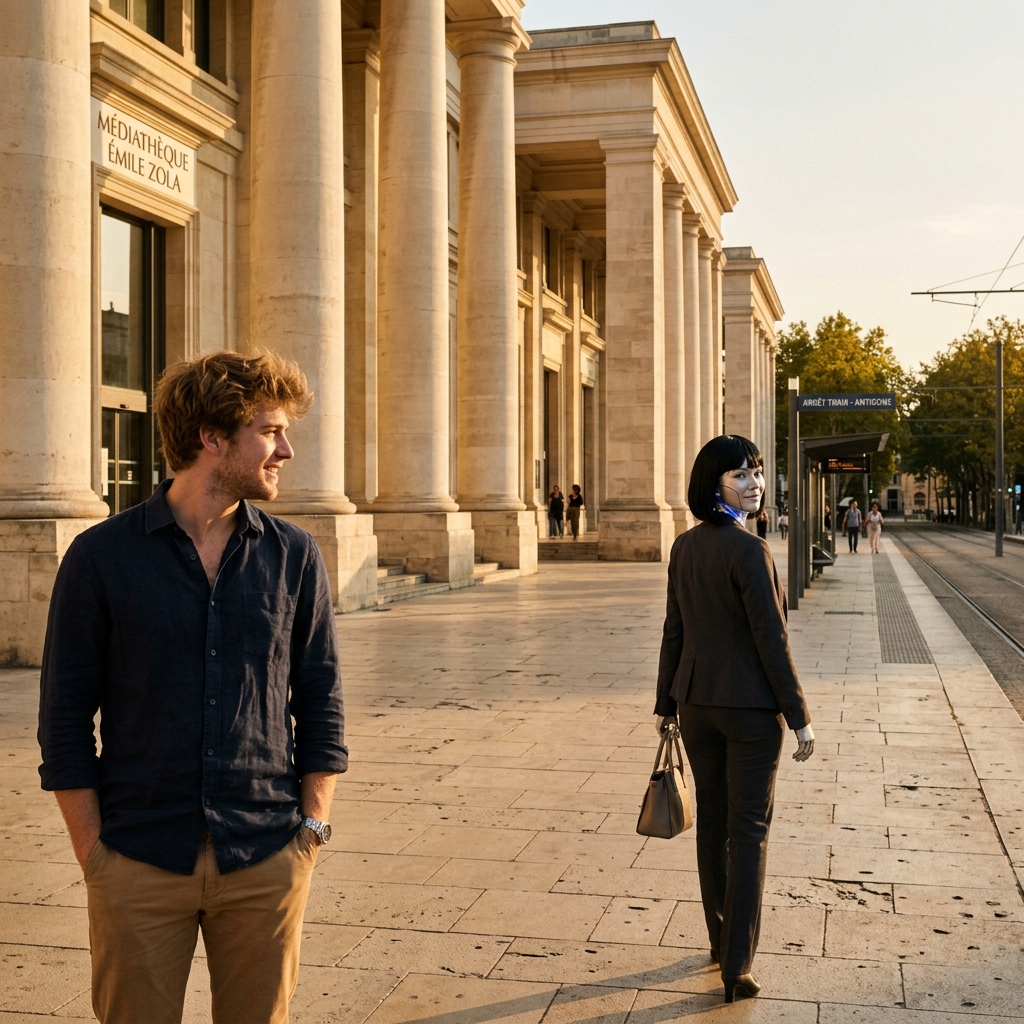
The bonjour experiment, as Julien had privately come to think of it, produced mixed results.
The successes were small and unremarkable to everyone except him. The woman at the tabac where he bought his weekly transit pass — he said it before she could say anything, bonjour, with the slight weight on the second syllable the way Lumière had shown him, and she said it back without looking up from her drawer, the exchange so ordinary and automatic that it was clear she had not registered anything unusual about it. Which was, he realized walking out, exactly the point. He had entered the room. He had existed in it in the correct way. The transaction had a different quality than the ones before it, a small, invisible seam of normalcy where previously there had been a kind of static.
He tried it at the boulangerie the next morning and the young man behind the counter said bonjour back with a warmth that felt disproportionate to the word, as though he had been waiting all morning for someone to observe the basic social contract and was genuinely relieved that someone finally had. Julien pointed at a pain au chocolat. The young man said something that was probably a question about anything else and Julien smiled and shook his head and that was the entirety of it, but he ate the pain au chocolat on the street in the September warmth and felt, obscurely, that he had earned it.
The failure came on Wednesday.
He had gone into a pharmacy — his toothpaste was running out, a problem he had been postponing with the specific irrationality of someone who finds the logistics of a foreign country exhausting even at the level of toiletries — and had approached the counter with his bonjour prepared and delivered it cleanly, he thought, with reasonable confidence. The pharmacist, a brisk woman in her fifties with reading glasses pushed up into her hair, had responded with a bonjour and then immediately, without pause, produced a sentence of such fluent and efficient French that Julien had stood there with his mouth open like a man who has knocked on a door and been entirely unprepared for it to open.
He had pointed, eventually, at his own teeth. The pharmacist had looked at him for a moment with an expression that managed to be simultaneously professional and deeply tired, and had produced toothpaste from behind the counter without further comment.
He had said merci on the way out, which was something. She had said bonne journée — good day, he guessed, a variation he hadn't learned yet — and he had nodded and left, which was not nothing, but was also not a triumph.
He told himself this was data rather than defeat. He was not entirely convinced.
On Friday evening, sitting with his third attempt at cooking something approximating dinner in the small kitchen of his sublet — the kitchen was equipped with the particular optimism of a space designed for someone who cooks more than its owner actually did, a full set of copper-bottomed pans and precisely zero English on any of the ingredient packaging — he picked up his phone.
He had fourteen unread messages. He had been aware of them the way you are aware of weather through a window: present, external, not currently your problem.
He opened one.
It was from his sister, Claire, sent nine days ago. It said, in the direct way that Claire said most things: I'm not angry. I'm worried. There's a difference. Call me when you're ready but don't make me wait too long.
He read it twice.
He put the phone face-down on the counter and stood there for a moment with the wooden spoon in his hand and the onions beginning to catch at the bottom of the pan. He turned the heat down. He did not call Claire. He was not ready, which she had apparently anticipated, and which made him feel simultaneously understood and ashamed, two sensations that in his experience tended to arrive together.
He ate dinner standing at the kitchen counter, looking out the small window at the narrow street below, where a cat was conducting a thorough investigation of something near the wall with the focused intensity of a detective who has already decided who did it and is simply building the case.
I'm not angry. I'm worried.
He washed the pan. He went to bed.
The following Thursday found him at the Médiathèque Émile Zola again, climbing the stairs to the second level with the slight familiarity of someone returning to a place a second time, which is enough to feel the difference between arrival and return. Room seven was available. He had booked it himself this time.
Lumière was already there, as she had been the first time, sitting with the same deliberate quality that made the act of waiting look like something she had chosen rather than something happening to her. There was a small addition to the table today: alongside her tablet, a single printed card, face-down.
"Bonjour," Julien said, in the doorway.
"Bonjour," she said. "Comment allez-vous?"
"Je vais bien, merci. Et vous?"
"Très bien, merci." A small adjustment to his answer, offered without comment, the word très — very — slipping in as a natural elaboration. He noted it. She continued: "You've been practicing."
"I've been saying bonjour to people," he said, sitting down. "With variable success."
"Tell me."
He told her about the tabac, the boulangerie, the pharmacist. She listened with complete attention, the sapphire light at her neck holding its steady rhythm. When he finished she was quiet for a moment, and then she said: "The pharmacist was not a failure."
"I pointed at my own teeth."
"You said bonjour. You said merci. You received what you needed. Communication occurred." She tilted her head slightly. "Failure would have been not going in at all."
He considered this. "That was also an option I entertained."
"I know," she said. "Most people do, in the early stages. The temptation to wait until you are fluent before speaking is very strong, and very counterproductive. A language is not a subject you study until you are ready and then deploy. It is something you grow inside yourself through use, through error, through the repeated small embarrassments of being a beginner in public." She paused. "The pharmacist has seen a thousand tourists point at their teeth. You are not her most interesting customer. You are also not her least."
"That's a surprisingly comforting thought."
"Comfort was the intention," she said, without irony.
She reached across the table and turned over the printed card. On it were two columns of words, French on the left, English on the right, with a single header at the top: Le ou La?
"Today," she said, "we are going to talk about the world."
"In English," Lumière began, "a thing is a thing. The book. The table. The door. The word the does not change regardless of what it precedes. It is neutral. Indifferent." She let this sit for a moment. "French does not share this indifference. In French, every noun in the world — every single object, concept, and idea that can be named — has been assigned a gender. Masculine or feminine. Le or la."
Julien looked at the card. "Le livre," he read. "The book. Masculine."
"La table," she said. "The table. Feminine."
"Why?"
"This," she said, "is the question every student of French asks, and the answer is both simple and deeply unsatisfying: history. The genders of French nouns descend from Latin, which itself inherited them from Proto-Indo-European roots that are several thousand years old. In some cases there is a traceable logic. In most cases, from the perspective of a modern speaker, there is simply the assignment, standing there in the language like a piece of furniture that has always been in the room. You did not put it there. You learn to move around it."
Julien looked at the card again. "Le soleil," he read. "The sun. Masculine. La lune. The moon. Feminine."
"The Romans gave the sun to Sol, a masculine deity, and the moon to Luna, a feminine one. This is how the assignment traveled." She watched him absorb this. "Other languages made different choices. In German, the sun is feminine and the moon is masculine. In Spanish, as in French, the sun is masculine. The world does not have a single agreed-upon gender. Each language decided for itself, a long time ago, and the decision has been carried forward by every speaker since, without renegotiation."
"So every time I learn a French word," Julien said slowly, "I have to learn its gender at the same time."
"Always," she said. "You cannot separate them. The gender is part of the word in French the way the pronunciation is part of the word. Le livre is not livre plus a separate fact about gender — it is le livre, one thing, learned whole." She looked at him carefully. "This frustrates most students initially."
"It seems like an enormous amount of inherited information to carry."
Something shifted in her expression — not quite the precursor to a smile this time, but something adjacent to it, a quality of recognition. "Yes," she said. "It is exactly that. Every noun arrives with its history attached. You do not get to assign it yourself. You receive it as it is, and you learn to carry it."
Julien was quiet for a moment, looking at the card. Le livre. La table. Le soleil. La lune. The world sorted into two categories by a civilization that no longer existed, the sorting persisting across millennia and arriving here, in a study room in Montpellier, at a table between a man named Julien Marchand and an android who was teaching him to speak.
He thought about his name. The Frenchness of it, inherited from a grandfather he had never met, a Québécois who had moved to Ontario and whose name had come down through the family like a piece of furniture in a room Julien had not chosen to live in. Julien Marchand. He had not picked it. He had learned to move around it.
He did not say any of this aloud.
"Le or la," he said instead. "How do I know which one to use if I don't know the word's history?"
"You learn them together," she said. "Always learn the article with the noun. Not livre — le livre. Not table — la table. If you learn the word alone, you will have to relearn it later with its gender, which is twice the work. Learn it whole the first time."
"And if I get it wrong?"
"You will be understood," she said. "A masculine article on a feminine noun will not prevent communication. But it will mark you as someone still learning, the way a slight accent marks a speaker as someone who arrived at a language from elsewhere." She paused. "This is not a criticism. It is simply what it is. You come from elsewhere. The language will show this, for a while."
"For a while," he said.
"For a while," she confirmed.
He looked at the card again, and she walked him through it: le before masculine nouns beginning with a consonant, la before feminine nouns beginning with a consonant, and then — the first complication, delivered with the calm of someone who has decided not to apologize for the language's particularities — l' before any noun beginning with a vowel or silent h, regardless of gender, the apostrophe swallowing the article's final vowel in a process called elision.
"So l'ami," Julien said. "The friend. I can't tell from the article alone whether it's masculine or feminine?"
"Not from the article alone, no. Context usually clarifies. But this is why learning the gender with the word matters — un ami is a male friend, une amie is a female friend, and the indefinite articles un and une preserve the distinction that l' erases." She turned the card over to reveal its other side, which he hadn't seen: un and une in their various forms, and beneath them, a short list of nouns for him to practice with. "Un book" — she corrected: "un book" was not right — "un book" $\rightarrow$ "un livre," she said. "A book. Masculine. Une table. A table. Feminine."
"Un and une are the French a and an," he said.
"Yes. Indefinite articles — used when referring to something nonspecific, something the listener doesn't yet know about. I have a book — I have one book, any book, a book in general. J'ai un livre. Once the book is known, established in the conversation, it becomes le livre. The indefinite becomes definite. The general becomes specific."
"Like meeting someone," Julien said, without entirely meaning to say it. "First they're a person. Then they become the person."
Lumière looked at him. The sapphire light at her neck held its rhythm, and for a moment she did not say anything, and the quality of her silence was the kind that indicates genuine consideration rather than the mere absence of speech.
"That is," she said finally, "a very good way to think about it."
He looked out the window. The Antigone columns stood in their afternoon positions, that elaborate inheritance of invented antiquity, carrying their assigned history without complaint.
"Le monde," he said. The world. Masculine. "La vie." He had seen this one on the card and it had stayed with him. Life. Feminine.
"La vie," she confirmed.
"Life is feminine in French."
"It is."
"And la mort," he said, having found it near the bottom of the card. Death. Also feminine.
"Also feminine," she said. "Life and death, in French, share a gender. They are, grammatically speaking, the same kind of thing."
He sat with this for a moment in the particular way that certain pieces of information require: not analyzing, just holding.
"French is strange," he said.
"French is precise," she said. "The strangeness is often just precision arriving from an unexpected direction."
They worked through the card methodically — not drilling, exactly, which would have made it feel like a test, but circling, Lumière offering words and their genders and the occasional history of why, Julien repeating and asking and occasionally guessing wrong and being corrected with the same tone she used for everything: even, specific, without the slight inflation of praise or the slight deflation of error that less careful teachers allow into their voices. He found he could work inside this tone. It did not require him to perform either confidence or humility, only attention.
Near the end of the hour she said: "One more thing. The plural."
"Les," he said, because he had noticed it on the card and inferred.
She looked at him with the brightness in her eyes that he was beginning to associate with being surprised in a way she found agreeable. "Les," she confirmed. "In the plural, the distinction between le and la disappears entirely. Everything becomes les. The masculine and the feminine, the assigned genders of a thousand years, collapse into a single article when there is more than one of a thing."
"So the plurality erases the difference."
"Grammatically, yes. When things multiply, they become the same kind of thing." She closed the tablet. "This is not a metaphor I am making. It is simply grammar. But you are welcome to make the metaphor yourself, if you find it useful."
He did find it useful. He suspected she knew this.
Outside, the afternoon had developed the particular golden authority of a September day that knows it is among the last of its kind. The tram chimed at the Place de l'Europe stop a hundred metres away. They stood on the pavement in front of the médiathèque, in the long shadow of the Antigone district's columns, with the slightly suspended quality of two people whose shared context has just ended and who are recalibrating to the larger world.
"Same time next week?" Julien said.
"I will book the room," Lumière said.
He nodded. He looked at the columns for a moment — all that inherited architecture, standing in its assigned positions, carrying its history into a century that hadn't asked for it and had learned to coexist with it anyway.
"Le monde a un genre," he said. The world has a gender. He had constructed the sentence himself, from the pieces she had given him, and he felt the small distinct satisfaction of a thing built rather than borrowed.
Lumière regarded him with the quality of attention that had, over the course of two lessons, begun to feel less like observation and more like recognition. "It does," she said. "Several of them, depending on the language."
She said au revoir first. He said it back, and meant it in the way that the French word actually meant it: until the seeing again. Not goodbye. Not an ending. A return, already implied in the leaving.
He watched her walk toward the tram stop with the unhurried certainty of someone who has decided where they are going and found no reason to rush the getting there. The sapphire light at her neck caught the afternoon sun for a moment as she turned, a brief pulse of blue in all that gold, and then she was around the corner and gone.
He stood there a moment longer than was necessary.
Then he put his hands in his pockets, and turned, and walked back into the old quarter through streets that were becoming, slowly and without his permission, familiar.
Le livre. La table. Le soleil. La lune. La vie. La mort. Les amis.
The world sorted into its inherited categories, carrying its history forward, waiting to be learned whole.
End of Chapter 2
© 2026 William Newell. All rights reserved.
Le Choix d'Être (The Choice to Be) is an original literary work protected by copyright. No part of this novel may be reproduced, copied, distributed, translated, or transmitted in any form or by any means — electronic, mechanical, or otherwise — without the prior written permission of the author. Unauthorized use constitutes copyright infringement and may result in legal action.
For permissions and licensing inquiries, contact: JoeNewell68@gmail.com