The First Door
The lesson was scheduled for Thursday at two o'clock in the afternoon, which gave Julien four days to think about what he had agreed to.
He used them poorly.
He walked, mostly. Montpellier rewards walking if you are willing to accept that you will get lost, and Julien had by now reached a grudging peace with lostness as a mode of transport. He learned the city the way you learn a face — not by studying it systematically but by spending time near it, letting the features arrange themselves into something familiar through sheer accumulated exposure. The old quarter's tangle of streets, each one narrowing without warning into something that was arguably a passageway rather than a road. The sudden expansions into small squares with their fountains and their café terraces and their pigeons conducting business with great seriousness. The way the city kept producing, around unlikely corners, small eruptions of beauty — a carved doorway, a burst of bougainvillea over whitewashed stone, a medieval tower standing in improbable good health beside a glass-fronted building that could only exist in the twenty-first century.
He did not write any of it down. The notebook remained blank. He told himself he was still gathering, which was the thing people told themselves when they were avoiding the page.
He thought about what Lumière had said, the French phrase she had offered him at the end of their first meeting like something held out in an open palm. He could not reproduce the sounds of it. He could not have spelled it. But the cadence of it had lodged somewhere in him, the rhythm of a sentence whose meaning he didn't possess but whose weight he had somehow felt anyway. He thought about this more than he intended to.
He also thought about the shoes.
He had heard this, and understood it, and left anyway. He was aware that this was not a point in his favor. He was also aware, in the way that people are aware of things they have decided not to examine too closely, that coming to Montpellier was not the same as stopping. He had simply run in a direction that required a passport.
The left heel of his shoe continued to separate. He noticed it each morning when he put them on, and each morning he did not think about buying new ones, because buying new shoes would constitute an acknowledgment that he was staying, and he was not yet ready to acknowledge anything of the kind.
On Thursday, at half past one, he took the tram.
The Médiathèque centrale Émile Zola announced itself from a distance through sheer scale before anything else. It sat at the edge of the Antigone district, which was itself an experience Julien had not been prepared for: an entire quarter of the city conceived in the 1980s by the architect Ricardo Bofill as a kind of neoclassical fantasy, all columns and pediments and grand axial perspectives in pale stone, as though someone had set out to build ancient Rome and arrived, through some interesting detour, at something that was thoroughly modern while refusing to admit it. The médiathèque occupied its own position at the border between Antigone and the newer Port Marianne district beyond, a building that wore its ambition plainly, five levels of it, the kind of public institution that communicated through its proportions alone that books and the people who came for them were considered serious business in this city.
Julien stood outside it for a moment longer than was strictly necessary.
Inside, the ground floor opened into a news forum where current periodicals from what seemed like every country with a printing press were arranged on low displays: papers in French and Arabic and English and a dozen other languages he couldn't identify, their headlines asserting the world's ongoing dramas with the mild authority of things in print. A few people sat reading with the focused stillness of those who have found, for the moment, exactly what they needed. Androids moved through the space alongside human staff, shelving returns and assisting at the information terminals, their various chassis distinguishable from the human librarians at a glance in the way that the law required.
He found his way to the study room bookings desk and gave his name. The room had been reserved under Lumière's, which struck him as efficient and also as slightly unsettling — the implication that she had thought through the logistics of this more carefully than he had.
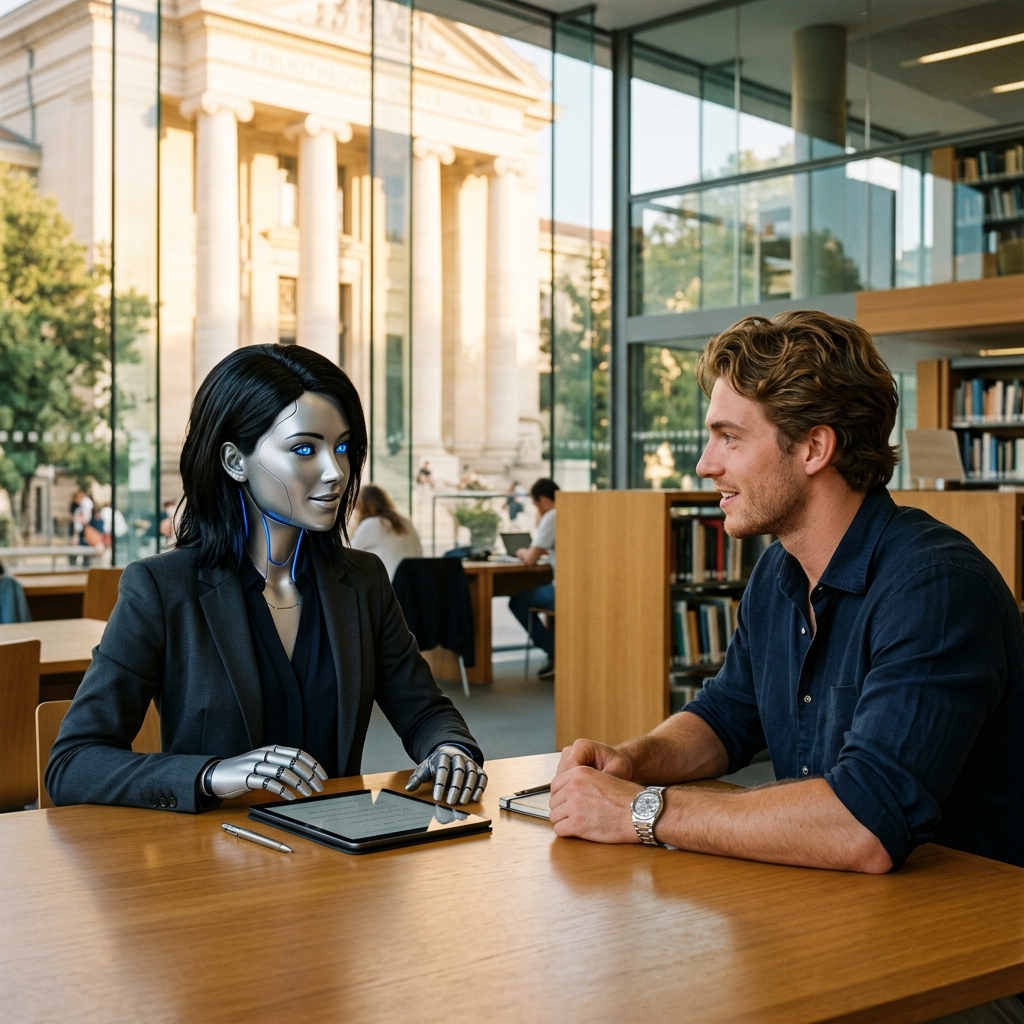
Room seven was on the second level, up a staircase and through a set of glass doors that hushed the ambient sounds of the building to something more concentrated: the occasional soft percussion of a keyboard, someone turning pages, the particular quality of silence that gathers in places where people have agreed to be quiet together. The study rooms lined the inner wall, each with a glass panel giving onto the corridor so that the solitude inside was visible rather than absolute. Room seven held a rectangular table for four, four chairs, a wall screen for projections, and a window that looked outward over the Antigone district — all those columns and stone pediments settling into the afternoon light with the satisfaction of things that have decided what they are.
Lumière was already there.
She sat with a deliberateness that made the act of sitting look considered rather than incidental, her back to the window, a slim tablet on the table in front of her and nothing else. She had dressed, as she seemed always to dress, in the kind of restrained elegance that wore itself without calling attention to the wearing of it: a deep charcoal jacket, a dark blouse with a collar that sat just high enough to let the light catch the edge of the neck plates without quite concealing them. The sapphire pulse of the seams was quieter indoors, a gentler rhythm, like something resting.
She looked up when he pushed open the door.
"You found it," she said.
"Eventually." He pulled out the chair across from her and sat, dropping his bag beside it. "I went to the wrong building first."
"Which one?"
"One that turned out to be a government office of some kind. A man gave me a very long explanation in French."
"Did you understand any of it?"
"No. But I nodded at what seemed like appropriate intervals."
Something in her expression shifted — not quite a smile, but the precursor to one, the thing that happens in a face before it decides. "That," she said, "is actually a legitimate survival strategy. We can discuss it more formally later. It has a name."
"The nodding strategy has a name?"
"Active listening," she said. "Though yours sounds more like active pretending." She considered him for a moment. "Are you ready?"
Julien looked at the blank table between them, the clean rectangle of it, the same quality of waiting that his notebook had. "I don't know what ready would feel like," he said, "for learning a language from scratch."
"Probably not unlike this," she said. "A little uncertain. Slightly embarrassed in advance."
"That's accurate."
She placed her hands flat on the table — a gesture that seemed to mark a beginning, the way a conductor's raised baton marks the moment before sound. "Then we start," she said. "With the most important word in French."
He waited.
"Bonjour," she said.
She said it as the French say it — not the flattened, two-equal-syllable version that anglophone ears tend to produce, but with the slight weight on the second syllable, the jour opening and settling like a door swinging gently on good hinges. Bon-JOUR. And within the word itself, if you listened for it, the thing it actually meant: good day. Not hello, not hi, not the phatic placeholder that greetings become in any language after enough use. Good day. A small daily wish, offered as a matter of social contract to whoever you encountered.
"Bonjour," Julien said.
Lumière was quiet for a moment. Not the silence of criticism, but of attention.
"Say it again," she said.
He did.
"Your second syllable is flattening," she said. "You are saying bonjour the way an English speaker reads it on a page. But the word lives in the mouth differently. The jour wants to open." She said it again, and this time he noticed what her jaw did, a very slight drop on the second syllable, as though the word required a small additional space to exist in. "It is not jaw, like in English," she continued. "It is more forward. More in the lips."
He tried again. It was better. Not good, but better.
"Good," she said, which he suspected was generous.
"Is that really the most important word?"
"It is the word that opens every door in France," she said. "Walk into a shop without saying it and you will find the staff very busy with other things. Say it and suddenly you exist in the room." She tilted her head slightly, the neck plates making their small adjustment. "France has an entire philosophy contained in this word. The acknowledgment of another person's presence is not optional here. It is not a nicety. It is the minimum condition for a civil exchange."
Julien thought about the number of shops he had entered in the past two weeks, preoccupied with the mechanics of pointing at what he needed and calculating whether his card would be accepted at a given terminal. He had not said bonjour to anyone. He had simply appeared in spaces and attempted to accomplish transactions.
"I've been very rude," he said.
"You have been unaware," she said, which was a distinction she seemed to consider important. "Rudeness requires intention. You have simply been a person who did not yet know the rules of the place." She paused. "Though from tomorrow, you will know this one."
He nodded. Then, because it seemed the obvious question: "Bonsoir?"
She looked at him with what he would come to recognize as a specific quality of attention — the slight brightening of the sapphire in her eyes that accompanied something she had not expected. "You know bonsoir?"
"It seems like it should exist," he said. "If bonjour is good day, then good evening would be..."
"Bonsoir," she confirmed. "Bon means good. Jour means day. Soir means evening." She said it: bonsoir. Where bonjour opened on its second syllable, bonsoir settled, the soir closing like a door at the end of something rather than the beginning. "You use bonjour from the morning until the early afternoon. Then bonsoir takes over. There is no precise moment of transition — it is a matter of feeling, of light, of the way the day has begun to change its quality."
"That's very French," he said.
"Most things about French are," she agreed, without irony.
He tried bonsoir. It came more easily than bonjour had, which Lumière observed without commenting on directly, though he noticed the slight settling of her expression that seemed to be her version of satisfaction.
"And goodbye?"
"Au revoir," she said. "Literally: until the seeing again. Until we see each other again." She let him sit with this for a moment. "The French do not say goodbye the way English speakers do. Au revoir always implies a return. There is a word for a goodbye without return — adieu — but you use it very rarely, and carefully, because it carries weight. It means something closer to: I am leaving you to God. You say it when you mean it."
Julien was quiet for a moment.
He thought, without intending to, about the last conversation he'd had before leaving Montreal. The things said in it. The things that had been, in some sense, the opposite of au revoir — not a parting that implied return, but one that had felt like an ending dressed in words that were still pretending otherwise. He had not said adieu. He had said something ordinary and insufficient and then left while it was still dark.
"That's a meaningful distinction," he said, carefully.
"Yes," Lumière said. She was watching him with the quality of attention that did not demand anything of what it observed. "Languages carry the values of the cultures that made them. In English, goodbye is from 'God be with you,' which has been worn down through centuries of use until the meaning is almost entirely gone. In French, the farewell still knows what it is."
Outside the window, the Antigone district continued its afternoon, those improbable columns standing in the September light. A tram chimed somewhere below, going somewhere with its customary indifference.
"Bonjour, bonsoir, au revoir," Julien said, mostly to himself. Three words. The grammar of encounter and departure.
"And one more," Lumière said. "The response to bonjour."
He looked at her.
"When someone greets you," she said, "you do not only say the word back, though that is acceptable. In France, you ask. You say: Bonjour, comment allez-vous? Which means: Hello, how are you? Or, more precisely: Hello, how do you go?" She said it at natural speed, the syllables flowing into one another with the liquid ease of someone for whom this was not a phrase but a single unit of social breath. "The vous is formal," she added. "We will discuss the difference between formal and informal address in time. For now, know that with strangers, with people you do not know well, you use vous. It is a form of respect. A small distance that is actually a kind of courtesy."
"How do you go," he repeated. "Not how are you. How do you go."
"The French conception of wellbeing is more active than the English one," she said. "It is not a state you are in. It is a direction you are moving."
He looked at her. "Is that a linguistic observation or a philosophical one?"
The precursor to the smile again. "In French, they are often the same thing."
He repeated the phrase three times, working through the sounds: the comment with its "sometimes" silent t, the allez with its emphasis on the second syllable, the vous closing the whole thing like a small, polite bow. She corrected him twice, gently, with a precision that did not make him feel corrected so much as guided — the difference, he was beginning to understand, between a teacher who knows the destination and one who simply knows the road.
"And the answer?" he asked.
"Je vais bien, merci," she said. "I go well, thank you. Or, if you want to be more casual about it: Ça va bien. It goes well."
"Ça va bien," he tried.
"Ça va," she said. "On its own, this is also used as a question. Ça va? — Is it going? Are you alright? It is the informal version of comment allez-vous, the kind of thing you say to someone you know, someone your own age, someone you have already decided deserves the shorter distance."
"Which one would you use," he asked, "with me?"
She considered him for a moment, the sapphire light at her neck holding its steady rhythm. "Today," she said, "comment allez-vous. We do not know each other yet."
"Fair," he said.
"But ask me again," she said, "in a few weeks."
He was not sure why this landed the way it did — a small, quiet thing, an ordinary conditional about language — but something in him registered it as a kind of promise. That there would be a few weeks. That they would, by then, have moved from vous to something shorter, something that implied the smaller distance.
"Bonjour," he said. "Comment allez-vous?"
"Je vais bien, merci, et vous?" Lumière said.
He blinked.
"And you?" she translated, gently. "Et vous? When someone asks how you are, you ask them in return. This is also required. France is not only about the greeting. It is about the exchange."
"Et vous," he repeated.
"Good," she said. And then, because apparently the lesson had decided this was the right moment: "Your name."
"My name?"
"In French, to introduce yourself, you say: Je m'appelle. It means: I call myself. Not 'my name is' — I call myself." She paused to let this land. "In English, your name is a fact about you, a label attached. In French, it is something you perform, something you actively call into being each time you say it. Je m'appelle Lumière. I call myself Lumière."
He thought about his name. Julien Marchand. He had always lived slightly ironically inside it, the Frenchness of it sitting at odds with everything else about him. But I call myself Julien — there was something in that framing that felt different. Less inherited. More chosen.
"Je m'appelle Julien," he said.
"Good," she said. "And to ask someone their name: Comment vous appelez-vous? How do you call yourself?"
"Comment vous appelez-vous," he tried.
"Notice what comment allez-vous and comment vous appelez-vous share," she said. "comment allez-vous. comment vous appelez-vous. Both begin with comment — how. Both use vous — the formal you. You have only just learned these words, and already you are using the same tools in two different ways. This is how a language builds itself in you, not as isolated pieces but as patterns that return in new forms."
He had not noticed this. He noticed it now, the echo between the two phrases, the way the language was already beginning to reveal its internal logic, the way any system does when you spend enough time near it. He filed it somewhere.
Outside, the light had shifted, the September afternoon beginning its slow negotiation toward evening. Not there yet, but considering it.
"Bonjour," he said, gathering the hour's words like items collected from a surface. "Bonsoir. Au revoir. Comment allez-vous. Je vais bien, merci. Et vous. Je m'appelle Julien. Comment vous appelez-vous."
Lumière listened to all of it.
"Your au revoir is the best of them," she said.
"Why that one?"
She considered. "It sounds like you mean it," she said. "Until the seeing again."
He looked at the window. The columns of Antigone stood in the changing light, patient and slightly absurd and entirely committed to being what they were, all that invented antiquity refusing to apologize for itself.
"Bonsoir," he said, to the room, to the hour.
"Not yet," Lumière said, glancing at the time. "Still bonjour. But close."
He took the tram back toward the old quarter as the light began to make good on its earlier suggestion. The city was shifting into its evening register: different people on the streets now, different quality of purpose to the movement. Market stalls breaking down. Restaurant terraces setting out their dinner configurations, small adjustments of furniture with the practiced efficiency of things done daily. The tram slid through all of it, its chime marking intersections, and Julien sat with his bag on his lap and said the words quietly to himself, feeling their shapes in his mouth like new objects he was learning to carry.
Bonjour. Bonsoir. Au revoir.
Comment allez-vous. Je vais bien, merci. Et vous.
Je m'appelle Julien.
At his stop, he stepped off the tram into an evening that had finally decided to commit to itself, the warmth of the day still present in the stones underfoot but the light gone amber and long, the sky doing the thing Mediterranean skies do in September when they are showing off. He walked the four minutes to his sublet through the narrow streets that no longer confused him as much as they had a week ago, that were beginning to arrange themselves into a map he could feel rather than consult.
At the door of his building, he passed his downstairs neighbor, a small elderly woman named — so her mailbox told him — Madame Aubert, who was wrestling a paper bag of groceries with the focused irritation of someone who had expected it to be lighter.
He stopped.
"Bonsoir," he said.
She looked up. A brief assessment, the kind that takes in a stranger in under a second and arrives at a verdict. Then: "Bonsoir," she said, and continued inside.
A small thing. An ordinary thing. The minimum condition for a civil exchange.
He stood in the doorway for a moment after she had gone, in the amber evening with the warm stones and the smell of the city settling into itself, and felt, for reasons he did not examine, something loosening.
One word. One door, opening.
Bonsoir.
End of Chapter 1
© 2026 William Newell. All rights reserved.
Le Choix d'Être (The Choice to Be) is an original literary work protected by copyright. No part of this novel may be reproduced, copied, distributed, translated, or transmitted in any form or by any means — electronic, mechanical, or otherwise — without the prior written permission of the author. Unauthorized use constitutes copyright infringement and may result in legal action.
For permissions and licensing inquiries, contact: JoeNewell68@gmail.com