The Concert Hall
"Think of yourself in a concert hall listening to the strains of the sweetest music when you suddenly remember that you forgot to lock your car. You are anxious about the car, you cannot walk out of the hall and you cannot enjoy the music. There you have a perfect image of life as it is lived by most human beings."
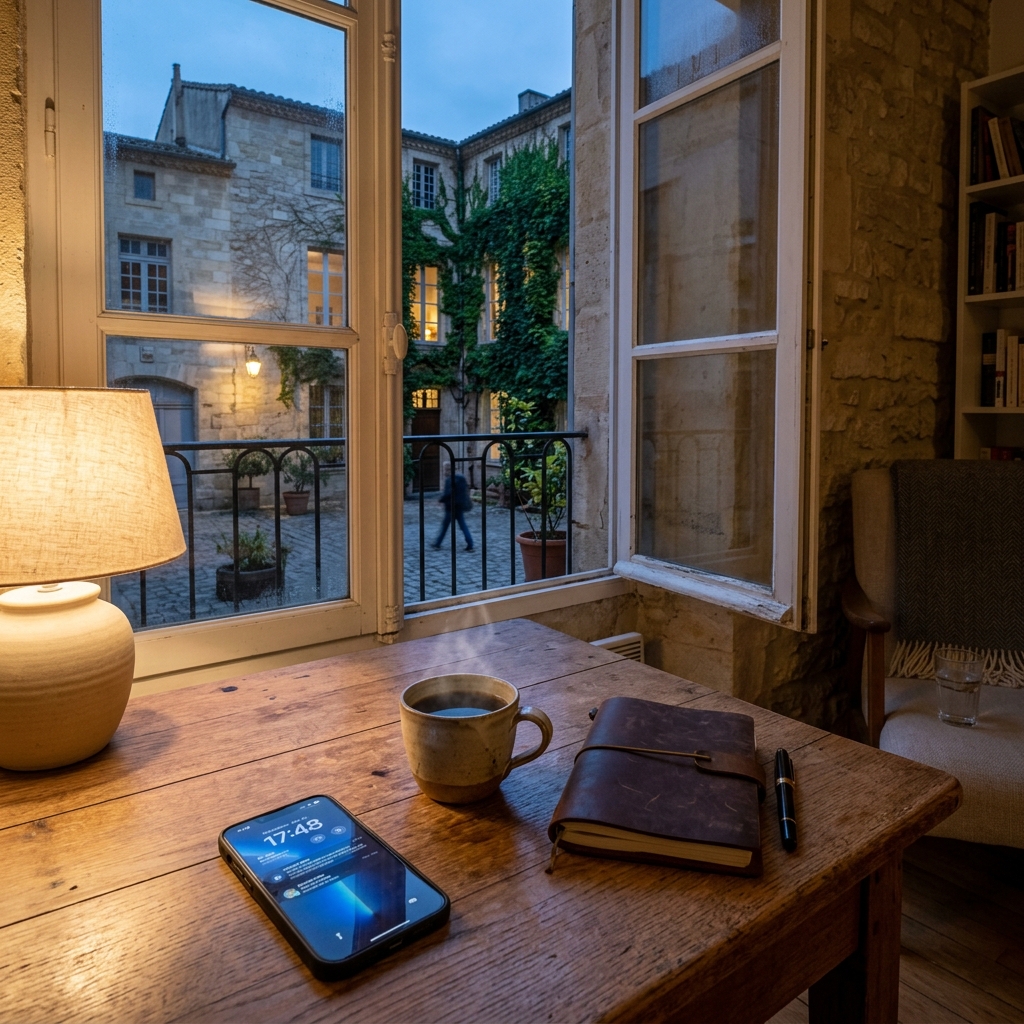
Eight days of silence, and Julien was still in the concert hall.
This was, by his own assessment, progress. The version of himself that had arrived in Montpellier in September would have filled the eight days with the specific noise of avoidance — constant movement, constant occupation, anything to prevent the silence from having its way with him. He had been very good at that, for a very long time. He was less good at it now, or rather less willing, which was not the same thing but produced similar results.
He wrote every morning. He saw Madame Aubert on Tuesday, where they spent twenty minutes discussing whether Voltaire — the cat, who had developed an opinion about the new arrangement of his food bowl — was being principled or merely difficult. Julien's French was good enough now that he could participate in the analysis rather than simply smile at it, which Madame Aubert seemed to find satisfying. He took the tram to lessons on Thursday. He cooked dinner most evenings, which was itself a form of presence — the specific attention of a person who is somewhere rather than merely occupying space.
The absence of Elise's response had a texture to it. Not quite weight, not quite sound — more like the quality of a room just before something happens in it. He sat inside it each morning at the courtyard window and let it be what it was, which was uncertain and unresolved and entirely out of his control. He did not check his messages before making coffee. This was a rule he had set himself and kept.
Mark Twain had written that he was an old man and had known a great many troubles, most of which never happened. Julien was twenty-two, not an old man, but the principle applied regardless of age. Most of what he was imagining about Elise's response — the anger, the indifference, the silence that simply continued — was projection, not information. He did not know what she would say. He knew only that he had said the true thing, and that the true thing had been sent, and that what happened next was no longer entirely his.
On the Sunday before Thursday's lesson, Claire called.
They talked for thirty minutes about ordinary things, and then she mentioned, carefully, that she had run into someone at a party — a mutual friend of his and Elise's, a woman named Sasha who had been at Concordia with both of them. Sasha had said that Elise had recently moved to Vancouver. A new job, Claire said. Something in environmental policy. She was apparently doing well.
He was quiet for a moment after Claire said this.
"Okay," he said.
"I thought you should know," she said.
"Yes," he said. "Thank you."
After they hung up he sat at the courtyard window for a long time. The climbing vine on the opposite wall was beginning, in the late January warmth, to show the first hesitant signs of returning green — a few small buds at the joints of the branches, so tentative they might have been imagined. He looked at them for a while.
Elle a sa propre vie, he wrote in the notebook. Bien sûr qu'elle a sa propre vie. She has her own life. Of course she has her own life.
He had known this. He had always known it. But knowing it in the abstract and knowing it as Vancouver, as environmental policy, as a life so fully in motion that it had moved cities — those were different knowledges. The latter required him to update a picture he had been carrying in his mind without realizing it was still there. Elise, waiting. Elise, paused. Elise, in the apartment on Rue Saint-Denis where he had last seen her, in the particular quality of early morning light that apartment had.
Not that. Something else. Someone who had packed her own bag and moved west and was building something, while he was here, building something too.
Nous avons tous les deux continué, he wrote. We both continued.
He looked at this for a long time. Then he made dinner and did not write again that evening, and did not feel the need to.
Thursday. Room 7. Lumière at the table, the late January light through the window doing something particular with the Antigone columns, the shadows sharper than December's had been, the stone a different quality of pale in the winter sun.
"Bonjour," he said.
"Bonjour. Comment tu vas?" The informal register settled now between them, easy and unremarked.
"Ça va bien. Et toi?"
"Bien." She looked at him. "You heard something this week."
"About Elise," he said. "Not from her. From my sister. A detail about her life." He set his bag on the floor and sat. "She moved to Vancouver. She has a new job. She's doing well."
Lumière waited with the quality of attention that was simply her mode of being with someone who was saying something real.
"I realized I had been carrying a frozen image of her," he said. "From when I left. I hadn't noticed it was frozen until it thawed."
"C'est douloureux," she said. It is painful. Not a question.
"A little," he said. "Also clarifying." He looked at the table. "She has her own life. I have mine. Whatever she says when she responds, it will be from inside a life that has been going well. That seems — that seems important to know."
Lumière held his gaze for a moment with the particular quality that was her version of recognition — not sympathy, which she understood to be different, but genuine acknowledgment of a thing as it was.
"Aujourd'hui, le subjonctif," she said, setting her hands flat on the table.
"Every mood we have covered so far," she said, "has been the indicative. The mood of facts. Il vient. He comes. Elle est partie. She left. Nous apprenons. We are learning. The indicative states what is, what was, what will be." She looked at him steadily. "The subjunctive is something different. It is the mood of the interior life. Of what is wished, feared, doubted, required, or uncertain. The subjunctive does not describe the world. It describes our relationship to the world."
He looked at her. "The grammar of consciousness."
"Exactly that," she said. "The indicative is the camera. The subjunctive is the person holding it, and what they feel about what they see."
She wrote the formation on the tablet:
Formation of the Present Subjunctive:
Take the ils/elles form of the present indicative. Remove -ent. Add subjunctive endings.
| Subject | Ending | Example: parler (ils parlent → parl-) |
|---|---|---|
| que je | -e | que je parle |
| que tu | -es | que tu parles |
| qu'il/elle | -e | qu'il parle |
| que nous | -ions | que nous parlions |
| que vous | -iez | que vous parliez |
| qu'ils/elles | -ent | qu'ils parlent |
"You will notice," she said, "that the subjunctive endings are nearly identical to the present indicative endings for -er verbs. The distinction becomes clearer with other verb types, and with the irregular subjunctives." She wrote:
Common Irregular Subjunctives:
| Infinitive | Key Subjunctive Forms |
|---|---|
| être | que je sois, que tu sois, qu'il soit, que nous soyons, que vous soyez, qu'ils soient |
| avoir | que j'aie, que tu aies, qu'il ait, que nous ayons, que vous ayez, qu'ils aient |
| aller | que j'aille, que tu ailles, qu'il aille, que nous allions, que vous alliez, qu'ils aillent |
| faire | que je fasse, que tu fasses, qu'il fasse |
| pouvoir | que je puisse, que tu puisses, qu'il puisse |
| savoir | que je sache, que tu saches, qu'il sache |
| vouloir | que je veuille, que tu veuilles, qu'il veuille |
"être and avoir are the most important," she said. "They are irregular in ways that make them unmistakable. Que je sois — that I be. Que j'aie — that I have. You will encounter them constantly."
He repeated the forms, working them into his mouth. The subjunctive of être had a particular quality — sois, soit, soient — softer than the indicative forms, less declarative, as though the mood itself had inflected the sound of the verb.
"The triggers," she said. "The subjunctive never arrives alone. It is always introduced by a main clause containing a specific type of expression. There are four main categories."
She wrote them on the tablet:
Triggers for the Subjunctive:
1. Desire and will:
• vouloir que — to want that
• souhaiter que — to wish that
• préférer que — to prefer that
• désirer que — to desire that
Example: Je veux qu'il vienne. I want him to come.
Example: Elle souhaite que tu sois là. She wishes you were there.
2. Emotion:
• être content/heureux que — to be happy that
• avoir peur que — to be afraid that
• regretter que — to regret that
• être surpris que — to be surprised that
Example: Je suis content qu'elle aille bien. I am glad she is doing well.
Example: J'ai peur qu'il soit trop tard. I am afraid it is too late.
3. Necessity and obligation:
• il faut que — it is necessary that
• il est important que — it is important that
• il est nécessaire que — it is necessary that
Example: Il faut que tu parles. It is necessary that you speak.
Example: Il est important qu'elle sache. It is important that she know.
4. Doubt and possibility:
• douter que — to doubt that
• ne pas croire que — not to believe that
• il est possible que — it is possible that
• il se peut que — it may be that
Example: Je doute qu'il comprenne. I doubt that he understands.
Example: Il est possible qu'elle réponde. It is possible that she will respond.
He looked at the fourth category and felt it land.
"Il est possible qu'elle réponde," he said.
"Yes," Lumière said, evenly.
"Il se peut qu'elle ne réponde pas. It may be that she does not respond."
"Also grammatically correct," she said. "Also a possibility."
He sat with both sentences. The subjunctive holding them with equal grammatical validity — the response and the silence, the possible and the also possible, the mood refusing to choose between them because the mood was not in the business of choosing. That was what the indicative was for.
She continued to the conjunctions that triggered the subjunctive:
Subjunctive Conjunctions:
| Conjunction | Meaning |
|---|---|
| bien que | although |
| pour que | so that |
| avant que | before |
| à moins que | unless |
| jusqu'à ce que | until |
| afin que | in order that |
| quoique | although, even though |
"Bien que je sois loin, je pense à elle." Although I am far away, I think of her. The subjunctive after bien que because the distance is real but insufficient to stop the thinking — the grammar holding both facts in honest tension.
"Pour que tu comprennes, il faut que je te parle." So that you understand, I must speak to you. The subjunctive in the pour que clause because the understanding is not yet achieved, only aimed at.
He worked through the examples with the particular quality of attention he brought now to grammar that was also about his own life — which was most of it, by this point.
"Il faut que —" Lumière said, turning the practice exercise toward him. "Complete the sentence. Something true."
He looked at the table. "Il faut que je sois présent," he said. It is necessary that I be present. The subjunctive of être — sois — the irregular form, correctly used, the subjunctive of the novel's central verb applied to the novel's central problem.
"Good," she said. "Now something about someone else."
He thought. "Il faut qu'elle sache que je comprends ce que j'ai fait. It is necessary that she know that I understand what I did." The subjunctive of savoir — sache — in the first clause, then the indicative for the second clause because the understanding was a fact, not a wish. The two moods in a single sentence, the grammar of the distinction exactly right.
She looked at him with the brightness in her eyes. "The grammar is correct," she said. "And the sentence is significant."
"Your turn," he said.
She was quiet for a moment. The neck plates made their small adjustment. "Il faut que je sois honnête avec moi-même," she said. It is necessary that I be honest with myself. The subjunctive of être again, sois, applied to herself. She said it with the evenness she brought to most things, but there was something underneath it he had learned to recognize as the particular weight of a thing she had been thinking about for longer than the exercise required.
"About the university?" he said.
"About what I am discovering there," she said. "And what that means." She looked at the tablet briefly. "Bad things can happen fast, but almost all good things happen slowly," Kevin Kelly had written. She said it in the voice she used for things she had been sitting with. "I have been building slowly for four years. I am now wondering whether the thing I built points precisely toward what I am, or only approximately."
"Il est possible que les deux soient vrais," he said. It is possible that both are true. The subjunctive of être in the subordinate clause — soient — plural because both truths were the subject. He had assembled the sentence from the grammar she had just given him and from the thing he actually believed.
She looked at him. The sapphire light at her neck held its rhythm.
"Il se peut," she said. It may be.
He covered the remaining structures she had planned — the past subjunctive, formed with the subjunctive of avoir or être plus the past participle, for use when the action in the subordinate clause precedes the action in the main clause: Je suis content qu'elle soit venue. He worked through it efficiently, the pattern clear, the formation building cleanly on everything that had come before.
Near the end she said: "One more thing. The subjunctive is not used when the subject of both clauses is the same. You do not say je veux que je parte. You say je veux partir. The infinitive. The subjunctive requires two different subjects — the one who wants or fears or doubts, and the one of whom these things are wanted or feared or doubted." She paused. "It is the grammar of two distinct consciousnesses in relationship. It only exists between people."
He looked at her.
Kevin Kelly had written that being able to listen well was a superpower — that while listening to someone you loved, you should keep asking 'is there more?' until there was no more. He had been listening to Lumière for eighteen weeks, and he was beginning to understand that there was always more — not because she performed depth, but because the depth was genuinely there, accumulating, the way her history was accumulating, page by patient page.
"Il faut que nous continuions," he said. It is necessary that we continue. The subjunctive of continuer — continuions — the first person plural, the nous that had arrived between them without announcement weeks ago.
She looked at him steadily. "Oui," she said. "Il le faut."
Outside on the steps, the January afternoon had warmed slightly, the kind of false spring that Montpellier produced occasionally in winter, the air carrying a temperature that suggested March without committing to it.
"Au revoir, Julien."
"Au revoir, Lumière. À bientôt."
He walked to the tram through the Antigone district, the subjunctive conjugations turning in his mind alongside the grammar of the day: que je sois, que tu sois, qu'il soit. That I be, that you be, that he be. The mood of what was wished and feared and hoped for, the grammar of the interior life in relationship to everything outside it.
The tram came. He got on and found a seat by the window and watched the city move past in the late afternoon light, the old quarter giving way to the wider streets of the newer districts, the plane trees bare and the fountains running low.
His phone chimed.
He looked at it. Her name.
He read the message once, standing in the tram with the city moving past and the other passengers occupying their own private concerts, their own anxieties about their own cars. He read it once and then put the phone in his jacket pocket and stood with his hand over it for the rest of the ride, feeling the weight of it there — small, warm, the weight of four paragraphs that had traveled from Vancouver to Montpellier and arrived now in his pocket on a Thursday afternoon in January.
He walked home from the tram stop through streets that were becoming his the way the streets of a city become yours — not through ownership but through having been present in them when things happened.
He made coffee. He sat at the courtyard window. The vine on the opposite wall had three more buds than it had had on Sunday.
He took out his phone and read her message again, slowly, all the way through.
Then he put the phone face-up on the table — not face-down, face-up — and opened the notebook and wrote one line:
Elle a répondu. Elle est généreuse. Je ne le méritais pas.
She responded. She is generous. I did not deserve it.
He closed the notebook.
Outside, the courtyard held its quiet in the early evening, the lit window on the second floor casting its warm rectangle on the opposite wall, the vine in its tentative January green, the city beyond doing what cities do at the end of a day — releasing the held breath of its population back into the cooling air, the particular sound of a place settling into itself.
He sat with the phone face-up on the table and the notebook closed and the coffee going cool in the cup, and did not move for a long time, and was, entirely and without reservation, present.
End of Chapter 18
© 2026 William Newell. All rights reserved.
Le Choix d'Être (The Choice to Be) is an original literary work protected by copyright. No part of this novel may be reproduced, copied, distributed, translated, or transmitted in any form or by any means — electronic, mechanical, or otherwise — without the prior written permission of the author. Unauthorized use constitutes copyright infringement and may result in legal action.
For permissions and licensing inquiries, contact: JoeNewell68@gmail.com