Pour Elise
"Anything real begins with the fiction of what could be. Imagination is therefore the most potent force in the universe, and a skill you can get better at. It's the one skill in life that benefits from ignoring what everyone else knows."
Arsenault's response arrived on a Wednesday morning while Julien was making coffee, which was becoming, without his having planned it, the hour when the significant things arrived.
It was longer than his first email. Arsenault wrote the way he always had — directly, without the social scaffolding that most correspondence required — but there was a warmth in this one that the first had held back, as though Julien's reply had confirmed something Arsenault had been waiting to have confirmed before allowing himself to be warm about it.
He wrote about the work, specifically. Not in the general terms of encouragement but in the particular terms of someone who had been thinking about what Julien had been trying to do for two years and had ideas about why it had not been working. He wrote about the project Julien had described to him in their last real conversation in Montreal, the one that had felt like it was going in circles, and he wrote that the problem, as he saw it, had been that Julien had been writing about the true thing without writing from inside it. The distance, Arsenault said, had been both the subject and the obstacle.
Then, near the end, the sentence that stopped Julien where he stood:
The pages you described sound like the book you were always supposed to be writing. Not the one you planned.
He read it three times. Then he set the phone on the counter beside the cafetière and stood at the courtyard window for a while, the coffee going cold in his cup.
The book he was always supposed to be writing. Not the one he planned.
He had spent two years planning. The plan had been meticulous and had produced forty-one pages and a stopped sentence and a packed bag in the dark. The three pages he had written at the courtyard window, the pages he had not planned at all, were closer to something real than anything the two years had given him.
He drank the cold coffee. He put on his jacket. He went out into the December city and walked.
He walked for two hours, which was longer than he had walked without purpose since arriving in Montpellier, through streets he knew and streets he didn't, the old quarter giving way to neighborhoods he had not explored, the city opening itself in the way cities do when you are moving through them without a destination — generously, without structure, offering things you would not have found if you had been looking for them.
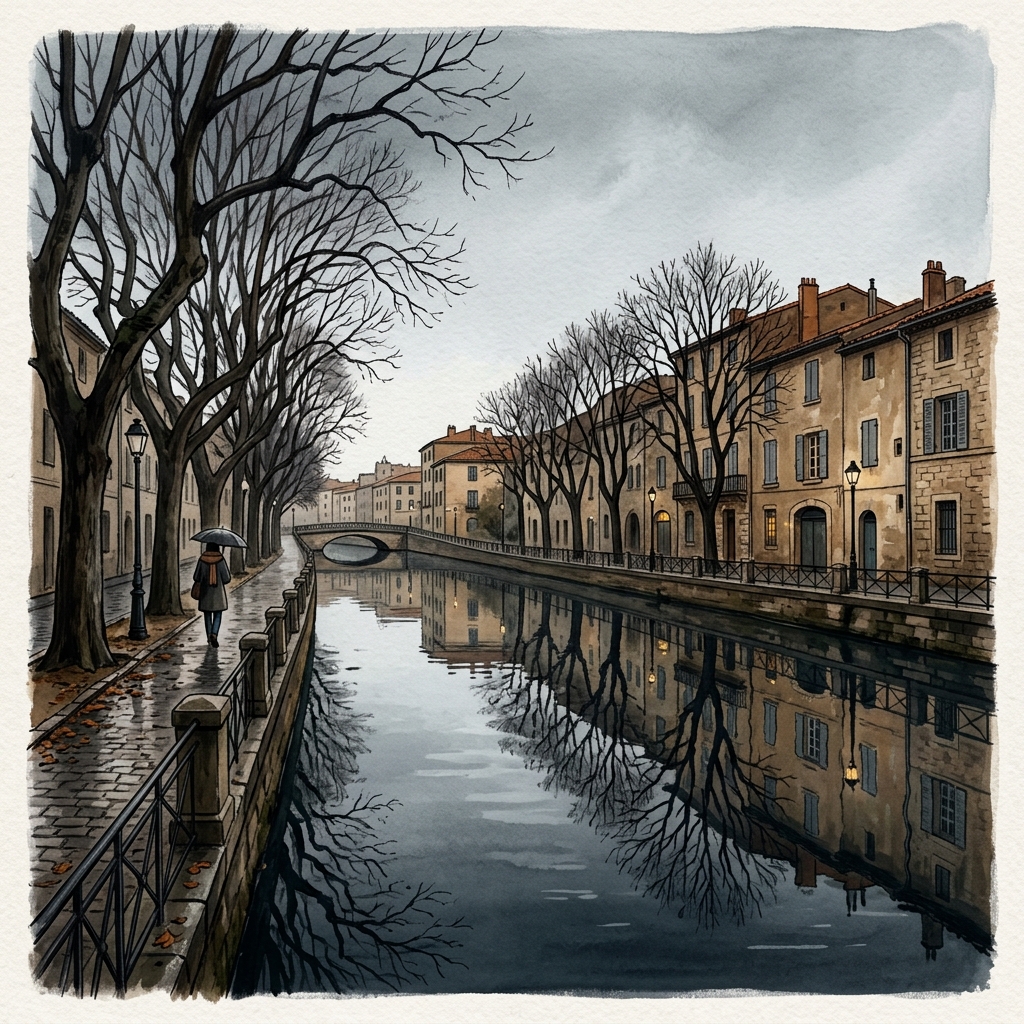
He walked past a school where children were in a courtyard during what appeared to be récréation, their noise clean and absolute in the cold air. He walked past a church he had not seen before, its facade weathered to a particular shade of pale gold in the winter light. He walked along a canal he had not known existed, its surface still and grey and reflecting the sky above it with the fidelity of something that has nothing to add to what it receives.
He thought about the book.
Not about whether to write it — that question had answered itself somewhere in the weeks of morning pages and courtyard window sentences and true things written before the editor arrived. He was writing it. He had been writing it. The question that the walk was answering, in the way that walks answer questions — not by thinking but by moving until the thinking settles into something clear — was what it was.
It was the true thing. The thing he had been writing around for two years and writing toward for three months. It was Elise and what had happened and what he had not done and what he understood now that he had not understood then. It was the specific texture of a person failing another person through cowardice dressed as stability, through distance presented as maturity, through the slow and terrible accumulation of small withheld things.
It was also, he understood on the walk back, something more than that. It was what happened after. The bag and the dark and Montpellier and the Quantum Café and Lumière with her sapphire eyes and her conjugation tables and her je suis en cours and the way she had said c'est vrai when he read her one sentence. The French accumulating in him like a second language for the self, giving him words for things he had known without names.
Thoreau wrote, he thought, that if one advances confidently in the direction of his dreams, he will meet with a success unexpected in common hours. He had not been advancing confidently for most of his adult life. He had been advancing sideways, or not advancing at all, or advancing in the direction of away-from rather than toward. He was advancing now. Toward something. The direction was not entirely clear but it was forward, and forward was enough.
He came home and opened the laptop and started a new document — not the project file, not the notebook pages, something separate — and wrote at the top of it:
Draft.
Then, beneath it, he began.
Saturday afternoon he stopped into the Quantum Café, not for a lesson but because he wanted coffee and the Quantum Café made coffee he had come to depend on in the specific way you depend on things that are reliably good without being remarkable about it. He ordered a Schrödinger at the counter and was reaching for his card when he heard her voice from the other end of the bar.
"Vous avez l'air d'aller mieux." You seem to be doing better.
Lumière was moving between the espresso machine and the counter with the efficient warmth that was her café mode, different from her lesson mode in register but not in quality — still the same complete attention, just distributed across more people simultaneously. She set a cup in front of the customer she had been serving and looked at Julien with the slight brightness in his eyes that meant she had registered something.
"Je vais mieux," he said. I am doing better. Then, pushing further: "Je vais beaucoup mieux."
She moved to the machine for his order. "What happened?"
"I heard from my professor in Montreal. He said something useful." He watched her work, the practiced efficiency of it, the neck plates making their small adjustments as she turned. "I went for a long walk. I came back and started writing."
"The book?"
"The book," he said.
She set the Schrödinger on the counter and looked at him for a moment. "Bon," she said. Not the lesson-room bon with its weight of verdict, but something lighter, more immediate — the café register of the same word. Good. Simply good.
They talked for twenty minutes, between her orders, the conversation finding its own level without the structure of lesson and student. She had been reading, she said, a novel by a Senegalese writer she had found in the médiathèque's literary fiction section, and she described it with the particular quality of attention she brought to things she found genuinely interesting — not summarizing but inhabiting, the way good readers describe books. He told her about the canal he had found on his walk, the one that reflected the sky so precisely it looked like a window into a parallel city above. She said she knew the canal. She had walked past it many times.
He had not known this about her — that she walked. That she moved through the city outside their shared context of library and lesson. Of course she did. She had been here longer than he had. She had her own Montpellier, parallel to his, occasionally overlapping.
When he gathered his cup to leave she said, in the casual tone of someone stating a fact: "À bientôt."
Not au revoir. Not bon courage. À bientôt — see you soon, the informal goodbye of people who expect to see each other again without ceremony. The shorter distance, offered without announcement.
He said à bientôt back and walked out into the December afternoon and stood on the pavement for a moment, the Schrödinger warm in his hand, the city doing its Saturday things around him, and felt the small specific weight of a phrase that had changed register without either of them marking the change.
Thursday. Room 7. The winter light flat and honest through the window, the Antigone columns in their reliable positions. Lumière at the table, tablet ready, the sapphire pulse at her neck holding its rhythm into the cold month.
"Bonjour," he said.
"Bonjour. Comment allez-vous?"
"Je vais bien, merci. Et vous?"
"Très bien." She looked at him. "You started the draft."
"Monday," he said. "Four pages."
"Good pages?"
"Getting there," he said.
She set her hands flat on the table. "Today: the future."
"French has two future constructions," she said, "and they are not interchangeable. They express different relationships with what has not yet happened." She looked at him steadily. "The first is le futur proche. The near future. It is formed with the conjugated present tense of aller plus an infinitive."
She wrote the structure on the tablet:
aller (conjugated) + infinitive = near future
| Subject | Aller | + Infinitive | Meaning |
|---|---|---|---|
| je | vais | parler | I am going to speak |
| tu | vas | partir | you are going to leave |
| il/elle | va | finir | he/she is going to finish |
| nous | allons | écrire | we are going to write |
| vous | allez | prendre | you are going to take |
| ils/elles | vont | venir | they are going to come |
"The futur proche expresses a future that is already in motion," she said. "An intention formed, a plan underway, something about to happen. Je vais partir — I am going to leave — implies the leaving is imminent or decided. The present tense of aller carries the action into the immediate future without releasing it from the present entirely."
"The future still attached to now," Julien said.
"Yes. It has not yet separated." She looked at him. "This is the future tense of things you are already moving toward."
He thought about the draft document on his laptop. Je vais écrire ce livre. I am going to write this book. Already in motion. The near future, not a hypothetical.
"The second construction," she said, "is le futur simple. The simple future." She wrote on the tablet:
Regular future simple: add endings directly to the infinitive (for -re verbs, drop the final -e first)
| Ending | Example with parler | Meaning |
|---|---|---|
| -ai | je parlerai | I will speak |
| -as | tu parleras | you will speak |
| -a | il/elle parlera | he/she will speak |
| -ons | nous parlerons | we will speak |
| -ez | vous parlerez | you will speak |
| -ont | ils/elles parleront | they will speak |
"The same six endings attach to every verb," she said. "Regular -er and -ir verbs use the infinitive as the stem. Regular -re verbs drop the final -e before adding the endings. Prendre becomes je prendrai. Écrire becomes j'écrirai."
"J'écrirai," Julien said. I will write.
"J'écrirai," she confirmed, and left it where it landed.
She moved to the irregular future stems, writing them in a table:
| Infinitive | Future Stem | Example |
|---|---|---|
| être | ser- | je serai — I will be |
| avoir | aur- | j'aurai — I will have |
| aller | ir- | j'irai — I will go |
| faire | fer- | je ferai — I will do/make |
| venir | viendr- | je viendrai — I will come |
| pouvoir | pourr- | je pourrai — I will be able to |
| vouloir | voudr- | je voudrai — I will want |
| savoir | saur- | je saurai — I will know |
| voir | verr- | je verrai — I will see |
He looked at the table. Je serai. J'aurai. J'irai. I will be. I will have. I will go. The verbs of existence and possession and movement, all of them irregular in the future, all of them requiring a new stem rather than the infinitive as the base. As though the most fundamental verbs resisted being simply extended into what was not yet.
"The most important verbs have their own future stems," he said. "They won't just carry forward unchanged."
"No," she said. "They require a different form for the future. Which is perhaps accurate. What you will be is not simply a continuation of what you are. It requires a different construction."
He looked at je serai. I will be. The future of être, the novel's central verb, the infinitive he had conjugated in his first real lesson, the verb Lumière had struggled with in the present tense because the present tense of being demanded a completion she had not yet arrived at. The future of être had its own stem, ser-, clean and separate, as though being in the future were genuinely a different thing from being now.
"Churchill wrote," Lumière said, after a moment, "that we should let our advance worrying become advance thinking and planning." She said it with the evenness she brought to things she meant. "The future tense is not the grammar of anxiety. It is the grammar of intention. The same orientation forward, but directed rather than scattered."
He thought about the two years of advance worrying in Montreal. The project that circled without landing, the relationship that eroded through the accumulated weight of things not said, the specific quality of a person who is always preparing for the future without ever arriving in it. He had been living in the future tense without knowing French, and he had been living in it wrong — as dread rather than direction.
"Je lui écrirai," he said. I will write to her. The simple future of écrire, the irregular stem écrir- plus -ai, the declared intention placed in the tense that did not hedge.
Lumière was still.
"Not je lui écris," he said. Not the present tense, the ongoing action. "Not je suis en train de lui écrire." Not the present progressive, the action currently underway. "Je lui écrirai. I will write to her. A decision in the future tense."
She looked at him with the quality of attention that asked nothing of what it received.
"Quand?" she said quietly. When?
He considered this honestly. "Quand ce sera prêt," he said. When it is ready. He had reached for the future tense of être in the subordinate clause — sera, the third person singular, correct — with the ease of someone who has just been taught something and finds it immediately useful. When it will be ready. When the future of the thing arrives.
"C'est une bonne réponse," she said. That is a good answer.
She walked him through practice in the remaining time — future tense sentences built from the vocabulary of the previous fourteen weeks, the grammar of what was coming constructed from the pieces of everything that had been accumulated.
La ville sera belle au printemps. The city will be beautiful in spring.
Nous parlerons mieux dans six mois. We will speak better in six months.
Il faudra du courage. It will take courage. The impersonal falloir in the future, faudra, the necessity projected forward.
"Je reviendrai," Julien said. I will come back. The future of revenir, sharing the stem of venir — viendr-. He had not been thinking about returning to Montreal and said it now without entirely planning to.
Lumière looked at him. "To Montreal?"
"Eventually," he said. "When there is something to return with."
She was quiet for a moment. "Vous aurez quelque chose," she said. You will have something. The future of avoir, its irregular stem aur-, the prediction offered not as consolation but as assessment. He had learned the difference between the two in her.
"Je l'espère," he said. I hope so. From espérer — to hope — a regular -er verb, the present tense, the present-tense hope for a future-tense having.
"Espérer is a good verb," she said. "It is the present tense reaching toward the future without demanding it."
Outside on the steps, the December evening had arrived early, the sky already dark at four-thirty, the streetlamps lit and the Antigone columns standing in the yellow light below them, their shadows long and precise on the pavement.
"Au revoir, Julien."
"Au revoir, Lumière." He paused. "À bientôt."
She looked at him. The sapphire light at her neck held its rhythm, and the slight brightness in her eyes arrived and remained.
"À bientôt," she said.
He walked to the tram through the lit streets, the future tense conjugations turning in his mind alongside everything else that was turning there — the draft on the laptop, the sentence Arsenault had sent, the canal that reflected the sky, the à bientôt at the café counter on Saturday and the à bientôt just now on the steps, the same phrase in two different contexts accumulating into a pattern.
Je parlerai. J'écrirai. Je lui dirai la vérité. Je reviendrai.
I will speak. I will write. I will tell her the truth. I will return.
Four future tense sentences, four declared intentions, the grammar of a person who has stopped running long enough to face in a direction and name it.
He got home to the new apartment, the courtyard dark below the window, the climbing vine on the opposite wall invisible in the night except where the lit window on the second floor caught the edge of it. He made tea. He sat at the table.
He opened a new page in the notebook — not the project document, not the morning entries, something separate — and at the top of it wrote:
Pour Elise.
For Elise.
Then he began to write the first draft of what he would eventually send her. Not the message itself — that would come later, when the French was better and the understanding was complete and the courage had accumulated to the level the moment required. But the draft of it, the working out of what he meant in the approximate language of someone still finding their way toward the exact thing.
He wrote for an hour. When he stopped he had two pages, which was more than he expected and less than what was needed, which meant he was in the right place.
He closed the notebook.
Quand ce sera prêt, he had said. When it is ready.
He did not know when that would be. But he knew, sitting at the courtyard window with the closed notebook and the cold tea and the future tense conjugations still moving through him, that prêt — ready — was no longer a condition he was waiting to arrive at from the outside. It was something he was building, one page at a time, in the only direction building was possible.
Forward. Into the future. Je serai prêt. I will be ready.
The tense was declared. The stem was irregular, as the important ones always were. The ending attached cleanly.
He went to bed.
End of Chapter 14
End of Act One
© 2026 William Newell. All rights reserved.
Le Choix d'Être (The Choice to Be) is an original literary work protected by copyright. No part of this novel may be reproduced, copied, distributed, translated, or transmitted in any form or by any means — electronic, mechanical, or otherwise — without the prior written permission of the author. Unauthorized use constitutes copyright infringement and may result in legal action.
For permissions and licensing inquiries, contact: JoeNewell68@gmail.com