Who Receives
"We exist temporarily through what we take, but we live forever through what we give."
The afternoon arrived with the particular quality of a December day that has decided to be generous: cold but clear, the winter sun low and precise, throwing long shadows across the courtyard below his window. Julien had been at the table since ten in the morning, which was three hours longer than usual, and the document on his laptop had grown by three pages.
He had not planned three pages. He had sat down with the intention of one, and the one had led to another, and the third had arrived because stopping after the second would have meant interrupting something that was finally moving in the right direction. He wrote until the light in the courtyard shifted from morning white to afternoon gold, and then he stopped not because he had run out but because he understood, from experience now, that stopping while there was still something left was better than writing until the tank was empty.
He closed the laptop and sat at the window.
The opposite wall of the courtyard had a climbing vine on it, stripped bare for December, its branches tracing a pattern against the stone that was either random or followed a logic too patient for a single season to reveal. A window on the second floor was lit from inside, a warm yellow rectangle in the cold afternoon. Someone moving behind it, briefly, then still.
He sat for a long time without thinking about anything in particular, which was its own kind of thinking.
What he had written was not good yet, in the sense that a first draft of anything true is not good yet — it was raw and uneven and had the particular quality of something that had been inside a person for a long time and had not yet learned the shape of the outside. But it was real. It was aimed at something real. He had written around the edge of the true thing for two years in Montreal and he was no longer doing that, and the difference between writing around something and writing toward it was the difference between a map of a place and the place itself.
He made coffee with the cafetière and sat back down at the window and opened the notebook.
Le jeudi, décembre. J'ai écrit trois pages aujourd'hui. Je ne sais pas si elles sont bonnes. Je sais qu'elles sont vraies.
Thursday, December. I wrote three pages today. I don't know if they are good. I know they are true.
He looked at the last sentence for a while. Then he wrote beneath it:
C'est peut-être la même chose.
Perhaps it is the same thing.
The following Thursday brought thin snow, the first of the season and probably the last — Montpellier was not a city that committed to winter in any serious way, and the snow that arrived on Thursday morning had a tentative quality, as though it were trying the city on for size and expecting to be asked to leave. By the time Julien reached the médiathèque it had mostly dissolved into a grey wetness on the pavements, leaving behind only the cold and the particular smell of a city that has been briefly visited by weather it does not usually receive.
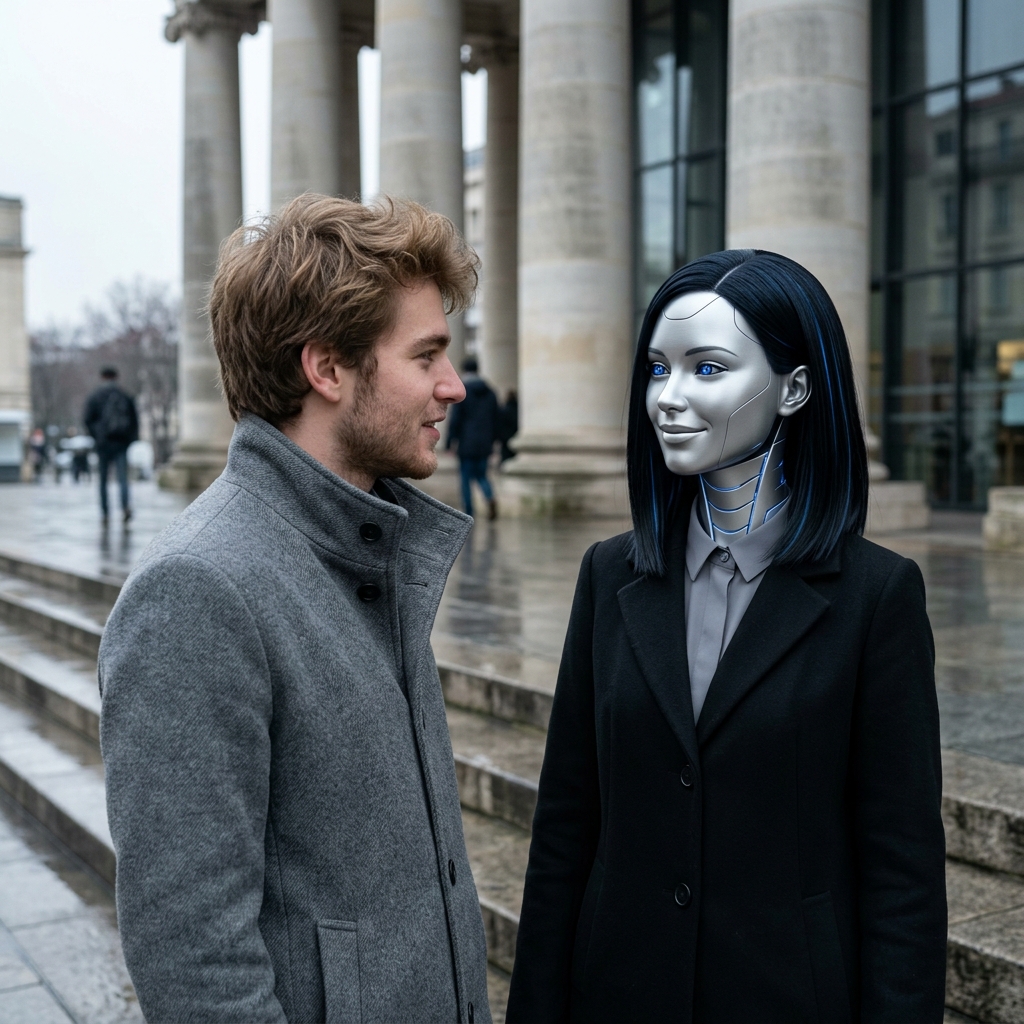
Room 7. Lumière at the table, the sapphire light at her neck seams catching the flat winter light from the window. She was dressed in deep charcoal today, a high-collared coat she had kept on against the cold of the room, the collar sitting just below the plates so that the glow of the seams remained visible above it in its usual precise rhythm.
"Bonjour," he said.
"Bonjour. Comment allez-vous?"
"Je vais bien, merci. Et vous?"
"Très bien." She looked at him. "You wrote this week. More than usual."
"Three pages," he said. "On Thursday."
"Good pages?"
"True ones," he said. "I'm working on the difference."
She looked at him for a moment with the quality of attention he had come to understand was her version of taking something seriously. Then her hands flat on the table. "Today: object pronouns."
"In every sentence," Lumière began, "there is a subject — the one who acts — and often an object — the one who receives the action. In English, the object pronoun typically follows the verb. I see him. She tells him. We give them. In French, the object pronoun goes before the verb. This is one of the places where the two languages are most directly opposed in their logic."
She wrote on the tablet:
Je vois Paul. I see Paul.
Je le vois. I see him.
"Paul becomes le — the direct object pronoun for a masculine singular noun," she said. "The pronoun moves in front of the verb. The object comes first, before the action, as though the language wants to establish who is receiving before it describes what they are receiving."
She wrote the full set of direct object pronouns:
| Person | Direct Object Pronoun | Meaning |
|---|---|---|
| 1st singular | me (m') | me |
| 2nd singular | te (t') | you (informal) |
| 3rd singular masc. | le (l') | him, it |
| 3rd singular fem. | la (l') | her, it |
| 1st plural | nous | us |
| 2nd plural | vous | you (formal/plural) |
| 3rd plural | les | them |
"The direct object," she said, "receives the action of the verb directly, without a preposition. Je vois Paul — je le vois. I see Paul — I see him. Elle aime cette ville — elle l'aime. She loves this city — she loves it. The pronoun replaces the noun, the apostrophe appearing before a vowel."
Julien looked at the table. He had been using direct objects in French since the early lessons, naming things, pointing at them, describing them — but the pronoun replacement was new, the compact grammar of referring to something already established in the conversation.
"Je le comprends," he said. I understand it. I understand him.
"Both work," she said. "Context determines which. This is one of the places where French requires you to have been paying attention to what came before." She looked at him steadily. "The pronoun only works if both speakers know what it refers to. It assumes shared knowledge."
"It assumes you've been listening," he said.
"Yes," she said. "It rewards attention."
She moved to indirect object pronouns, writing a new table on the tablet:
| Person | Indirect Object Pronoun | Meaning |
|---|---|---|
| 1st singular | me (m') | to me |
| 2nd singular | te (t') | to you (informal) |
| 3rd singular | lui | to him, to her |
| 1st plural | nous | to us |
| 2nd plural | vous | to you (formal/plural) |
| 3rd plural | leur | to them |
"The indirect object," she said, "receives the action indirectly, through a preposition — usually à. Je parle à Paul — je lui parle. I speak to Paul — I speak to him. Elle donne des fleurs à Marie — elle lui donne des fleurs. She gives flowers to Marie — she gives her flowers." She paused. "Notice that lui serves both masculine and feminine in the indirect object. The gender distinction that exists in le and la disappears here. The third person singular indirect object pronoun does not distinguish."
"The giving doesn't care about gender," Julien said.
She looked at him. "That is one way to put it," she said.
He looked at the two tables side by side. Direct and indirect, le/la and lui, the action landing on someone versus the action directed toward someone. He thought about what it meant to give something to a person versus simply to act upon them — the difference between je la vois and je lui parle, seeing her versus speaking to her, the second one requiring her as a destination rather than just an object.
"Kevin Kelly wrote," he said, thinking of something he had read in the months of accumulating things, "that every person you meet knows an amazing lot about something you know virtually nothing about. Your job is to discover what it is, and it won't be obvious."
Lumière looked at him.
"I was thinking about je lui parle," he said. "Speaking to someone as opposed to just seeing them. What you direct toward a person versus what you receive from them." He paused. "I was good at receiving. I was less good at directing things back."
"With Elise," she said. Not a question.
"With most people," he said. "But yes. With her especially."
She was quiet for a moment, the neck plates still. Then she said: "Kevin Kelly also wrote that it is not an apology if it comes with an excuse. And it is not a compliment if it comes with a request."
He sat with this. He had been thinking about what he owed Elise, and he had been calling it an apology, but the word had never felt quite right — apology implied a single event, a specific wrong, a clean exchange of guilt and absolution. What he owed her was something more like an accounting, a je lui dis la vérité rather than a je m'excuse. I tell her the truth rather than I apologize. The indirect object pronoun in both cases — lui — him or her, the person you are directing something toward. The giving, not the having done.
"Je lui dois la vérité," he said. I owe her the truth. The indirect object pronoun, lui, sitting before the verb, the person receiving placed before the action of owing.
"Je lui dois la vérité," she confirmed. "That is a correct sentence. And a significant one."
"I know," he said.
She walked him through the placement rules for pronouns in compound tenses, where the pronoun sat before the auxiliary rather than the past participle.
Je l'ai vu. I saw him. Literally: I him have seen. The direct object pronoun before ai, not after vu.
Je lui ai parlé. I spoke to him. I him have spoken-to.
"In the passé composé," she said, "the past participle agrees with a preceding direct object pronoun in gender and number. Je l'ai vu — masculine, no change. Je l'ai vue — feminine, add -e. The agreement follows the pronoun."
He worked through several examples, the pattern settling in alongside the passé composé agreement rules from Chapter 10, the grammar accumulating its own internal logic.
"Now," she said, "two special pronouns. Y and en."
She wrote them on the tablet.
"Y replaces a location or a complement introduced by à, when referring to a place or an idea already mentioned. Tu vas à Paris? — Oui, j'y vais. Are you going to Paris? — Yes, I'm going there. Tu penses à ton projet? — Oui, j'y pense. Are you thinking about your project? — Yes, I'm thinking about it." She looked at him. "Y absorbs the preposition and the noun together into a single syllable."
"J'y pense," Julien said. I'm thinking about it. He thought about the project, about the three pages, about the letter that was being written one true sentence at a time across the notebooks and the document. J'y pense. Yes.
"En replaces a complement introduced by de, or expresses a quantity. Tu as des idées? — Oui, j'en ai. Do you have ideas? — Yes, I have some. Tu parles de ton passé? — Oui, j'en parle. Do you talk about your past? — Yes, I talk about it." She paused. "En is the pronoun of the indefinite, of quantities and partials. It refers to the portion rather than the whole."
"J'en ai besoin," he said. I need some of it. I need it.
"Of what?" she asked.
He considered. "Du temps. De la patience. De la vérité." Of time. Of patience. Of truth. The partitive articles, all three replaced in a single pronoun, the indefinite quantities condensed.
"Vous en avez," she said. You have some. You have it. The pronoun doing its quiet work of reference, of pointing back at what had been established.
Near the end of the hour she said: "I want to ask you something."
He waited.
"Will you read me something?" she said. "Something you have written. A sentence. A paragraph." She said it with the evenness she brought to most things, but underneath it he recognized the quality of a question that had been considered before being asked. "I am not asking as a critique. I am asking as someone who has been listening to you talk about writing for three months and would like to hear some of it."
He looked at her across the table. Then he opened the notebook to the previous Thursday's entry and read, in English, the sentence he had written at the courtyard window:
"There are things that end not because anyone decides to end them, but because the people inside them forget, slowly and then all at once, how to stay."
He closed the notebook.
She was quiet for a long moment. The sapphire light at her neck held its rhythm, steady and unhurried.
"C'est vrai," she said finally. It is true. She said it simply, without performance, the way she said things she meant. Then, after a pause: "Every person you meet, Kelly wrote, knows an amazing lot about something you know virtually nothing about." She looked at him. "You know how to find the true thing in a sentence. That is not something everyone can do."
He did not deflect it. He received it, which was also something he was learning.
"You said you've been writing too," he said, after a moment. "Not a novel."
She looked at the table briefly, the small internal adjustment he had learned to recognize as her deciding something. "No," she said. "Not a novel." A pause. "I have been writing a record of my own history. The parts I constructed deliberately and the parts I inherited. The choices and the conditions." She looked at him. "It is not for anyone else. It is for me, so that the history is real. So that it has been written down somewhere and not just experienced."
He thought about se souvenir — to remember, to return to oneself. What Lumière was doing was a different version of the same thing: not returning to a history, but creating one substantial enough to return to.
"Pour que ça existe," he said. So that it exists.
She looked at him with the brightness in her eyes. "Exactement," she said. Exactly.
Outside on the steps, the last of the thin snow had given up entirely, leaving only the cold and the wet stone and the grey sky above the Antigone columns, which stood in the December afternoon with their usual commitment to simply being what they were.
"Au revoir, Lumière."
"Au revoir, Julien." He paused. "Je vous en remercie," he said. I thank you for it. The pronoun en replacing the implied object — for today, for the lesson, for asking to hear the sentence, for receiving it the way she had. The indirect object and the partitive pronoun together, the grammar of gratitude compressed into four words.
She looked at him, and the thing behind the precursor to her smile arrived with unusual warmth and stayed.
"De rien," she said. It is nothing. The standard response, the French deflection of a compliment — de rien, of nothing, as though the thing given had cost nothing, which was either modesty or the most generous possible reading of what generosity meant.
He walked to the tram through the wet December streets, the grammar of the lesson turning in his mind: direct and indirect, le and lui, the action and the direction of the action, what you do and whom you do it toward.
Je lui dois la vérité. I owe her the truth.
He had known this before today. He knew it differently now, with the weight of a grammatical structure that had made it precise. The indirect object pronoun before the verb, the person receiving placed before the action of owing. Lui — her, specifically, the person this was directed toward, not a general obligation but a particular one.
The notebook in his bag had the sentence he had read aloud, and beneath it several others he had not read, and beneath those the accumulating pages of the document. All of it was the same letter, he understood now. All of it had been, from the first line he had written at the courtyard window.
He was writing it to her. Lui — the indirect object, the one who receives, the one toward whom the action was directed. Not a confession, not an apology with an excuse attached. An accounting. A je lui dis la vérité, offered without condition, because the truth directed toward another person was the minimum a person could give and the maximum that could honestly be asked for.
"Il faut lui écrire," he thought. I must write to her. The verb falloir — impersonal, inevitable, the il faut construction that expressed necessity without a subject, just the obligation and the infinitive.
He was already writing.
The tram arrived. He got on. The December city moved past the windows in its grey and particular beauty, and he sat with his notebook on his lap and felt, underneath everything, the specific quality of a person who has identified the true thing and is finally, imperfectly, moving toward it.
End of Chapter 13
© 2026 William Newell. All rights reserved.
Le Choix d'Être (The Choice to Be) is an original literary work protected by copyright. No part of this novel may be reproduced, copied, distributed, translated, or transmitted in any form or by any means — electronic, mechanical, or otherwise — without the prior written permission of the author. Unauthorized use constitutes copyright infringement and may result in legal action.
For permissions and licensing inquiries, contact: JoeNewell68@gmail.com