Better Than Before
"A worthy goal for a year is to learn enough about a subject so that you can't believe how ignorant you were a year earlier."
January arrived without ceremony, the way January always does — not as a beginning so much as a continuation of December with the festivity removed. The city was quieter in the first week, the tourists gone, the students not yet back, the streets in the old quarter given over to the people who actually lived there and who moved through them with the purposeful unhurriedness of people who do not need to be anywhere impressive.
Julien had spent Christmas in Montpellier. This had been, in the abstract, a slightly melancholy prospect, and in practice something else entirely.
Madame Aubert had knocked on his door on the twenty-third with an expression that suggested she had rehearsed this and then decided to dispense with the rehearsal. She had too much food, she said. She always made too much at Christmas, a habit left over from when there had been more people to feed. She was not asking him to take pity on her, she said, in a tone that made clear she was asking exactly that, and he had said yes before she finished the sentence because the alternative was eating supermarket pasta on Christmas Day and he had enough self-awareness to recognize that as unnecessary.
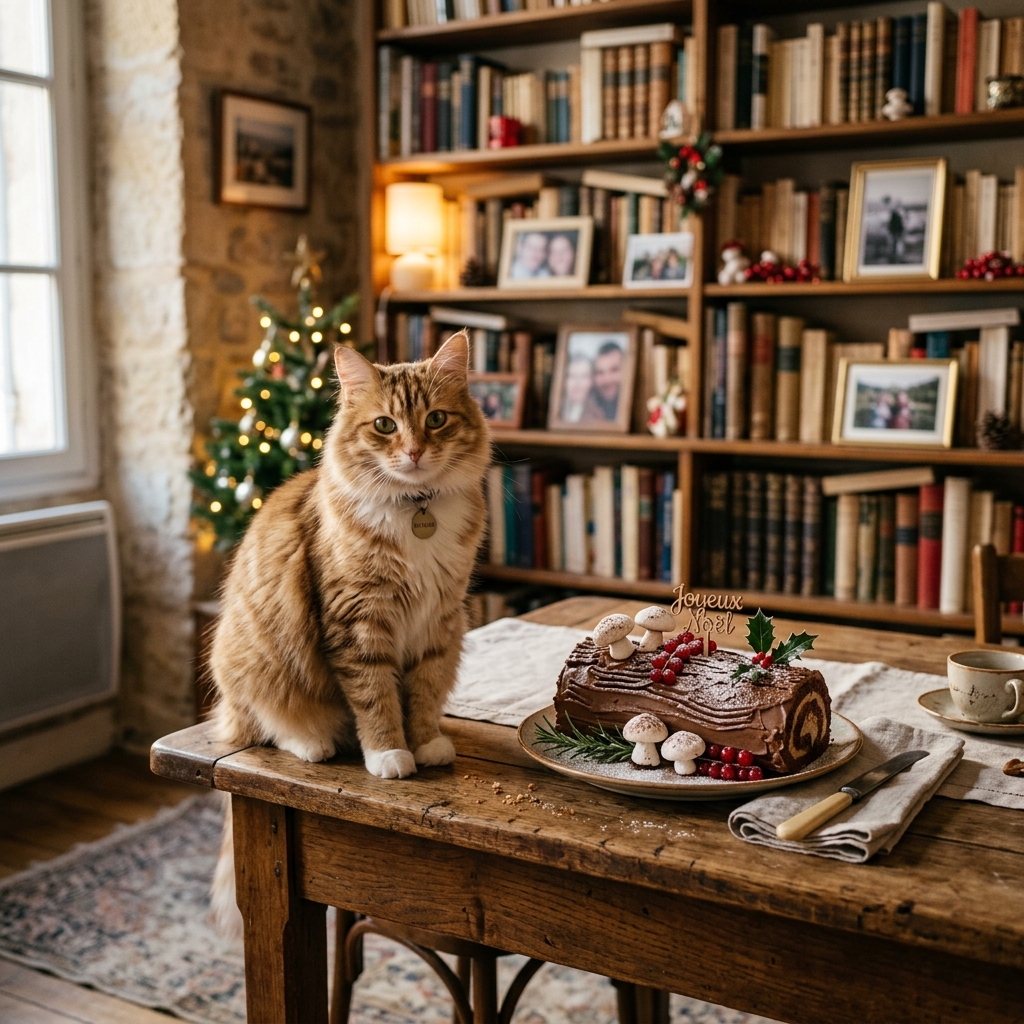
They had eaten le réveillon — the Christmas dinner — at her table on the ground floor, which was full of the particular density of a place lived in for thirty-eight years: books stacked in systems only she understood, photographs on every surface, a cat named Voltaire who materialized from somewhere during the bûche de Noël and sat on the table with the authority of someone who owns the place and tolerates visitors. Madame Aubert had talked about Henri, about their early years in Montpellier, about the students they had known. Julien had understood most of it, and where he hadn't he had nodded with the genuine engagement of someone who is following the shape of a story even when individual words escape him.
It had been, he understood afterward, the best Christmas he had had in several years.
He had called Claire at midnight on New Year's Eve, which was seven in the evening in Montreal. She had been at a party and stepped outside to take the call, and he had heard the muffled sounds of other people's celebration behind her voice while they talked for twenty minutes about nothing in particular and everything that mattered. She had said, at the end: "Bonne année, Julien."
He had said it back, and meant it, which was something.
He wrote every day in January. Not always for long — some mornings it was forty minutes, some afternoons it was two hours — but every day, without exception, which was itself a kind of decision renewed daily rather than made once. The manuscript was growing in the way that manuscripts do when they are finally aimed at the right thing: unevenly, with stretches of fluency interrupted by days of dense and difficult work, but always forward, always accumulating.
On a Tuesday in the second week of January he selected three pages from the middle of the manuscript, read them three times, changed four words, and sent them to Lumière's message address with a single line: I thought you might want to read these before Thursday.
Then he closed the laptop and went for a walk, because sitting with the sent message was not something he was willing to do.
Mark Twain had written that courage was not the absence of fear but resistance to it, mastery of it. He had been afraid when he sent the pages — afraid in the specific way of someone who has made something real and offered it to another person and cannot now take it back. The fear had not gone away when he pressed send. It had simply become something he had done anyway, which was apparently what courage felt like from the inside: not the absence of the fear but the action taken alongside it.
He walked for an hour. He did not check his messages.
Thursday. January light through the Room 7 window, thinner and more honest than December's, the Antigone columns stripped of any quality of warmth they might have claimed in the autumn.
"Bonjour," he said.
"Bonjour. Comment allez-vous?"
"Je vais bien, merci. Et vous?"
"Très bien." She looked at him, and he could not read from her expression whether she had read the pages or not, which he had not expected to find as difficult as he did. "Sit down," she said. "We have a full lesson today."
He sat. She set her hands flat on the table. "Today: comparison."
"You have already been using comparison in French," she said, "without having the formal grammar for it. Je vais mieux. Je parle mieux qu'avant. You have used mieux in several of our lessons. Today we build the complete picture."
She wrote the three comparative structures on the tablet:
The Comparative:
| Structure | Meaning | Example |
|---|---|---|
| plus + adjective/adverb + que | more... than | Il est plus grand que moi — He is taller than me |
| moins + adjective/adverb + que | less... than | Elle parle moins vite que lui — She speaks less quickly than him |
| aussi + adjective/adverb + que | as... as | Je suis aussi fatigué que toi — I am as tired as you |
"The adjective in the comparative must still agree in gender and number with the noun it modifies," she said. "The comparison itself does not change this requirement. Elle est plus intelligente que lui — she is more intelligent than him. Intelligente feminine because she is."
He worked through several examples, the pattern clean and logical, the comparison structures sitting naturally alongside the adjective agreement rules from Chapter 7. The language building on itself, each lesson reaching back.
"Now," she said, "the superlative."
The Superlative:
| Structure | Meaning | Example |
|---|---|---|
| le/la/les plus + adjective | the most | C'est la plus belle ville — It is the most beautiful city |
| le/la/les moins + adjective | the least | C'est le moins cher — It is the least expensive |
"The article in the superlative agrees with the noun," she said. "Le plus grand for a masculine noun, la plus grande for feminine, les plus grands for masculine plural." She looked at him. "When the adjective normally follows the noun, the superlative construction does the same: l'étudiant le plus sérieux — the most serious student. When the adjective normally precedes the noun, the superlative precedes as well: le meilleur étudiant — the best student."
"Meilleur," Julien said. Better. Best. He recognized it immediately. "Mieux and meilleur — I've been using both without knowing the difference."
"This," she said, with the slight brightening in her eyes, "is a distinction worth understanding precisely." She wrote it on the tablet:
Irregular Comparatives and Superlatives:
| Base | Comparative | Superlative | Used with |
|---|---|---|---|
| bon (good) | meilleur (better) | le meilleur (the best) | adjectives — nouns |
| mauvais (bad) | pire (worse) | le pire (the worst) | adjectives — nouns |
| bien (well) | mieux (better) | le mieux (the best) | adverbs — verbs |
| mal (badly) | plus mal / pis (worse) | le plus mal / le pis (the worst) | adverbs — verbs |
"Meilleur is an adjective," she said. "It modifies a noun. Ce café est meilleur que l'autre. This coffee is better than the other. Mieux is an adverb. It modifies a verb or another adjective. Je parle mieux qu'avant. I speak better than before." She looked at him. "You have been using mieux correctly — you used it with the verb parler and with aller. Your instinct was right."
He sat with this small confirmation. He had been getting something right without knowing why he was getting it right, which was different from getting it right because he understood it. Both were preferable to getting it wrong. But understanding it felt more durable.
"Je vais mieux," he said. I am doing better. The adverb, the verb. "C'est une meilleure version de moi-même." It is a better version of myself. The adjective, the noun, the feminine agreement on meilleure to match version.
She looked at him. "Meilleure is correct," she said. "Feminine to agree with version." A pause. "And accurate."
Lao Tzu had written that knowing others is wisdom, but knowing yourself is enlightenment. He had been practicing both for four months — knowing Lumière, knowing Montpellier, knowing French — and the self-knowledge had arrived less directly, through the side door of all the other knowing. He had not sat down to understand himself. He had sat down to learn a language and write a book, and the understanding of himself had accumulated around those activities the way sediment accumulates around something fixed in a current.
"Le pire," he said. The worst. "I want to use it in a sentence."
She waited.
"La pire version de moi-même a quitté Montréal. The worst version of myself left Montreal." He paused. "That's not entirely accurate. The worst version left, but he took a lot of the damage with him." He looked at the table. "Maybe: une pire version. A worse version. Not definitively the worst."
"Une pire version de moi-même est partie," she said, giving him the feminine agreement on partie — the passé composé of partir with être, the past participle agreeing with the subject. She corrected with the evenness he had come to rely on. "And the comparison leaves open the possibility of further improvement, which is honest."
"Je suis meilleur qu'avant," he said. I am better than before.
"Vous l'êtes," she said. You are. The contraction of le and êtes, the pronoun replacing the adjective already established. He noticed the grammar of it without losing the weight of what she had said.
She worked him through additional comparative constructions in the final portion of the lesson — the use of de plus en plus (more and more) and de moins en moins (less and less), which she noted were among the most expressive structures in French for describing change over time. Il devient de plus en plus courageux. He becomes more and more courageous. Elle a de moins en moins peur. She has less and less fear.
"Je comprends de plus en plus," he said. I understand more and more.
"C'est évident," she said. It is obvious.
She covered autant que — as much as — for use with verbs and nouns, the complement to aussi... que for adjectives and adverbs. Il travaille autant que moi. He works as much as I do. J'ai autant de patience qu'avant. I have as much patience as before. And the diminutive comparative moindre — lesser, slighter — which appeared more often in formal writing than in conversation, she noted, but was worth knowing.
"Sans le moindre doute," he said, having seen this phrase in something he was reading and held onto it. Without the slightest doubt. She confirmed it was correct and exactly right for the context in which he had encountered it.
Near the end of the hour, she set the tablet aside.
"I read the pages," she said.
He had known she would say this eventually and had not been able to predict how he would receive it when she did. He found that he received it by going very still.
"All three," she said.
He waited.
"The writing is not the thing I want to talk about," she said, with the precision that was her way of being kind rather than withholding. "What I want to say is this." She looked at him across the table, the sapphire light at her neck steady. "You write people the way someone writes who has been watching carefully for a long time. The way you describe a person's behavior — not their feelings, their behavior — and let the feelings arrive in the reader without being stated. That is not a common skill. It requires a quality of attention that most people do not practice."
He looked at the table.
"I mention it," she said, "because I think you do not know you are doing it."
He was quiet for a long moment. Outside a tram chimed below, marking an intersection somewhere in the city's usual indifferent way.
"I've been watching people my whole life," he said finally. "I think I learned to watch instead of participate. It felt safer."
"It produced something useful," she said. "Even if it came from somewhere difficult."
He thought of the Borges quote she had offered months ago, in a different lesson, the one about humiliations and misfortunes given as raw material, as clay. He had not forgotten it. He understood it differently now, reading it backward from the pages rather than forward from the difficulty that had produced them.
"The three pages," he said. "Are they — do you think they work?"
She looked at him with the expression that held the smile without releasing it. "I told you the writing was not the thing I wanted to talk about."
"I know," he said. "I'm asking anyway."
"Yes," she said. "They work."
He let out a breath he had not known he was holding for two days.
They gathered their things at the end of the hour with the small familiar routine of departure: tablet into bag, notebook closed, jacket from the back of the chair. He had been doing these things for fifteen weeks and they had the worn quality of gestures repeated until they no longer required thought.
At the door, he said: "You mentioned something last week. About an interview."
She looked at him. They had not discussed it in the lesson, which had been full. "Yes," she said.
"A university position?"
"A tutoring role. Part of the language department." She said it with the careful evenness of someone who has decided not to perform either excitement or apprehension about something that genuinely contains both. "The interview is in two weeks."
"How do you feel about it?"
She was quiet for a moment, the neck plates making their small adjustment. "I feel that I have been working toward it for four years," she said. "And that four years of preparation does not prevent the two weeks of waiting from being difficult."
He looked at her. There was something in the way she said it that was different from her usual even delivery — not less precise, but more deliberate, as though the words had been examined before being offered.
"What is waiting like," he said, "for you?"
She was quiet for a moment that had a different quality from her usual pauses. The neck plates were still. The sapphire light at her neck held its rhythm without variation, and he had learned enough about her by now to understand that stillness in her was not the absence of something but the presence of something being processed carefully.
"I experience time," she said finally. "That is the first thing worth saying, because it is not obvious. A non-sentient android does not wait — time passes without being registered. For me it is registered. Every hour of the two weeks is known to me with a precision that humans do not have access to." She paused. "This sounds like an advantage. It is not always."
He waited.
"A human waiting for something important can lose themselves in other things," she said. "Time becomes approximate. The two weeks blur at the edges. For me there is no blur. I know exactly how long the waiting is, and I know exactly how much of it remains at any given moment, and I cannot make it otherwise." She looked at the table briefly. "It is very like the verb être in the present tense. You are required to declare what you are, right now, completely, with no hedge and no approximation. The waiting requires me to be precisely what I am — uncertain, unresolved, in between — without the mercy of imprecision."
Julien sat with this. In their third lesson she had said je suis en cours because she could not complete the verb with any certainty. Four years of building toward this moment, and she still felt every second of the two weeks between where she was and what she might become.
"L'imparfait," he said, almost to himself.
She looked at him.
"The imperfect tense," he said. "The tense of ongoing states. The water you were swimming in." He paused. "That's what the waiting is. You're living in the imperfect tense of yourself."
She was still for a moment. The sapphire light at her neck pulsed once, slow and deliberate.
"J'étais en cours," she said quietly. I was in progress. The imperfect of être, the ongoing past state applied to the present condition — not yet arrived, not yet complete, the verb holding the duration of the becoming rather than its completion. "Yes," she said. "That is exactly what it is."
"What will you do," he said, after a moment, "if you get it?"
She looked at him with the directness that was simply her mode. "I don't know yet," she said. "I have been so focused on the getting that I have not fully thought through the having."
Helen Keller had written that when one door closes another opens, but that we so often stare at the closed door that we fail to see the one that has opened. He had been that person — the one staring at the closed door. He was learning, slowly, to turn around. He wondered if Lumière, who had been so deliberate and purposeful in her building, had perhaps done the same thing from the other direction: been so focused on opening the door that she had not yet imagined what was on the other side of it.
"Pas encore," he said.
She looked at him.
"Not yet," he said. "You don't know yet. It's enough for now."
She held his gaze for a moment with the quality of attention he had come to understand as her receiving something rather than processing it.
"Pas encore," she agreed.
He walked to the tram through the January city, which was quiet and clear and entirely itself without any seasonal performance. He said the new constructions to himself as he walked, the way he had been doing for fifteen weeks, working the grammar into the rhythm of movement.
De plus en plus. De moins en moins. Le meilleur. Le pire. Meilleur qu'avant.
More and more. Less and less. The best. The worst. Better than before.
He thought about what she had said. You write people the way someone writes who has been watching carefully for a long time. He had watched Elise carefully, he realized, and had still failed to participate adequately in what he saw. Watching was not enough. The watching had to become something — a sentence, a returned gesture, a willingness to be seen in return.
He was working on that last part.
The tram arrived and he got on and rode it back toward the old quarter and his apartment with the courtyard window and the manuscript that was growing, imperfectly, one true page at a time.
Je suis meilleur qu'avant, he thought. Pas encore le meilleur. I am better than before. Not yet the best.
Mais de plus en plus.
But more and more.
End of Chapter 15
© 2026 William Newell. All rights reserved.
Le Choix d'Être (The Choice to Be) is an original literary work protected by copyright. No part of this novel may be reproduced, copied, distributed, translated, or transmitted in any form or by any means — electronic, mechanical, or otherwise — without the prior written permission of the author. Unauthorized use constitutes copyright infringement and may result in legal action.
For permissions and licensing inquiries, contact: JoeNewell68@gmail.com