Raising Oneself
"If a man does not keep pace with his companions, perhaps it is because he hears the beat of a different drummer. Let him step to the music he hears, however measured or far away."
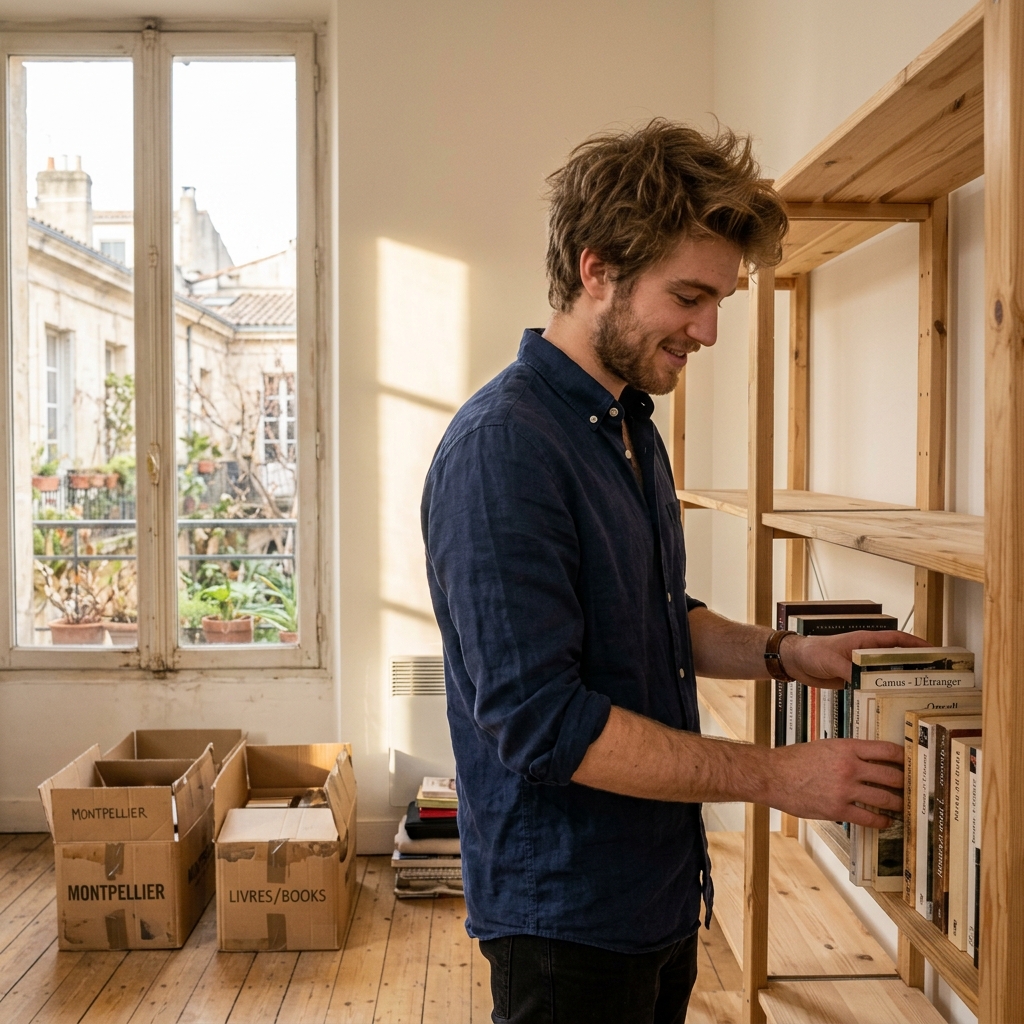
The move took one morning and two tram rides.
He did not own enough to require more than that. Three boxes of books, a duffel bag of clothes, the laptop and the notebooks and the small collection of kitchen things he had acquired over eleven weeks — a good knife, a pepper grinder, a cafetière at the market because the sublet's drip machine made thin, reluctant coffee that never quite got there. He carried it all in stages, the tram sliding between his old street and his new one with its customary indifference to the significance of the cargo.
The new apartment was on the third floor with no elevator, which he had known from the viewing and had not fully registered until the second trip up the stairs with the box of books. The courtyard window faced east, and the December light came through it in the late morning at an angle that landed on the far wall in a rectangle that moved slowly across the afternoon. He stood and watched it for a while after the last box was in, the apartment around him still blank and provisional, the walls not yet his.
He unpacked the books first. The shelves were empty pine, and the books on them changed the quality of the room immediately, gave it a density and a history it had not had with bare walls. He arranged them without system, which was how he had always arranged books — not alphabetically or by subject but by some private logic of association, placing things near other things they seemed to want to be near.
The cafetière went on the kitchen counter. The notebooks went on the table by the courtyard window.
That was enough for a first day.
He called Claire that evening, sitting on the floor with his back against the wall because the apartment did not yet contain a chair. The boxes were mostly open, their contents distributed across surfaces in no particular order.
She answered on the second ring.
"You sound like you're in a cave," she said.
"New apartment. No furniture yet."
"You moved." A pause. "That's — Julien, that's good."
"It's an apartment."
"It's a decision," she said, in the tone she used when she was being precise rather than argumentative. "Those aren't the same thing."
He looked at the rectangle of the courtyard window, the deep blue of the December evening outside it. He had been composing the beginning of this conversation for three weeks without knowing it, the sentences arranging themselves at a level below the one where he made decisions about what to say. He had carried it through the move and through the unpacking and through the first cup of coffee made in the new kitchen with the cafetière, and now, sitting on the floor with Claire's voice in his ear and nowhere to run, he said it.
"I need to tell you about Elise."
Claire was quiet. Not the silence of surprise — she had been waiting for this, he understood, since his first message from Montpellier, since before that probably. The silence of someone who has decided not to make the arrival of a thing more complicated than it needs to be.
"Okay," she said. "I'm listening."
He talked for twenty minutes. Not everything — the full account was still being assembled in the notebooks and the laptop document, still finding its shape — but the shape of it, the outline. He told her about the two years, about what Elise had been and what he had not been able to match in her. He told her about the gradual failure of courage, the conversations he had redirected, the moments he had received without returning. He told her about leaving in the dark and what he had not said before he did.
Claire listened without interrupting, which was one of the things he had always relied on her for — not the absence of opinion, she had plenty of those, but the discipline to receive something completely before responding to it.
When he finished she was quiet for a moment.
"Did you love her?" she said.
"Yes," he said. "Clumsily. But yes."
"Does she know that?"
He looked at the floor. "I don't think I showed her well enough for her to be certain."
"Are you going to tell her?"
"I'm working toward it," he said. "That's — that's what the writing is. Partly."
Another pause. Not the I-told-you-so he had expected and half-deserved, because Claire was not that kind of sister and also because she had told him so, quietly, twice, in the year before he left, and both times he had changed the subject. She knew she had been right. She did not need to say it.
"How's the French?" she said instead.
He felt something release in his chest — tension he had been holding since before he dialed. "Better," he said. "Je parle mieux qu'avant."
"Say that again."
"I speak better than before."
"In French, Julien."
"Je parle mieux qu'avant."
She made a sound that was somewhere between a laugh and something warmer. "Mom would have loved this," she said.
He sat with that for a moment. Their mother, who had given him the French name and the French surname and whose own French had been limited to the songs she sang in the kitchen on Sunday mornings, the words half-remembered and freely improvised where memory failed. She would have loved this. He knew it was true before Claire said it and it landed differently for being said.
They talked for another twenty minutes, practical things now, the register shifted. Their father's cycling. Her work. He told her about Madame Aubert and the gratin and she laughed properly at the gratin, which was the right response to the gratin.
After they hung up he sat on the floor for a while in the dark apartment, not moving, not thinking about anything in particular, just being in the new space with what had been said in it. Then he got up and made tea and opened the notebook to a new page and wrote the date: Le lundi, décembre.
Beneath it he wrote three sentences he did not show anyone.
Thursday arrived grey and dry, the December cold settled into something more permanent now, the city wearing it without complaint. Julien walked to the tram with his jacket buttoned and his hands in his pockets and the particular quality of alertness that came, he had noticed, after doing a difficult thing well. Not confidence, exactly. More like the absence of the specific weight he had been carrying.
Room 7. Lumière at the table, the sapphire light at her neck carrying its steady rhythm into the cold month.
"Bonjour," he said.
"Bonjour. Comment allez-vous?"
"Je vais bien, merci. Et vous?"
"Très bien." She looked at him with the quality of attention that had become, over twelve weeks, simply the atmosphere of these rooms. Then she said: "Vous vous sentez différent aujourd'hui."
He parsed it slowly. Vous vous sentez — you feel — différent — different. He recognized sentir from its past participle, and the doubled vous was new, the second one sitting between subject and verb like a small mirror.
"I moved into the new apartment," he said. "And I called my sister."
"Did you tell her?"
He understood she did not mean the apartment. "The shape of it," he said. "Enough."
She nodded, with the quality that meant something had been registered and placed. "Good," she said. Then her hands flat on the table. "Today: reflexive verbs."
"You just heard one," she said. "Vous vous sentez. You feel. Literally: you sense yourself." She wrote on the tablet:
se sentir — to feel (literally: to sense oneself)
"In French, a reflexive verb is one where the subject performs the action on itself. The verb carries a reflexive pronoun — me, te, se, nous, vous, se — that sits between the subject and the verb and reflects the action back." She wrote the full pronoun set beside the subject pronouns:
| Subject | Reflexive Pronoun |
|---|---|
| je | me (m' before vowel) |
| tu | te (t' before vowel) |
| il/elle | se (s' before vowel) |
| nous | nous |
| vous | vous |
| ils/elles | se (s' before vowel) |
"The conjugation of the verb itself follows the normal pattern," she said. "What changes is the addition of the reflexive pronoun. Let us take se lever — to get up, literally to raise oneself."
| Subject | Conjugation | Meaning |
|---|---|---|
| je | je me lève | I get up |
| tu | tu te lèves | you get up |
| il/elle | il/elle se lève | he/she gets up |
| nous | nous nous levons | we get up |
| vous | vous vous levez | you get up |
| ils/elles | ils/elles se lèvent | they get up |
"Notice that nous and vous appear twice in their respective forms," she said. "Once as subject, once as reflexive pronoun. This is not a mistake. The language is being precise: nous nous levons — we raise ourselves."
Julien looked at nous nous levons. We raise ourselves. The subject and the object of the action were the same — the self both doing and receiving. "It's grammatically redundant but philosophically exact," he said.
"That is a very good way to put it," she said. "French reflexive verbs are grammatically redundant and philosophically exact. The language insists on naming both the doer and the done-to, even when they are the same person." She looked at him steadily. "This is one of the places where French grammar and French philosophy are doing the same thing."
She walked him through the most common reflexive verbs, grouping them by the part of daily life they described:
Daily routine:
| Verb | Meaning | Example |
|---|---|---|
| se réveiller | to wake up | je me réveille à sept heures |
| se lever | to get up | il se lève tard le weekend |
| se laver | to wash oneself | elle se lave les mains |
| s'habiller | to get dressed | nous nous habillons vite |
| se coucher | to go to bed | je me couche tôt |
| se brosser | to brush (teeth, hair) | tu te brosses les dents |
"These are the verbs of the self in its most basic operations," she said. "Getting up, washing, dressing, sleeping. In French, these are things you do to yourself, not things that simply happen. The grammar makes the self an active participant in its own maintenance."
Eckhart Tolle had written, Julien thought, that the mind is a superb instrument if used rightly — but that usually it is not used at all, that it uses you. He had spent two years being used by his mind rather than using it. The reflexive grammar felt like a small counterargument: in French, you wake yourself, dress yourself, raise yourself. The self is not passive in its own life.
"Je me réveille," he said. I wake myself up.
"Je me lève," she confirmed. I raise myself.
She continued to the reflexive verbs of interior life:
Feeling and perception:
| Verb | Meaning | Example |
|---|---|---|
| se sentir | to feel | je me sens mieux aujourd'hui |
| se demander | to wonder, to ask oneself | il se demande pourquoi |
| se souvenir de | to remember | elle se souvient de tout |
| s'ennuyer | to be bored | nous nous ennuyons rarement |
| se perdre | to lose oneself, to get lost | il s'est perdu dans ses pensées |
| s'appeler | to be called, to call oneself | je m'appelle Julien |
He stopped at se souvenir. "To remember," he said. "Literally?"
"Se souvenir comes from the Latin subvenire — to come up from below, to rise up. The French reflexive adds the self: to come back up to oneself." She paused. "To remember in French is to return to yourself. The past does not visit you. You go back to it, actively, as an act of self."
He sat with this for a long moment. Outside, the December light held its flat position over the columns. A pigeon crossed the lower portion of the window and disappeared.
"Je me souviens d'elle," he said. I remember her.
Lumière looked at him. She did not ask who. She understood.
"Je me souviens d'elle," she confirmed. The reflexive pronoun, the de before the object, the whole construction carrying the weight of the act — not something that happened to him, not a memory that arrived uninvited, but something he was doing. Actively. Returning to.
"That changes the relationship with it," he said. "With remembering."
"It does," she said. "You are not a passive recipient of your past. You are someone who goes back to it." A pause. "Which means you can also choose what you go back to, and how."
She moved them through the passé composé of reflexive verbs, which had its own structure: all reflexive verbs formed their passé composé with être as the auxiliary, and the past participle agreed with the reflexive pronoun when it was a direct object.
"Je me suis levé," she said. I got up. Masculine speaker, -é on the participle. "Elle s'est levée. She got up. Feminine, -ée."
He worked through several examples, the pattern settling into place alongside everything that had come before — the être verbs of movement from Chapter 10, now expanded to include all reflexive verbs, the grammar of self-directed action always conjugated with the verb of being.
"Reflexive verbs in the passé composé always use être," he said, confirming it.
"Always," she said. "The self acting on itself is the grammar of existence, not possession. Avoir is for what you do to the world. Être is for what you do to yourself."
He looked at the pattern. What you do to the world takes avoir. What you do to yourself takes être. The French language, with its usual philosophical precision, had drawn a clean line between the two.
"Je me suis perdu," he said. I lost myself. The passé composé, masculine. "That's accurate for the last two years."
"Et maintenant?" she said.
"Je me retrouve," he said. I am finding myself again. The present tense of se retrouver — to find oneself, to rediscover oneself — which he had not been taught but which existed because retrouver was a verb he knew and the reflexive was now available to him as a grammatical tool.
She looked at him with the brightness in her eyes. "Se retrouver is exactly right," she said. "To find oneself again. To return to where one was." She wrote it on the tablet. "You formed it correctly."
"The grammar arrived before the lesson," he said.
"As it does," she said, "when you have been paying attention."
She covered reciprocal reflexives before the hour ended — reflexive verbs used to express actions performed mutually, between people.
"When nous nous parlons," she said, "it can mean either we talk to ourselves, or we talk to each other. Context distinguishes. But French has a specific phrase to clarify mutual action: l'un l'autre — one another. Nous nous parlons l'un à l'autre. We speak to one another." She wrote several examples:
Ils se regardent. They look at each other.
Nous nous comprenons. We understand each other.
Elles se connaissent depuis longtemps. They have known each other for a long time.
"Se connaître," Julien said. To know each other. He looked at the tablet, then at Lumière across the table. "Nous nous connaissons depuis trois mois." We have known each other for three months.
She looked at him. The sapphire light at her neck held its rhythm.
"Almost," she said. "Twelve weeks."
"Nous nous connaissons depuis douze semaines," he corrected.
"Better," she said, and the thing behind her precursor-to-a-smile arrived and stayed for a moment longer than usual before departing.
Outside, the December afternoon had committed to its darkness early, the sky already deep blue at four-thirty, the Antigone columns lit from below by the streetlamps that had come on without announcement. Lumière stood beside him on the steps of the médiathèque, the sapphire light at her neck seams catching the lamp glow, the neck plates making their small fluid adjustment as she turned toward the tram stop.
"Au revoir, Lumière."
"Au revoir, Julien." He paused. "Nous nous sommes bien appris." We have learned each other well. He was reaching, the grammar uncertain at the edges — apprendre was not typically reflexive, but the meaning felt right and the construction felt possible, the way the good instincts had begun to feel possible.
She considered it for a moment. "Not a standard construction," she said. "But comprehensible." A pause. "And perhaps accurate."
He walked to the tram through the lit streets, the cold air clean in his lungs, the city doing its evening reconfiguration around him — the restaurant terraces filling, the shop windows brightening against the dark, the particular quality of a December weekday evening that was not festive but was warm in its own way, the warmth of inhabited places doing what they were built to do.
Je me souviens. I remember.
Je me lève. I get up.
Je me retrouve. I find myself again.
Three reflexive verbs, three acts of self directed back at the self, the subject and object the same person in each one.
He got home to the new apartment, which was beginning, incrementally, to feel like his. He made coffee with the cafetière and sat at the table by the courtyard window, the notebook open, the evening courtyard outside — bare December vines on the far wall, a single lit window on the opposite side, a cat on a ledge considering its options with the focused patience of a creature that has nowhere particular to be and is making the most of this condition.
He wrote the date: Le jeudi, décembre.
Then, beneath it, a sentence. Not a notebook observation, not a fragment, not a practice construction assembled from lesson parts. A real sentence, the first sentence of the thing he had come here to write, arrived now in the new apartment at the courtyard window with the coffee and the cat and the December dark:
There are things that end not because anyone decides to end them, but because the people inside them forget, slowly and then all at once, how to stay.
He looked at it for a long time.
He did not cross it out.
End of Chapter 12
© 2026 William Newell. All rights reserved.
Le Choix d'Être (The Choice to Be) is an original literary work protected by copyright. No part of this novel may be reproduced, copied, distributed, translated, or transmitted in any form or by any means — electronic, mechanical, or otherwise — without the prior written permission of the author. Unauthorized use constitutes copyright infringement and may result in legal action.
For permissions and licensing inquiries, contact: JoeNewell68@gmail.com