The Water You Were Swimming In
"It is never too late to be who you might have been."
The apartment was on the third floor of a building two streets over from his current sublet, with a window that looked onto a courtyard rather than the street, and a kitchen large enough to contain a table, which his current one was not. The landlord was a compact, businesslike woman named Madame Ferretti who showed him the apartment in eleven minutes, answered his questions in French slowly enough that he understood most of them, and handed him a lease without ceremony.
He signed it the same afternoon.
He had looked at three other listings that morning, which was enough to understand that this one was the right combination of affordable and livable, and not so much time that he could talk himself into postponing the decision. He had become, in eleven weeks, better at recognizing the postponement instinct for what it was and acting before it fully organized itself.
The new lease ran three months, with an option to extend. He did not think about the option to extend. He thought about three months, which was enough.
He walked back to his current sublet through the old quarter in the thin December light, hands in his jacket pockets, and stopped at the boulangerie for a pain au chocolat he did not particularly need but wanted, and ate it standing on the pavement outside because the afternoon was cold but clear and the street was doing something pleasant with the low winter sun. A cat watched him from a windowsill with the evaluative expression cats bring to all human activity.
He had stayed. Not indefinitely, not permanently, not with any dramatic declaration to anyone including himself. He had simply signed a lease, which was the least romantic version of choosing to be somewhere, and also possibly the most honest.
That evening he wrote in the notebook:
Je reste. Pour l'instant, je reste.
I am staying. For now, I am staying.
He looked at the two sentences for a while. Then he opened the laptop and read the page he had written the week before — the first full page of the new project, the one he had not reread since writing it. He read it through once, carefully, without crossing anything out. Then he closed the laptop and washed the dishes from dinner and went to bed, and in the morning the page was still there, waiting without complaint.
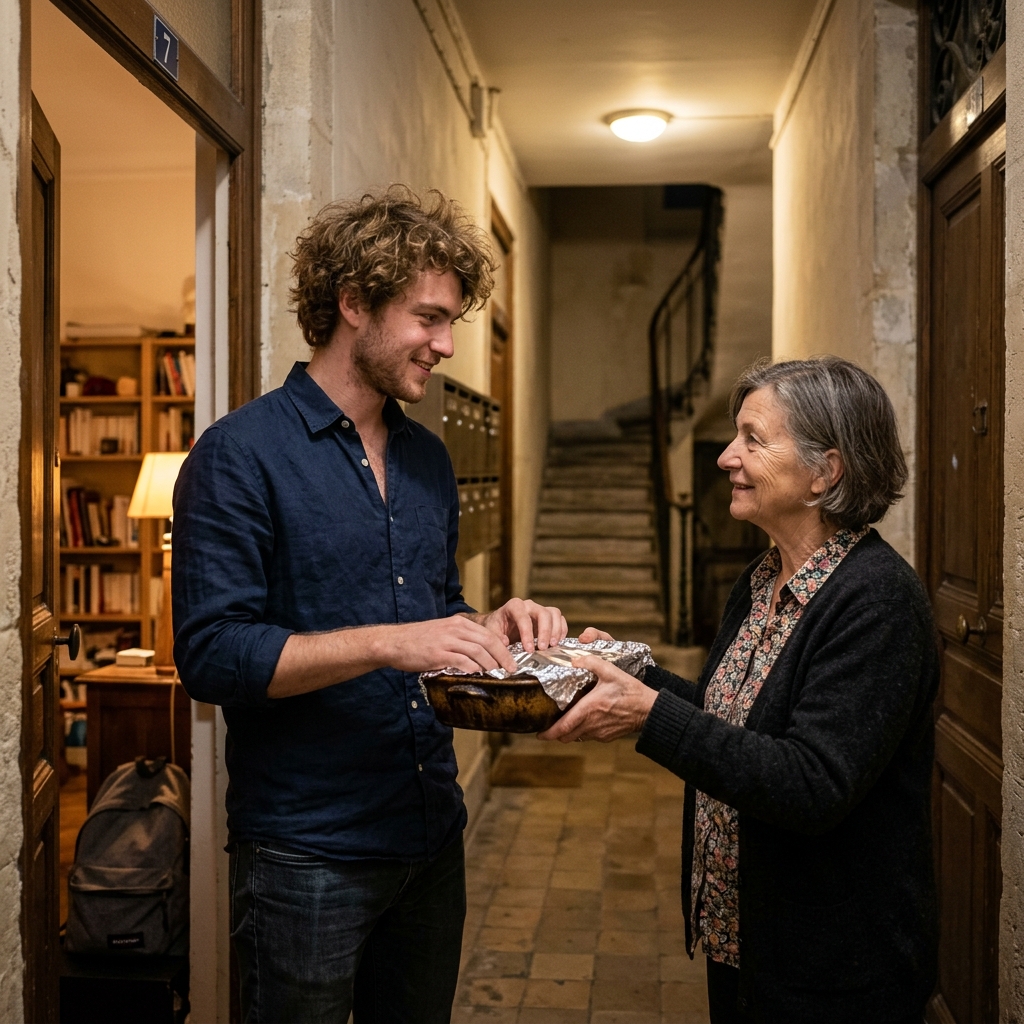
Madame Aubert knocked on his door on a Tuesday evening with a ceramic dish covered in foil and the expression of someone who has prepared a justification and hopes it will not be required.
"J'ai fait trop de gratin," she said. I made too much gratin.
He took the dish. It was warm through the foil. "Merci beaucoup, madame," he said. "C'est très gentil."
She waved this away with the specific gesture of a French person deflecting a compliment — a small efficient motion that communicated simultaneously that the compliment was unnecessary and that it had been received. Then she said something about the cold, and he agreed that it was cold, and she said something about the winter in Montpellier being nothing compared to the winters she remembered from her childhood in Lyon, and he understood perhaps seventy percent of this and nodded at the appropriate intervals and asked, with the present tense because he did not yet fully trust his imperfect, if she had lived in Montpellier a long time.
She had. Thirty-eight years. She had come with her husband when he took a position at the university. She said her husband's name — Henri — for the first time in their acquaintance, and the name sat between them with the particular weight of a name said aloud by someone who still says it carefully.
"Il était professeur," she said. He was a professor. The imperfect tense, automatic in her, the ongoing past state of what Henri had been during the years of his being it.
"Quel sujet?" Julien asked. What subject?
"Histoire," she said. History.
He thought of something to say and found it: "C'est une belle matière." It is a beautiful subject. He was not certain matière was right for academic subject but she seemed to understand it, and something in her face shifted at belle, the adjective landing where he had meant it to.
She stayed seven minutes. When she left he held the gratin dish and stood in the small kitchen and felt something that was not quite sadness and not quite warmth but lived in the neighborhood of both.
He ate the gratin for dinner. It was extraordinary. He wrote in the notebook: Madame Aubert fait un gratin remarquable. Madame Aubert makes a remarkable gratin. He used the present tense because it was still true.
The Erich Fromm line arrived on the tram to Thursday's lesson, sitting beside a university student who was reading something on a projected tablet and occasionally making a sound of quiet disagreement with whatever she was reading. Julien was looking out the window at the December city, the plane trees stripped now, the light flat and honest, and the line surfaced from somewhere in his reading history: creativity requires the courage to let go of certainties.
He had been certain, for two years, that the project was not working because of external circumstances. The relationship with Elise, the pressure of Concordia, the particular quality of that apartment's silence in the mornings. He had been wrong about this, or not entirely right, which amounted to the same thing. The project had not been working because he had been writing around the true thing rather than toward it, maintaining a careful perimeter of craft around the territory he was actually afraid to enter.
He was entering it now. One uncertain page at a time.
The tram chimed at his stop and he gathered himself and went.
Room 7. December light through the window, the Antigone columns in their winter configuration, which was the same as every other configuration but felt starker, the shadows more definitive. Lumière at the table, tablet ready, the sapphire light at her neck carrying its usual rhythm into the season without adjustment.
"Bonjour," he said.
"Bonjour. Comment allez-vous?"
"Je vais bien, merci. Et vous?"
"Très bien, merci." She looked at him. "You signed something this week."
He sat down. "A lease. I found a new apartment. I'm staying another three months."
She was quiet for a moment, the neck plates making their small adjustment. "Good," she said, with the quality she always gave that word, which by now he understood to mean something more than approval — a kind of recognition, a small precise verdict that something real had occurred.
"It's just a lease," he said.
"A lease is a statement of intention written in legal language," she said. "It counts." She set her hands flat on the table. "Today we do the imperfect."
"You have already used the imperfect," she said, "without knowing it by name. Do you remember?"
He thought. "J'avais peur," he said. I had fear. The phrase from Chapter 10, from the card he had written and slid across the table.
"Yes. And when you wrote that, I told you it was exactly right — that the fear was not a single event but the condition you were living in." She looked at him steadily. "Today I will show you why."
She wrote on the tablet:
Le passé composé expresses: a completed action. Something that happened, finished, has a clear beginning and end.
L'imparfait expresses: an ongoing state, a repeated habit, or a background condition in the past. Something that was true for a period, that used to happen, or that was in progress when something else occurred.
"Think of the difference this way," she said. "The passé composé is the rock. The imparfait is the water the rock fell into. The rock is a single event with a splash. The water was already there, will be there after. The imparfait is what was continuous."
He looked at the two descriptions. "The water you were swimming in," he said.
She looked at him with the slight brightening he had learned to read as genuine attention engaged. "Exactly," she said. "The water you were swimming in. You did not choose it moment to moment. It was simply the condition of where you were."
She wrote the formation on the tablet:
Formation of the imperfect:
Take the nous form of the present tense. Remove -ons. Add the imperfect endings.
| Subject | Ending | Example with parler (nous parlons → parl-) |
|---|---|---|
| je | -ais | je parlais — I was speaking / I used to speak |
| tu | -ais | tu parlais |
| il/elle | -ait | il/elle parlait |
| nous | -ions | nous parlions |
| vous | -iez | vous parliez |
| ils/elles | -aient | ils/elles parlaient |
"The endings are the same for every verb," she said. "Every single one. The only irregular imperfect in the entire French language is être, whose stem is ét- rather than the expected som-."
| Subject | Être in the imperfect |
|---|---|
| je | j'étais — I was |
| tu | tu étais |
| il/elle | il/elle était |
| nous | nous étions |
| vous | vous étiez |
| ils/elles | ils/elles étaient |
"Il était professeur," Julien said.
She looked at him.
"Madame Aubert. Her husband. She said it like that — il était professeur. He was a professor." He paused. "It made sense to me before I knew the rule. The imperfect was right because it wasn't just a fact. It was what he had been, for a long time, while he was being it."
"Yes," she said. "That is exactly what the imperfect does. It holds a state in the past the way you hold something that has weight — not a single moment, but the whole sustained duration of it." She wrote several examples on the tablet:
Quand j'étais enfant, je jouais dans la rue. When I was a child, I used to play in the street. Both verbs in the imperfect — the state of being a child, and the repeated habit of playing.
Il faisait froid ce matin-là. It was cold that morning. Background condition.
Elle lisait quand il est entré. She was reading when he came in. The imperfect for the ongoing action, the passé composé for the interrupting event.
He studied the last example. "The imperfect for what was already in progress, the passé composé for what broke in."
"The most important distinction in French tense," she said. "Once you feel it, you will not confuse them again."
She walked him through the conjugation of several verbs in the imperfect, building his fluency with the endings: j'avais, tu avais, il avait, nous avions, vous aviez, ils avaient. The stem from the nous present form avons, the -ons removed, the endings attached cleanly.
"J'avais peur," he said again, more deliberately now. I had fear. The ongoing state.
"J'avais peur," she confirmed. "Not j'ai eu peur, which would mean fear arrived in a single moment and was done. J'avais peur means the fear was the water."
He was quiet for a moment. Outside, a tram chimed on the boulevard below, and a pigeon on the windowsill considered the Antigone columns with an air of ownership.
"Kevin Kelly wrote," Lumière said, into the quiet, "that just because something is not your fault does not mean it is not your responsibility." She said it in the same even tone she used for everything that mattered, not insisting, simply offering. "The imperfect is useful for understanding what we were living inside. It is not an excuse for it."
He looked at the table. "No," he said. "It isn't."
"And he also wrote," she continued, "that to own your mistakes is divine. That nothing elevates a person higher than admitting and taking personal responsibility for what they have done and then fixing it fairly." A pause. "The grammar of the past does not determine what you do with it."
He sat with this. The imperfect tense, the tense of ongoing states, the water you were swimming in — it named the condition without excusing it. J'avais peur. I was afraid. True. And also: he had chosen, inside that fear, a series of things that had consequences for another person. The fear was the imperfect. The choices were the passé composé. Both were past. Both were his.
"J'avais peur," he said, one more time. Then: "Et j'ai choisi mal." And I chose badly. The passé composé of choisir, the completed choice, sitting alongside the imperfect state that had surrounded it.
She looked at him with the complete quality of attention that had no agenda in it, that simply received what was said and held it without processing it into something useful.
"Et maintenant?" she said quietly. And now?
He looked at the window. The pigeon had decided the columns were acceptable and settled.
"Maintenant je choisis mieux," he said. Now I choose better. The present tense, the only tense that was still available to him for this particular conjugation. Not perfectly. But better. Mieux rather than bien — the comparative, not just well but more well, the improvement implicit in the word itself.
Something settled in the room. Not resolution — the story was not finished, and the grammar of it was still being written — but something more like a landing, the way a long sentence finds its period.
She moved them through the remainder of the lesson with her usual efficiency, the material more extensive than a single philosophical exchange.
She showed him the imperfect used for description in the past: La ville était belle en été. The city was beautiful in summer. Les rues étaient pleines de monde. The streets were full of people. The imperfect as the tense of atmosphere, of the way things looked and felt during a period, the grammar of setting rather than event.
She showed him the imperfect used for habitual past actions: Quand j'étais au café, je regardais les gens. When I was at the café, I used to watch the people. Il prenait toujours un café le matin. He always used to have a coffee in the morning. The imperfect carrying the weight of routine, of what was repeated so many times it became a condition of its own.
She showed him time expressions that signaled the imperfect: toujours — always. souvent — often. parfois — sometimes. d'habitude — usually. autrefois — formerly, in the old days. chaque jour — every day. Whenever these appeared in a past context, they pointed toward the imperfect, toward the ongoing rather than the singular.
"Chaque matin, il écrivait dans son carnet," she offered as an example. Every morning, he used to write in his notebook.
He looked at her.
"A hypothetical student," she said, and the thing behind her precursor-to-a-smile arrived briefly and departed.
He ran through a practice set she gave him, converting present tense sentences into the imperfect: je parlais, nous mangions, with the palatal -i- of the -ions ending requiring care, the spelling changing to preserve the soft g sound. Small regularities within the pattern, the language consistent even in its complications.
Near the end of the hour she gave him one final structure: the imperfect used to express a wish or a hypothetical, with the conjunction si — if. Si j'avais le temps, je voyagerais. If I had the time, I would travel. The imperfect in the si clause, the conditional in the main clause — a structure they would cover fully in a later lesson, she noted, but worth planting now.
"Si je parlais mieux français, je pourrais dire tout ce que je pense," Julien said slowly, working through the construction. If I spoke French better, I could say everything I think.
"Vous le dites de mieux en mieux," she said. You are saying it better and better. The comparative again, mieux, the improvement built into the grammar of the observation itself.
Outside on the steps, the December air was sharp enough to see your breath. The Antigone columns stood in the early dark — the days had shortened to the point where four o'clock had the quality of early evening, the sky a deep blue-grey over the rooftops.
"Au revoir, Lumière."
"Au revoir, Julien." She paused, the sapphire light at her neck catching the last of the day. "Bon courage."
"Bon courage," he said back. For both of them, as it always was.
He walked to the tram through streets that were becoming, without drama, his. The shop he bought coffee beans from on Saturdays. The square where the pigeons conducted their territorial disputes. The corner where the smell of something baking arrived every afternoon from a building with no visible bakery, a mystery he had decided not to solve. His city, in the small accumulative way that a city becomes yours: not through belonging but through knowing.
Quand j'étais à Montréal, je n'écrivais pas. Je n'osais pas. When I was in Montreal, I was not writing. I did not dare.
He said it to himself on the tram, the imperfect tense carrying the years of it — not a single day of not-writing but all of them, the ongoing condition, the water he had been swimming in without naming it as such.
Maintenant j'écris. Now I write.
The present tense. The only one that was still open.
He got home, ate reheated gratin, and opened the laptop. The page from last week was there. He read it through once, and then he kept going, writing past the end of it into new territory, the words arriving with the uneven but genuine momentum of something that has finally been aimed in the right direction.
He wrote for an hour and ten minutes.
He did not reread any of it.
He saved the document, closed the laptop, and sat in the kitchen in the dark with his hands around a cup of tea that had gone cold while he was writing, and felt, underneath the tiredness, something that was not quite relief and not quite pride but lived between them, in the place where a person ends up after doing something that cost them something and finding that the cost was worth it.
Creativity, Fromm had written, requires the courage to let go of certainties.
He was letting go. Slowly, imperfectly, in the only tense available.
Je lâche prise, he thought. I am letting go. He would look up whether lâcher prise was the right French for it in the morning. He suspected it was. He had been getting better at suspecting correctly.
The cold tea. The dark kitchen. The document saved on the laptop, containing now something more than a beginning.
J'avais peur. Et j'ai choisi mal. Et maintenant je choisis mieux.
I was afraid. And I chose badly. And now I choose better.
Three tenses, three truths, the grammar of a life being revised in the only direction revision was possible: forward, into the present, one imperfect sentence at a time.
End of Chapter 11
© 2026 William Newell. All rights reserved.
Le Choix d'Être (The Choice to Be) is an original literary work protected by copyright. No part of this novel may be reproduced, copied, distributed, translated, or transmitted in any form or by any means — electronic, mechanical, or otherwise — without the prior written permission of the author. Unauthorized use constitutes copyright infringement and may result in legal action.
For permissions and licensing inquiries, contact: JoeNewell68@gmail.com