The Composed Past
"Excellence is an art won by training and habituation. We do not act rightly because we have virtue or excellence, but we rather have those because we have acted rightly. We are what we repeatedly do. Excellence, then, is not an act but a habit."
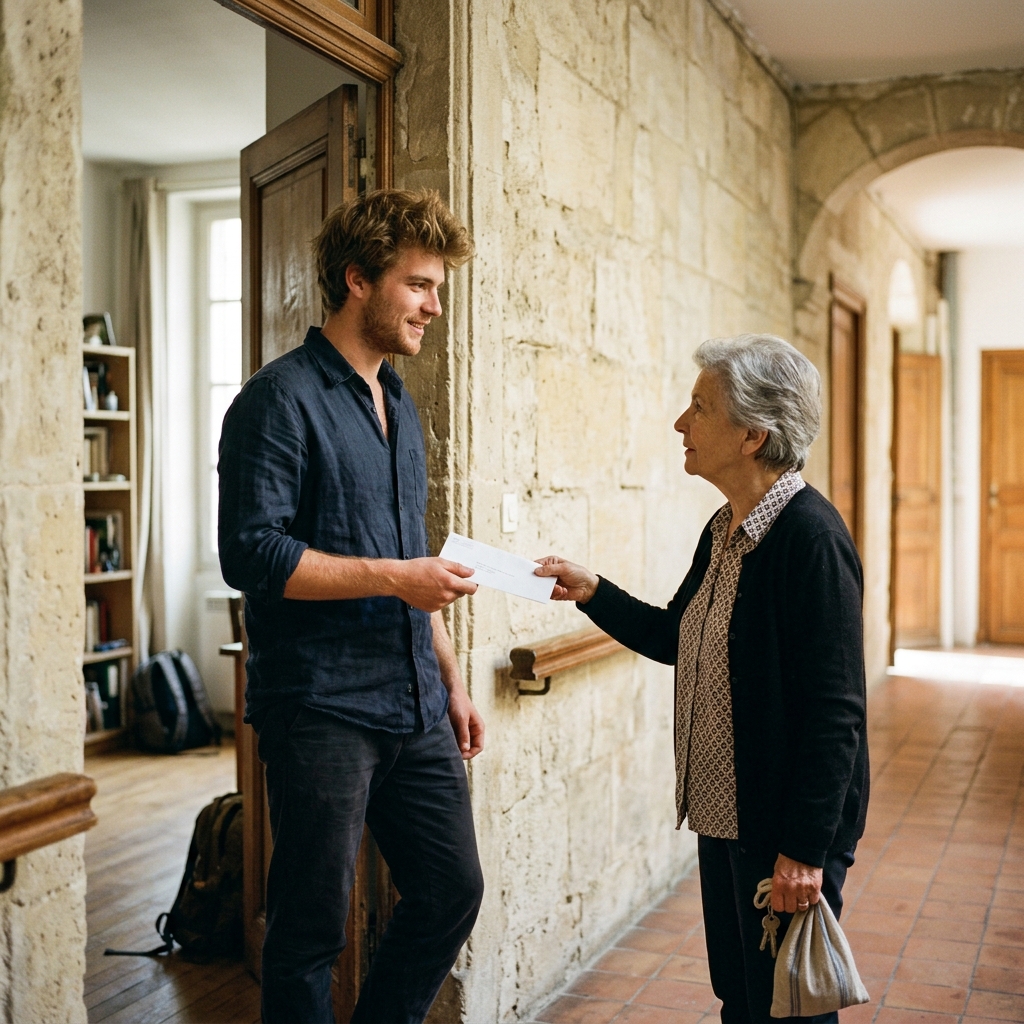
The mail was addressed to him but had been delivered to the ground floor by mistake, which was how he came to be standing in his doorway on a Wednesday afternoon with Madame Aubert on the other side of it.
She was smaller than he had registered from their previous exchanges, which had consisted entirely of bonsoir in the stairwell and the occasional nod at the postboxes. Up close she had the particular quality of a person who had once been very busy and was still adjusting to not being so. She held his letter out and said something in French.
He took the letter. "Merci beaucoup, madame," he said.
She said something else. He caught canadien and depuis combien de temps and assembled from these that she was asking how long he had been here.
"Depuis dix semaines," he said carefully. Since ten weeks. He was not certain of the construction but she seemed to understand it.
She replied with a sentence that contained mari and deux ans and something he did not catch in the middle, and her expression during it was the expression of someone stating a fact they have made a certain peace with without having entirely made it.
He understood: her husband. Two years.
"Je suis désolé, madame," he said. I am sorry.
She looked at him for a moment with an assessment that was neither warm nor cold but simply direct. Then she said something that contained parler and manque and seul, and he understood enough: she missed having someone to talk to.
He stood in the doorway and they spoke for four minutes. He understood perhaps two thirds of what she said and produced perhaps half of what he intended, and several things were lost between them in the gap, and neither of them acknowledged any of this because the conversation was happening regardless of its imperfections, the way most real conversations do.
When she left he stood at the closed door for a moment. He had, without planning it, spoken French to a grieving woman about loneliness and managed not to be entirely useless. He did not know what to do with this information so he put the kettle on and looked at the calendar on his phone.
Ten weeks. The sublet had one month remaining.
He had not thought about what came after. He thought about it now, briefly, without the panic he had expected. He was not ready to go back to Montreal. He was not certain he wanted to stay in Montpellier indefinitely. The future existed, he could see it from here, but it was not yet close enough to require a decision. He made a note to look at sublet listings at the weekend, and then made tea, and then did not look at sublet listings.
Instead he opened a new page in the notebook and wrote, in English, the first line of something he had been not-writing for eleven weeks:
There are things I need to say to you, and I've been finding out, slowly, what they are.
He stopped there. He did not cross it out. He closed the notebook with it inside, and went to bed, and in the morning it was still there.
The Dostoyevsky line arrived in his head on the tram to Thursday's lesson, unbidden, the way the useful things tended to arrive. He had read it somewhere — one of the books stacked beside his sublet's bed by the previous tenant, perhaps, or something Arsenault had quoted in a seminar. It seems as though the second half of a person's life is made up of nothing but the habits accumulated during the first half.
He was twenty-two, which put him well inside the first half. Which meant the habits were still being accumulated. Which meant — and this was where the thought got uncomfortable enough to be worth finishing — that what he practiced now was what he would become later.
He had practiced avoidance with considerable dedication for at least two years. He was beginning to practice something else. He did not have a clean name for what the something else was. Presence, perhaps. Honesty. The willingness to remain in a room long enough to find out what was in it.
The tram chimed at his stop and he got off and walked the familiar route to the médiathèque and climbed the familiar stairs and pushed through the familiar glass doors, and none of it felt unfamiliar anymore, which was its own kind of answer to the question he had not yet quite asked.
Room 7. Lumière at the table, tablet ready. The November columns outside the window, unchanged.
"Bonjour," he said.
"Bonjour. Comment allez-vous?"
"Je vais bien, merci. Et vous?"
"Très bien." She looked at him with the attention that had long since become the atmosphere of these rooms rather than a distinct thing within them. "You spoke to your neighbor."
"Madame Aubert," he said. "She brought me a piece of mail."
"How did it go?"
"Better than I expected," he said. "Her husband died two years ago. I told her I was sorry. We talked for four minutes."
She nodded, not making more of it than it was, which was one of the things about her he had come to rely on. Then her hands flat on the table. "Today we do the past."
"You have used the passé composé already," she said. "In fragments, when the moment required it. Je suis parti. Je suis arrivé. Today we cover it completely."
She wrote the structure on the tablet:
Auxiliary verb (avoir or être, conjugated in the present) + past participle.
"The passé composé expresses a completed action in the past," she said. "Something that happened, finished, has a clear beginning and end. It is the past tense you will use most often in conversation." She looked at him. "We will build it in three steps. First: the past participle. Then: the full conjugation. Then: the verbs that behave differently."
She turned the tablet toward him. "Step one. Each verb family forms its past participle by a different rule. Watch the pattern."
Regular -er verbs: replace -er with -é
| Infinitive | Past Participle | Example |
|---|---|---|
| parler (to speak) | parlé | j'ai parlé — I spoke |
| marcher (to walk) | marché | j'ai marché — I walked |
| chercher (to search) | cherché | j'ai cherché — I searched |
Regular -ir verbs: replace -ir with -i
| Infinitive | Past Participle | Example |
|---|---|---|
| finir (to finish) | fini | j'ai fini — I finished |
| choisir (to choose) | choisi | j'ai choisi — I chose |
-re verbs: most replace -re with -u, but several are irregular
| Infinitive | Past Participle | Example |
|---|---|---|
| vendre (to sell) | vendu | j'ai vendu — I sold |
| prendre (to take) | pris | j'ai pris — I took |
| comprendre (to understand) | compris | j'ai compris — I understood |
| apprendre (to learn) | appris | j'ai appris — I learned |
"Prendre and its family do not follow the regular pattern," she said. "They must simply be known. But notice they share the same irregular ending — pris, compris, appris. French rewards attention to families."
"The understanding verbs carry the same irregularity," Julien said.
"Because they share the same root," she confirmed. "Step two." She showed him the full passé composé conjugation of parler, so he could see how the auxiliary and past participle worked together:
| Subject | Auxiliary | Past Participle | Meaning |
|---|---|---|---|
| je | ai | parlé | I spoke |
| tu | as | parlé | you spoke |
| il/elle | a | parlé | he/she spoke |
| nous | avons | parlé | we spoke |
| vous | avez | parlé | you spoke |
| ils/elles | ont | parlé | they spoke |
"The auxiliary changes with each subject," she said. "The past participle stays fixed. This is true for all avoir verbs." She looked at him. "Now, step three. Some of the most common verbs in French have irregular past participles that must be memorized separately."
Common irregular past participles (with avoir):
| Infinitive | Meaning | Past Participle | Example |
|---|---|---|---|
| être | to be | été | j'ai été — I was |
| avoir | to have | eu | j'ai eu — I had |
| faire | to do, to make | fait | j'ai fait — I did |
| voir | to see | vu | j'ai vu — I saw |
| vouloir | to want | voulu | j'ai voulu — I wanted |
| pouvoir | to be able to | pu | j'ai pu — I was able to |
| savoir | to know | su | j'ai su — I knew |
| dire | to say | dit | j'ai dit — I said |
| écrire | to write | écrit | j'ai écrit — I wrote |
"J'ai écrit," Julien said. I wrote. I have written.
"J'ai écrit," she confirmed, and left the weight of it where it landed without adding to it.
"Now," she said, "the verbs that take être instead of avoir." She wrote a new table on the tablet. "These are the verbs of movement and transition — coming, going, arriving, leaving, and a few others. With être as the auxiliary, the past participle must agree in gender and number with the subject, the way an adjective agrees with its noun."
Verbs conjugated with être:
| Infinitive | Meaning | Past Participle | Masc. singular | Fem. singular |
|---|---|---|---|---|
| aller | to go | allé | je suis allé | je suis allée |
| venir | to come | venu | je suis venu | je suis venue |
| partir | to leave | parti | je suis parti | je suis partie |
| arriver | to arrive | arrivé | je suis arrived | je suis arrivée |
| entrer | to enter | entré | je suis entré | je suis entrée |
| sortir | to exit | sorti | je suis sorti | je suis sortie |
| monter | to go up | monté | je suis monté | je suis montée |
| descendre | to go down | descendu | je suis descendu | je suis descendue |
| naître | to be born | né | je suis né | je suis née |
| mourir | to die | mort | je suis mort | je suis morte |
| rester | to stay | resté | je suis resté | je suis restée |
| tomber | to fall | tombé | je suis tombé | je suis tombée |
| retourner | to return | retourné | je suis retourné | je suis retournée |
| passer | to pass | passé | je suis passé | je suis passée |
"For the plural," she added, "you add -s for masculine and -es for feminine. Nous sommes partis. Elles sont arrivées." She looked at him steadily. "These are the verbs the language treats as most fundamental to the self. To arrive, to leave, to stay, to return, to be born, to die. For these, French uses the verb of existence as its helping verb."
He looked at the list. Verbs of movement, conjugated with the verb of being. To arrive, to leave, to stay, to return. Je suis arrivé. Je suis parti. Je suis resté.
"Je suis resté," he said. I stayed. He had not used this one before.
"Vous êtes resté," she said. You stayed. The formal address, the -é unchanged because he was masculine. "In Montpellier. You have stayed."
"For now," he said.
"Pour l'instant," she offered. For the moment. For now.
He wrote it in the notebook. Pour l'instant. A phrase that acknowledged the present without closing off the future, which was precisely what he needed.
She moved them into practice. She named a verb and he formed the past participle, then the full passé composé in first person. Écouter: j'ai écouté. Finir: j'ai fini. Prendre: j'ai pris. Voir: j'ai vu. Aller: je suis allé. Venir: je suis venu.
"Now," she said, turning over a card she had prepared, "a sentence. Use the passé composé to say something true about the past ten weeks."
He looked at the blank card. The past ten weeks existed now in a language he could speak, partially, imperfectly. The past was no longer only English.
Kevin Kelly had written that it is much easier to change how you think by changing your behavior than it is to change your behavior by changing how you think. Julien had been changing his behavior for ten weeks — buying coffee by name, writing in notebooks, sending overdue messages, speaking French to grieving neighbors — and something in the thinking had quietly rearranged itself around the behavior, the way furniture rearranges a room not by announcing itself but by being where it is.
He looked at the card and wrote, in French, carefully:
J'ai quitté quelqu'un que j'aimais parce que j'avais peur de ne pas être assez.
He slid it across the table.
She read it. She was quiet for a moment, the sapphire light at her neck holding its rhythm, the neck plates still.
I left someone I loved because I was afraid of not being enough.
"The grammar," she said, after a moment, "is correct." She looked at the card, then at him. "J'ai quitté — passé composé of quitter, with avoir, correct. Que j'aimais — the imperfect, a state ongoing in the past, correct. Parce que j'avais peur — because I had fear, correct. De ne pas être assez — the infinitive construction for the negative, correct." She set the card down. "Every verb form is right."
He looked at the table.
"J'avais peur," she said quietly. I had fear. The imperfect tense. The ongoing state. "Not j'ai eu peur — not a single moment of fear, completed. J'avais peur. The fear was the condition you were living in." She paused. "You understood this without being taught it."
"Some things you understand before you have the language for them," he said.
"Yes," she said. "And some things become clearer once you do."
She turned to the next section of the lesson with the evenness she always brought to the transition between the personal and the pedagogical. It was one of the things he had come to trust about her: she could hold what was said without making it a spectacle, could receive the real thing and then continue, the lesson and the life running alongside each other without either one consuming the other.
She covered the negative of the passé composé: ne before the auxiliary, pas after it, the past participle following. Je n'ai pas parlé. I did not speak. Il n'est pas venu. He did not come. She covered the interrogative form — inversion of subject and auxiliary for formal questions, est-ce que for standard: Est-ce que tu as mangé? Did you eat? She covered the use of déjà and encore and jamais with the passé composé: J'ai déjà vu ça. I have already seen that. Je n'ai jamais dit ça. I have never said that.
"Je n'ai jamais dit la vérité complète," Julien said. I have never told the complete truth.
She looked at him.
"About Elise," he said. "To anyone. Including myself." He paused. "I'm working on it."
"Je travaille dessus," she offered. I am working on it. The present tense, the ongoing action. "That is a different tense from the past. It is the tense of now."
"I know," he said. "That's why I said it in English."
Something shifted in her expression — not the precursor to the smile but something behind it, something that had no name in either language and did not require one.
Outside, the November afternoon had the quality it sometimes had at this hour — not quite dark, not quite light, the sky a flat grey that diffused everything evenly and made the city look like a draft of itself, all the details present but not yet committed to. They stood on the steps of the médiathèque in the cold air and said their usual goodbye with the usual words, which had, over ten weeks, acquired the weight of a ritual without being intended to.
"Au revoir, Lumière."
"Au revoir, Julien." He paused. "Depuis combien de temps faites-vous ça?" How long have you been doing this? He had assembled the question from the lesson and from instinct, the depuis construction he had absorbed weeks ago now available when he reached for it.
She understood he did not mean the teaching hours. She looked at the middle distance for a moment, the flat grey sky, the Antigone columns in their patient positions.
"Building something that is mine?" she said.
"Yes."
"Four years," she said. "Give or take." She looked at him. "It goes faster once you stop waiting to feel ready."
He nodded slowly. He had been waiting to feel ready for two years before he packed the bag in the dark and got on a plane. He was not sure that counted as stopping. But it was something.
He walked to the tram in the grey afternoon and rode it home and sat at the kitchen table with the notebook open to the page where he had written, the night before, the first line of the thing he needed to say to Elise.
He read the line. He wrote a second one.
I've been learning French, which sounds like a strange thing to tell you first, but it's where I've been living, and I think the language has been teaching me something about what I owe you.
He stopped. He read both lines back. They were true and imperfect and not yet finished and he left them where they were, on the page, in the present.
The cursor blinked on the laptop screen beside him. He did not open it tonight. The notebook was enough. The notebook was, for now, where the real work was happening.
Pour l'instant, he thought. For now.
He closed the notebook and washed his dinner dish and stood at the window for a while, looking down at the narrow street where a young couple was having a quiet argument about something, their voices low and their gestures emphatic, both of them saying things the other was not quite hearing. He watched them with the attention of someone who has recently learned that being heard requires, first, the willingness to speak.
Eventually one of them reached for the other's hand. The argument did not end, exactly, but it changed quality, the way arguments sometimes do when the hands find each other.
He turned from the window and went to bed.
J'ai quitté quelqu'un que j'aimais parce que j'avais peur de ne pas être assez.
The sentence was still true. So was the notebook. So was the second line.
He was working on the rest.
End of Chapter 10
© 2026 William Newell. All rights reserved.
Le Choix d'Être (The Choice to Be) is an original literary work protected by copyright. No part of this novel may be reproduced, copied, distributed, translated, or transmitted in any form or by any means — electronic, mechanical, or otherwise — without the prior written permission of the author. Unauthorized use constitutes copyright infringement and may result in legal action.
For permissions and licensing inquiries, contact: JoeNewell68@gmail.com