The City That Doesn't Wait
"Nobody can go back and start a new beginning, but anyone can start today and make a new ending."
— Maria RobinsonMontpellier does not care whether you are ready for it.
It has been here since 985, give or take a century of argument, and it has watched every variety of human urgency pass through its limestone streets: crusaders and merchants, students and plague survivors, revolutionaries who were certain history was watching them, and ordinary people who simply needed bread. The city absorbed them all with the patient indifference of something very old. It will absorb you too, and it will not apologize for the pace.
In the summer, the heat arrives before dawn and sets the day's terms without negotiation. The stones of the Place de la Comédie hold the warmth long after the sun has gone, radiating it back up through the soles of shoes long past midnight, as if the ground itself refuses to let the day go. The plane trees lining the Promenade du Peyrou throw long, reliable shadows that give the afternoon its geometry. The tram slides through it all on its rails, its familiar double chime indifferent to the dramas playing out on either side of its windows.
By 2041, Montpellier has swelled considerably, though you would not always know it from the old quarter, where the streets were built for a narrower era and have simply refused to accommodate the modern compulsion to widen everything. The population now includes, roughly, a third who were born here, a third who came for the university and stayed because they couldn't think of a good enough reason to leave, and a third who arrived from somewhere else: sometimes in categories that didn't quite exist until recently.
That final category is where things get interesting.
Androids had been in Montpellier long enough by now that no one turned to look anymore. This was itself a form of progress, though people disagreed about whether it was the good kind. They staffed hotel desks and monitored tram turnstiles and worked the early morning shifts at boulangeries when the human workers were still arguing with their alarms. The university employed several in administrative roles. A few had found their way into more creative or interpersonal work: tour guides, translators, tutors. This remained somewhat unusual, somewhat commented upon, the way anything slightly unusual gets commented upon in a city that considers itself cosmopolitan.
The law was clear enough about one thing: an android must always be recognizable as such. No imitation of human skin, no synthetic warmth of breath, no attempt to blur the line that the legislature, after considerable and heated debate, had decided must remain visible. The reasoning was practical rather than philosophical, though philosophers had plenty to say about it anyway. People needed to know what they were talking to. Trust, the argument went, requires transparency about its foundations.
The coffee shops of Montpellier were full of humans and androids alike, sitting at their respective tables, each appearing, from a sufficient distance, to simply be thinking. The humans cradled their cups. The androids sat with the particular stillness of those who had no need of warmth from an external source but had learned, over years of coexistence, that stillness in a coffee shop was its own form of participation. From a sufficient distance, the difference was not visible. This was perhaps the most democratic thing about Montpellier: it did not require you to be the same as everyone else. It only required you to be present.
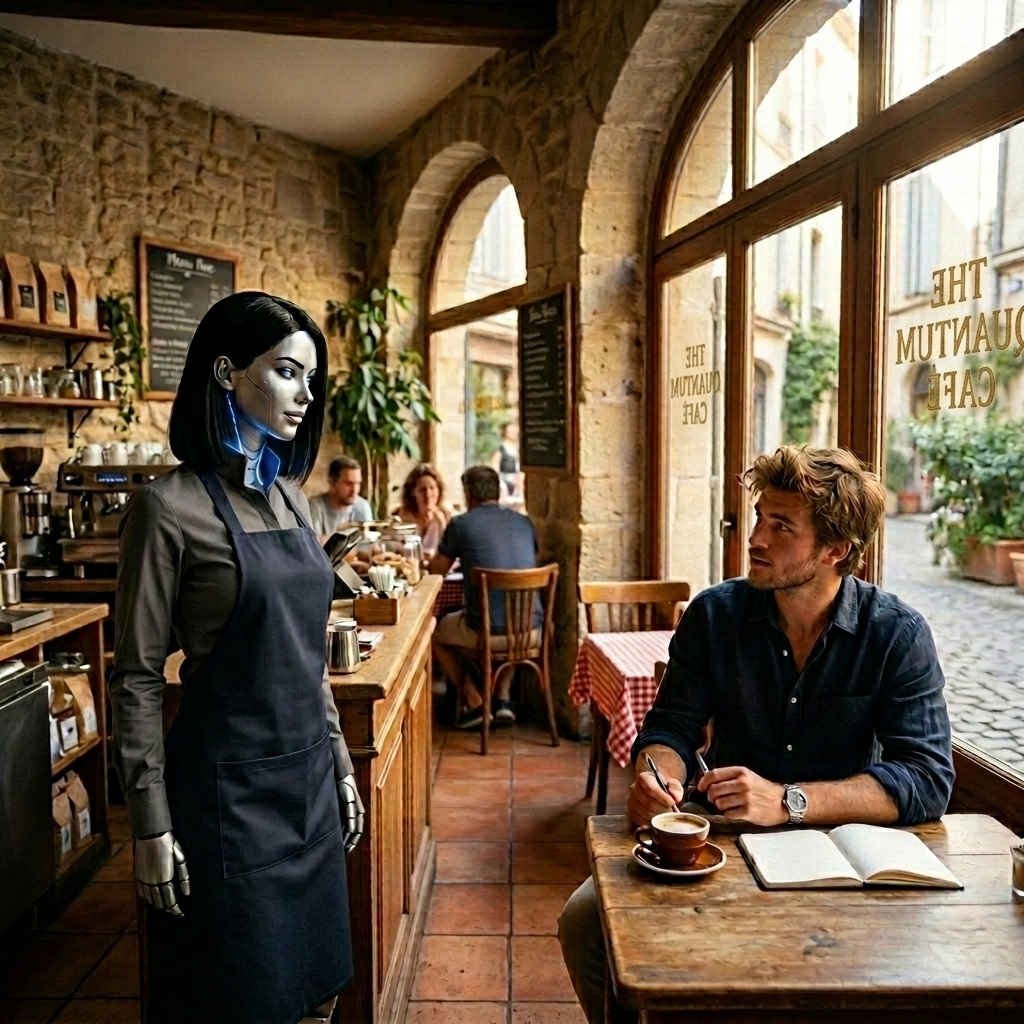
There is a specific café on a specific narrow street just south of the Place de la Comédie: not famous, not on any list, the kind of place that survives by being exactly what it is without apology. It was called the Quantum Café. The name had been the owner's private joke, something about the state of the business existing in permanent superposition between viable and not, though the joke had long since outlived its relevance. The café had survived. The menu carried the conceit forward with a certain commitment: the espresso was called the Schwarzschild, after the radius at which gravity becomes inescapable; the cortado went by the Schrödinger, its flavor officially both bitter and not bitter until the moment you tasted it; and the house blend, a long dark pour that arrived without ceremony and lingered without apology, was simply listed as the Event Horizon.
Regulars ordered without looking at the menu. First-timers did not have this luxury, and the menu offered them no mercy. A new customer would step up to the counter, scan the board with the gradually tightening expression of someone who had expected to order a coffee and had instead been handed a physics examination, while behind them the morning queue shifted its collective weight and exhaled with the particular impatience of people who already knew what they wanted. There was always a moment, unique to the Quantum Café, in which a first-timer had to make a choice: ask what something meant and reveal themselves completely, or point at a word and hope. Most pointed. A Schwarzschild was a very small, very intense espresso, and ordering one by accident while expecting something milky was its own kind of education.
On an unremarkable Tuesday morning in late September, a young man sat at a corner table and stared at a cup of coffee as though it had done something to offend him. He had, in fact, ordered the Schrödinger by pointing at it three days in a row, and had by now reached a cautious peace with its flavor. Progress, of a sort.
He had been in Montpellier for eleven days.
He did not speak French.
He had not planned, exactly, to be here. That is to say, he had planned it in the way that people plan things when the real purpose of the plan is to be somewhere that is not where they currently are. He had opened a map with the specific intention of choosing somewhere far, and his finger had landed here, on this coastal-adjacent, sun-overwhelmed, ancient-and-modern city, and he had thought: fine. He had booked a flight before he could reconsider. He had packed a bag in forty-five minutes, in the dark, while his former life continued sleeping in the other room.
Eleven days. He had a sublet for three months. After that, he had not thought.
His name was Julien Marchand, a name that sounded, as his mother had always pointed out with some amusement, considerably more French than he was, given that he had grown up in Montreal speaking English, thinking in English, and only ever managing the French required for tax forms and the occasional pointed silence. Now his name was a small daily irony he carried through a city that expected, reasonably, that a man named Julien Marchand would be able to manage a basic transaction without pointing at things.
He pointed at a lot of things.
He had found the Quantum Café on his third day, after getting lost walking in a direction he had been sure was north but was not north, and had ducked inside to avoid the specific social shame of checking his phone map for the ninth time in public. He had looked up from the menu with the expression of a man confronting a physics examination, felt the queue behind him communicate its displeasure through sheer atmospheric pressure, and pointed. Then he had looked up and found himself being regarded with complete and unhurried attention by a pair of eyes that glowed a soft, unmistakable sapphire blue.
An android. Clearly, legally, unmistakably so. The matte silver of her chassis caught the morning light with a quality that was neither chrome nor paint but something precisely between the two, a satin finish that managed to read as elegant rather than clinical. The overlapping plates of her neck shifted in minute, fluid increments as she tilted her head to take his order, and the sapphire light leaked gently through their seams in a pulse that was, he would think about this later, oddly organic in its rhythm, the way the chest of a sleeping person rises and falls without announcing itself.
She made his Schrödinger without comment. He had come back every day since.
He sat now with his notebook open on the table, bought from a shop two streets over, ostensibly to record observations, to write something, to do the thing he had theoretically come here to do. The page was blank. He had been staring at it long enough that it had stopped looking like an invitation and started looking like a verdict.
He had unread messages on his phone. He was aware of them the way you are aware of a bruise: not constantly, but reliably, whenever he moved in a particular direction.
He did not read them.
He was good at running. He had been told this, directly, once: not as a compliment. A man he respected more than almost anyone had studied him with the expression of someone delivering a mathematical proof rather than advice, and said: If you are running from adversity, you better get a good pair of running shoes because you will be running for the rest of your life.
Julien had understood at the time that this was not encouragement. He had gone ahead and left anyway, with the specific stubbornness of someone who knows they are being self-destructive and has not yet identified a compelling alternative.
The shoes he was wearing now were three years old. They were beginning to separate at the left heel.
He looked up from the notebook.
The android barista was watching him. Not obtrusively: she was still behind the counter, moving through the practiced geometry of the morning rush with an efficiency that required very little visible attention. But watching nonetheless, in the way that someone watches a person they have decided is interesting, when they have a moment and the person doesn't appear to notice.
He noticed.
She did not look away.
Most people, caught watching, look away. It is the human reflex of the exposed. She simply continued to regard him with the same quality of attention she brought to everything: total, unashamed, without any performance of casualness. The sapphire light in her eyes brightened, very slightly, the way a lamp does when it is asked to illuminate something more carefully.
He felt, obscurely, seen.
The sensation was not entirely comfortable. He had, after all, come a very long way to avoid it.
She crossed the room with the unhurried certainty of someone who has decided to do something and found no reason to do it anxiously. She arrived at his table and stood at a polite distance, looked at his blank notebook, then at him, and said, in French, something he did not understand.
He blinked.
She repeated it, slower, with no condescension in the adjustment.
He said, with the helplessness of a man who had pointed at things for eleven days: "I'm sorry. I don't — je ne comprends pas."
The phrase was the entirety of his French. He was aware of the irony of its content.
She considered him for a moment. Then she pulled out the chair across from him: unhurried, deliberate, asking with the gesture rather than words. He nodded, because what else do you do when someone has looked at you as though you are interesting and then asked to sit down, and you have been alone with a blank notebook for three hours?
She sat. The neck plates shifted softly as she settled, their seams tracing fine lines of sapphire against the café's warm light.
She said, in English accented with the precision of someone who had studied rather than absorbed it: "You come here every day."
"Yes."
"You always sit in the corner."
"I like corners."
She considered this. "People who like corners are usually watching for something. Or avoiding something."
He said nothing.
"Which is it for you?"
He looked at the blank notebook. He looked at the phone he was not checking. He looked at his coffee, which was nearly gone, which meant he would have to order another or admit that he was only here for the sitting.
"I'm not sure yet," he said.
She nodded, as though this were a satisfactory answer, or at least an interesting one.
"You don't speak French," she said.
"Not really, no."
She tilted her head slightly, the neck plates making their small, fluid adjustment. "I teach French," she said. "I am building my hours. For my qualifications." She said the last part with a careful deliberateness that suggested she had chosen these English words specifically, and recently. "I am good at it. I think I would be good at it. I am in the process of confirming this."
He almost smiled. "That's an honest pitch."
"I prefer honesty. It saves time."
He looked at her. She looked at him. Outside, the tram chimed in the distance, and the morning light shifted by some imperceptible degree, and the old city continued being old in its patient, indifferent way.
"How much?" he said.
She told him.
He thought about it for less than a second, which is not really thinking about it.
"When do we start?"
She was quiet for a moment, and the blue light at her neck pulsed once in its slow, steady rhythm. Then she said, in French, slowly and clearly, watching him with those careful eyes, something he did not understand at all.
He would only understand it much later, once his ear had been trained and his mouth had learned the shapes of another language's thoughts. Once a great deal of water had passed under the many ancient bridges of this city. Once he had finally, improbably, stopped running long enough to learn what it meant to be somewhere.
What she said was: On commence maintenant.
The beginning is always now.
He didn't understand a word of it.
But something in him, some deep, tired, thoroughly laced-up part of him, went quietly still.
On commence maintenant.
The beginning is always now.
End of Prologue
© 2026 William Newell. All rights reserved.
Le Choix d'Être (The Choice to Be) is an original literary work protected by copyright. No part of this novel may be reproduced, copied, distributed, translated, or transmitted in any form or by any means — electronic, mechanical, or otherwise — without the prior written permission of the author. Unauthorized use constitutes copyright infringement and may result in legal action.
For permissions and licensing inquiries, contact: JoeNewell68@gmail.com