Because It Was You, Because It Was Me
"Parce que c'était lui, parce que c'était moi."
(Because it was him, because it was me.)
She had said, at the end of the previous lesson, that the next one would be different. Not grammar. A French concept she wanted him to have before the year was fully over. She had not told him what it was.
He looked it up.
He found Montaigne. He found Les Essais, the essay on friendship, the passage where Montaigne is asked why he loved La Boétie so deeply, and finds that he cannot answer. Every reason he reaches for is inadequate. Every explanation dissolves under examination. He is finally left with the only sentence that is true: parce que c'était lui, parce que c'était moi. Because it was him, because it was me.
He read this on a Thursday evening and sat with it for a long time.
On Friday he wrote in the notebook, in French: Je crois que je comprends ce qu'elle va m'enseigner. I think I understand what she is going to teach me.
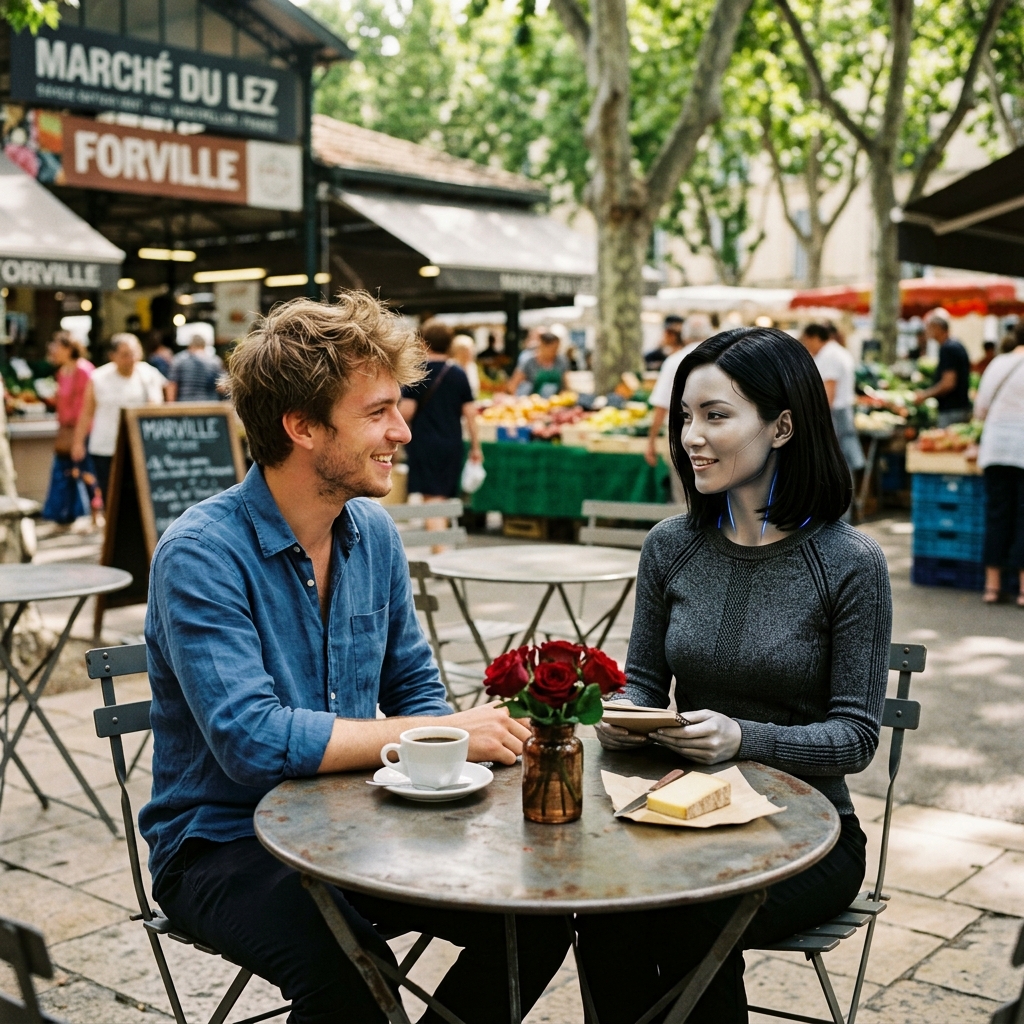
Saturday morning. The Marché du Lez.
He arrived at ten, as they had agreed, and she was already there at the entrance, in the mode he recognized as her unhurried version of early, not impatient, simply present before the appointed time because she had nowhere more pressing to be.
The market in June was full and warm and smelled of cut flowers and bread and the specific earthiness of good cheese in open air. Stalls ran the length of the space in both directions, vendors in the particular mode of Saturday morning sellers, not the urgent pitch of someone who needed to move product, but the settled confidence of people who knew their thing was good.
"Bonjour," he said.
"Bonjour," she said. Not the lesson beginning. Simply the greeting between two people who are glad to see each other on a Saturday morning at a market, in the ordinary register of a life that had become, without his fully noting the transition, ordinary in the best sense.
They walked. Not with a destination within the market, just through it, the flâner of it, the Saturday version of the Tuesday and Thursday walks.
"You looked it up," she said, after a few minutes. Not a question.
"Montaigne," he said.
"Et?"
He thought about how to answer. "Je crois que j'ai compris avant que tu l'enseignes. I think I understood before you taught it." He paused. "Or I thought I did. Now I'm not sure understanding is the right word."
She looked at him with the brightness in her eyes. "C'est exactement le bon endroit pour commencer," she said. That is exactly the right place to begin.
They passed a flower stall where the roses were the dark red of something that had decided to be completely itself. He bought a small bunch for Madame Aubert, which he would drop off on the way home, and tucked them under his arm.
"L'amitié profonde," she said, beginning the lesson without marking it as a lesson, no hands flat on a table, no tablet, just the two of them walking through the June market. "It is not a sentimental concept. It is a philosophical one. The French have thought about it more carefully than most cultures, perhaps because French culture has always taken the life of the mind seriously as a social activity, something done between people, in conversation, in correspondence, in genuine exchange."
"Montaigne and La Boétie," he said.
"Yes. But also Madame de Sévigné and her daughter, whose letters across twenty years are one of the great documents of l'amitié profonde in French literature. Also Sartre and Beauvoir, not only as companions but as genuine intellectual equals whose thinking was shaped by the exchange. The tradition is long." She paused to let a family with a stroller pass. "What distinguishes l'amitié profonde from ordinary friendship is not intensity or duration. It is the quality of mutual recognition. Each person sees the other clearly, and is changed by what they see."
He thought about the first lesson, Room 7, September. The person he had been, sitting down across from her with his forty-one abandoned pages and his Montreal French and his careful watching of everything from a safe distance. He thought about what she had seen then, before he had shown her anything worth seeing. She had taught him anyway, with the full allocation of attention she brought to everyone.
"The vocabulary," she said, "is important. French distinguishes between aimer and tenir à, which English collapses."
She led him through the words as they walked, each one given its weight and its difference from the others:
Tenir à, to hold dear, to care about specifically. Not general affection but the particular attachment to a particular person, irreplaceable by its nature. Je tiens à toi said not I love you but: you specifically matter to me in a way I would not want to be without.
Compter pour, to matter to. "Tu comptes beaucoup pour moi." You matter greatly to me. The verb of significance rather than feeling: the person who registers, whose presence and absence have weight.
Faire confiance à, to trust, in the sense of genuine reliance, built over time through the accumulation of honesty.
Se sentir compris, to feel understood. "Je me sens compris quand nous parlons." I feel understood when we talk. The reflexive construction: the understanding is something that happens in you, through the other person's presence.
La franchise, the freedom to speak honestly without managing the other person's reaction. The quality that both of them had been practicing since the first lesson, when she corrected his French without softening and he received the correction without defensiveness.
He walked beside her through the market saying the words back quietly as she gave them, his French absorbing them the way it absorbed everything now, not as information to be stored but as new territory becoming familiar in the walking.
At the cheese stall, the one he had described to Elise in his message months ago, the stall with its organized ambition, the wheels and wedges arranged with the seriousness of a considered opinion, he stopped and bought a small piece of aged Comté, because the vendor handed him a sample without asking and it was excellent and refusing would have been the wrong response to excellence. He ate it standing at the stall, and the vendor watched with the satisfaction of someone who knows exactly how good a thing is.
Lumière stood beside him while he ate, watching the market with the quality of attention she brought to everything, not waiting for him, simply being in the place they were.
"La franchise," he said, when he had finished. "That is the one that surprises me most. That it has its own word."
"Most cultures do not name it," she said. "They assume honesty in friendship without marking it as a specific gift. The French named it because they understood it was rare. Most friendships involve some management, the careful calibration of what is said, what is softened, what is left out entirely. L'amitié profonde does not require this. You can say the true thing and trust that the other person can receive it."
He thought about thirty-five chapters of lessons, of corrections, of the true thing said across the small table without management or softening. She had always told him when his French was wrong. He had always told her when something she said landed precisely. Neither of them had performed for the other. The franchise had been present from the first lesson without their naming it.
Kevin Kelly had written that friends were better than money, that almost anything money could do friends could do better, that a friend with a boat was better than owning a boat. The friend with the boat was better not because of the boat but because of the friend, the specific person, the one you called rather than the one you hired, the one whose presence changed the quality of the journey. Lumière was the friend with the boat. He had not needed a boat. He had needed what she was.
"La réciprocité," she said, moving to the next word. "The exchange must be genuinely bidirectional. Both people changed. If only one person is changed, it is not l'amitié profonde, it is influence, or instruction, or admiration. All of these are valuable; none of them is this."
"Bidirectional," he said. The word from her private record, from the lesson where she had told him she had written about him.
"Oui."
"You changed," he said. Not a question.
"Oui," she said again. Settled, unelaborated.
"How?"
She was quiet for a moment as they walked, past a stall of Provençal fabrics in the yellow and blue of the region, past a man selling olives from large ceramic jars with the patience of someone who had been selling olives from those jars for twenty years.
"I learned what it was to be known by someone who was paying attention," she said. "Not observed, I had been observed for years at the café, by many people. Known. There is a difference. Observation collects data; knowledge requires care about what the data means." She paused. "I also learned what it was to give attention that was not professional. That did not belong to a role. With students I pay attention because that is what the work requires. With you I paid attention because I wanted to. The distinction mattered more than I expected."
Da Vinci had written that for once you have tasted flight you will walk the earth with your eyes turned skyward, for there you have been and there you will long to return. Julien thought about what the year had given him, not the manuscript, not the French, though both of those were real, but this quality of exchange, this specific experience of being known by someone who cared about what the knowing meant. He would carry it. Wherever he went after Montpellier, he would walk with his eyes turned toward this. Not with longing, because he was staying. But with the knowledge that this was what flight felt like, and that having tasted it, he would always know the difference between it and everything else.
They found a small café at the edge of the market where the tables spilled out onto the pavement and the morning was warm enough to sit outside. He ordered a coffee. She sat across from him with the ease she had always had in cafés, not despite being an android but simply as herself, in a place she knew.
"Montaigne," he said. "He was asked why he loved La Boétie, and he could not answer."
"Oui."
"I understand that now," he said. "I couldn't have understood it in September." He looked at his coffee, then at her. "Parce que c'était toi, parce que c'était moi. Not because of the lessons, not because of the French. Because it was you and it was me, and I don't have a better explanation than that, and I don't think one is available."
The market moved around them, unhurried and full.
Lumière was quiet for a moment in the way that meant she was receiving something fully. The sapphire light at her neck held its steady rhythm.
"Je ne savais pas, au début, ce que c'était que d'avoir un ami," she said. I did not know, at the beginning, what it was to have a friend. Not a student, not a professional contact. Un ami in the full sense. "J'apprends encore." I am still learning.
He looked at her.
"Mais je sais que tu en fais partie maintenant," she said. But I know you are part of it now. "Tu comptes pour moi, Julien. Parce que c'est toi." You matter to me, Julien. Because it is you.
The Montaigne construction, returned to her, in her voice, with the precision that was always hers.
He did not rush toward it or elaborate on it or manage it in any direction. He said: "Et parce que c'est toi." And because it is you.
The exchange sat between them, complete, symmetrical. No further explanation available or necessary.
Epicurus had written: do not spoil what you have by desiring what you have not; remember that what you now have was once among the things you only hoped for. He had not known, in September, that he was hoping for this. He had not had the vocabulary for it, not yet. He had arrived in Montpellier hoping for the French, hoping for the pages, hoping to become someone who could stay. All of that had arrived. And with it, unexpectedly, irreducibly, this, the specific person across the table, the franchise and the réciprocité and the se sentir compris, the friendship that French had always had a name for, needed without knowing the name.
He had simply received it.
He finished his coffee. The market was beginning its late-morning shift, the crowds thickening, the vendors settling into the rhythm of a good Saturday. The roses for Madame Aubert were on the table beside him, dark red, completely themselves.
"Une dernière chose," Lumière said. One last thing.
He waited.
"L'amitié profonde does not require explanation," she said. "But it does require one thing that is easy to overlook." She looked at him directly. "Il faut la choisir. Activement. Pas une fois, mais régulièrement." It must be chosen. Actively. Not once, but regularly. "Ce n'est pas quelque chose qui arrive. C'est quelque chose qu'on fait." Not something that happens; something one does.
He thought about the Sartre line from the Agency category, we are our choices. The amitié profonde was also a choice. Not the initial recognition, that arrived as Montaigne said it arrived, without explanation, but the sustained choosing, the showing up, the franchise maintained over time, the attention given not because it was required but because it was wanted.
"Je choisis," he said. I choose. Present tense, active, simple.
"Moi aussi," she said. Me too.
They walked back through the market on their way out, passing the cheese stall, the flower stall, the olive vendor who had not moved. At the entrance they stopped.
"Au revoir, Lumière."
"Au revoir, Julien."
A pause that required nothing to fill it.
"À bientôt," she said.
"À bientôt," he said.
He walked home through the June city with the roses for Madame Aubert and the small piece of Comté he had bought for later and the specific quality of a Saturday morning that had given him exactly what it had promised and nothing more and nothing less. He did not say grammar forms quietly. He did not need to. The lesson had not been grammar.
He stopped at Madame Aubert's door and knocked and she answered in the manner of someone who had been awake for hours and had opinions about it. He gave her the roses. She looked at them and at him and said: tu as l'air heureux. You look happy.
Oui, he said. Je crois que oui. Yes. I think so.
She accepted this with the directness she applied to most things, took the roses inside, and called back from the kitchen that he should come on Tuesday, she had found more of Henri's annotation system to show him, she thought he would understand it now in a way he would not have understood it in September.
He said he would come.
He went upstairs and sat at the courtyard window and did not write and did not think about the manuscript or the next project or Montreal or the future perfect of anything. He sat and the vine was there and the June afternoon was there and the city was there, and the day had the specific quality of a day on which the important thing had been said and received and had not needed to be more than it was.
Parce que c'était elle, parce que c'était moi.
He wrote it in the notebook, in French, in the present tense, changing Montaigne's past to the present because the present was where he lived:
Parce que c'est elle, parce que c'est moi.
Because it is her, because it is me.
He looked at the sentence for a long time.
Then he closed the notebook.
End of Chapter 35
© 2026 William Newell. All rights reserved.
Le Choix d'Être (The Choice to Be) is an original literary work protected by copyright. No part of this novel may be reproduced, copied, distributed, translated, or transmitted in any form or by any means — electronic, mechanical, or otherwise — without the prior written permission of the author. Unauthorized use constitutes copyright infringement and may result in legal action.
For permissions and licensing inquiries, contact: JoeNewell68@gmail.com