What You Spend Your Time On
"You are what you do. Not what you say, not what you believe, not how you vote, but what you spend your time on."
Claire called on a Wednesday evening, and he knew from the fact of the call rather than a message that something had shifted.
"Bonsoir," she said. In French, which she did not speak, which meant she had been practicing the word. The effort of it landed before anything else.
He smiled. "Bonsoir," he said. Then, in English: "You've been practicing."
"One word," she said. "I figured I should learn one word." A pause in which he could hear the specific quality of his sister's attention, which was thorough and unhurried and had always been one of the most reliable things in his life. "You sound different."
"Different how?"
"I don't know exactly," she said. "Like you're somewhere. Like when you talk about Montpellier you're not describing it, you're just in it." Another pause. "Maman said you've been there almost a year and you haven't said anything about coming back and she's not worried but she mentioned it three times in one week, which is her version of worried. So I thought I'd call."
"I'm glad you did," he said.
"You sound glad," Claire said. "That's the other thing. You sound glad." She said it with the slight wonder of someone reporting something unexpected. "Julien. Tu as l'air d'être là-bas."
He was quiet.
"You seem to be there," she said, completing the translation herself. "Really there. Not watching from somewhere else. There."
He sat at the courtyard window with the phone and the June evening and the vine in its full condition, and did not say anything for a moment.
"Oui," he said. "Je suis là." I am there.
They talked for an hour. About Montpellier, about Montreal, about their mother who was well and had started swimming again, about Claire's work and her apartment and the bookshop on Saint-Denis she had mentioned months ago and had finally visited and found exactly as good as the reviews suggested. He listened with the full allocation of attention that was his now, the things she said landing rather than skimming past.
Near the end she asked: "Tu reviens quand?" When are you coming back? She said it neutrally, without pressure, which meant she had thought about whether to ask it and decided to ask it without inflection.
He paused. "Je ne sais pas encore," he said. I don't yet know. The indirect form, but barely. The direct answer was almost there.
After the call he sat for a long time.
He thought about what she had said, tu as l'air d'être là-bas, vraiment là, and what it confirmed. She had heard it in his voice, the ease of the French, the way he spoke about the city without describing it, the quality of presence that ten months of staying had produced. She had not needed to read anything. It was simply in him now, audible to someone who had known him long enough to measure the distance from where he had been.
He thought about the sentence he had written in the notebook last week: Est-ce que je vais rester? The direct question, left without an answer.
He thought about what he had been doing for ten months. The writing, the lessons, the Tuesday teas with Madame Aubert, the Thursday walks, the Schrödinger ordered by name, the notebook filled with French, the manuscript sent. He thought about the word chez and the lesson where Lumière had given it to him and what it had meant then and what it meant now, which was the same thing but inhabited more completely.
Kevin Kelly had written that you were what you did, not what you said, not what you believed, but what you spent your time on. He had spent ten months on this. He was this. The staying was not something he needed to decide. It was something he had already done, every day, for ten months, and the decision was simply the naming of what had already been true.
He opened the notebook. He crossed out Est-ce que je vais rester? with a single clean line. Below it he wrote:
Je reste.
I am staying.
Present tense. No qualification. No indirect form cushioning it. He looked at it and it looked correct and he closed the notebook and made dinner and went to bed and slept without the particular quality of unresolved things that had been in his sleep for the past two weeks.
Thursday morning. Before the lesson.
Lumière sat at the desk in the room she used between sessions and thought about Paris.
She thought about it the way she had learned to think about difficult things: by finding the question that cut through the deliberation rather than adding to it. She had been adding to it for two weeks, with lists of considerations: the students, the program, Dr. Ferrand's confidence in her, the recognition the offer represented, the new students she would meet in Paris, the new difficulties that would require new keys. Both sides of the ledger held real weight.
She set the ledger aside.
Kevin Kelly had written it precisely, though she did not know it was Kevin Kelly: would you accept this if it was scheduled for tomorrow? She had encountered the idea in a different form years ago, filed it somewhere in her memory, and retrieved it now without its attribution. The question was the thing.
Would she go tomorrow?
She held the question for a moment without moving toward an answer, the way she held her students' difficulties before deciding how to address them.
No.
The answer arrived cleanly, without deliberation, the way answers arrived when the right question had been asked. She would not go tomorrow. She would not leave her four students mid-arc, the doctoral candidate who had just found her spoken confidence, Nasser who was preparing for his qualifying exam in French, the two newer students whose specific doors she had only begun to locate. She would not leave the program she had spent a year building from a credential into something real. She would not leave Montpellier.
And underneath these reasons, which were all true, there was something else: the d'autres choses from the previous week, the things she had not yet named. She did not name them now either. But she knew they were there, and she knew they were part of the no, and knowing that was enough for the decision.
She opened her email and wrote to Dr. Ferrand. Two sentences:
"Je suis reconnaissante de cette opportunité. Après réflexion, je choisis de rester à Montpellier pour continuer le travail ici."
I am grateful for this opportunity. After reflection, I choose to stay in Montpellier to continue the work here.
She sent it. She closed the laptop. She gathered herself for the day's sessions, and then for the lesson, and felt in the gathering the specific quality of someone who has set something down in the right place.
Tuesday. The Quantum Café. The small round table.
She arrived and he was already there with a Schrödinger, his expression one she had learned to read as the face of someone who has resolved something and is carrying it quietly.
"Tu as quelque chose à me dire," she said. Not a question, as he had said it to her three weeks ago.
"Oui," he said. "Toi aussi."
She looked at him.
"Toi d'abord," he said. You first.
She set her hands flat on the table. "J'ai décliné l'offre de Paris. Ce matin. Par email à Ferrand."
He received this. The brightness in his eyes arrived, the quiet kind, the kind that meant something had landed precisely.
"Et toi?" she said.
"Je reste à Montpellier," he said. "J'ai décidé hier soir. Après avoir parlé avec Claire." I decided last night. After speaking with Claire. He paused. "Elle m'a dit que j'avais l'air vraiment là, dans ma voix, dans la façon dont je parlais de Montpellier. Et j'ai compris que j'étais déjà là, ici, depuis longtemps. Que la décision était déjà prise." She told me I seemed genuinely there, in my voice, in the way I spoke about Montpellier. And I understood that I was already here for a long time. That the decision had already been made.
She looked at him across the table with the quality of attention that had always been the chapter's architecture and the lesson's foundation and the walk's sustaining presence. "Aujourd'hui: la concordance des temps," she said. Her hands still flat on the table. The lesson beginning, as it always began.
"When you report what someone said," she said, "the tense of the reported content shifts according to the tense of the reporting verb. This is called the sequence of tenses, la concordance des temps. It is the grammar of how a decision, once made, enters language."
She wrote the structure cleanly:
La Concordance des Temps, Reported Speech
When the reporting verb is in the present: reported content keeps its original tense.
| Original statement | Reported (present reporting verb) |
|---|---|
| Je reste. (I am staying.) | Il dit qu'il reste. (He says he is staying.) |
| J'ai décidé. (I decided.) | Il dit qu'il a décidé. (He says he decided.) |
| Je resterai. (I will stay.) | Il dit qu'il restera. (He says he will stay.) |
When the reporting verb is in a past tense: reported content shifts back one step.
| Original statement | Reported (past reporting verb) |
|---|---|
| Je reste. (present) | Il a dit qu'il restait. (imparfait) |
| J'ai décidé. (passé composé) | Il a dit qu'il avait décidé. (plus-que-parfait) |
| Je resterai. (future) | Il a dit qu'il resterait. (conditional) |
"The present becomes imparfait," she said. "The passé composé becomes plus-que-parfait. The future becomes conditional. Each tense steps back one level when reported in the past." She looked at him. "Let us use the actual sentences."
She wrote:
Tu m'as dit que tu restais à Montpellier. You told me you were staying in Montpellier. The present becomes imparfait with a past reporting verb.
J'ai décidé que je resterais. I decided I would stay. The future becomes conditional.
Elle m'a dit qu'elle avait décliné l'offre. She told me she had declined the offer. The passé composé becomes plus-que-parfait.
He looked at the sentences. Their actual decisions, grammatically formalized, moved through the tense sequence with the precision of things that were genuinely true. Tu m'as dit que tu restais. You told me you were staying. The imparfait of staying, reported in the past, the decision becoming transmissible.
"The sequence of tenses," she said, "is the grammar of how a private resolution becomes a shared fact. Je reste belongs to you alone. Il a dit qu'il restait belongs to everyone who is told." She paused. "The tense shift marks the transition from interior to exterior. From decided to reported."
He thought about the notebook sentence, je reste, and how it had moved from the private page to this table, from the present indicative to the imparfait of reported speech, from private to shared. The grammar tracking the movement precisely.
Stephen King had written that the most important things were the hardest to say because words diminished them. The big choice had been made in September, to come to Montpellier, to stay long enough for the language to arrive, to write the thing that needed to be written. The small choices had been every morning at the courtyard window, every Thursday in Room 7 and the Quantum Café, every Tuesday with Madame Aubert, every Schrödinger ordered by name rather than by pointing. He had reached the destination through the accumulation of small choices: this table, this decision, this reported speech.
She covered the remaining structures efficiently: indirect questions in reported speech, il m'a demandé si je restais, the si holding the yes/no question in its reported form. Reported imperatives, elle m'a dit de rester, il m'a demandé de ne pas partir. Reported speech with que and without, depending on the verb of reporting.
He practiced several sentences. His French was precise now in the way that fluency was precise, not effortful, not translated, just there, the grammar arriving before he decided to use it. He made errors occasionally, small ones, the kind that existed not because he did not know the rule but because the rule had not yet become fully automatic. She corrected each one with the directness that was her mode, the correction immediate and then over, no dwelling.
Near the end of the lesson she set the tablet aside.
The June morning moved around them, Thomas at the machine, the café doing its Tuesday business. He looked at her across the small round table where the lesson had been and felt the specific quality of something finished and something else beginning in the same moment.
"Je suis content que tu restes," he said.
He said it in French, in the present tense, directly, without the je me demande or any of the indirect forms he had been using for weeks to approach the things that were difficult to say. The subjunctive, que tu restes, correctly triggered by the expression of feeling. The grammar serving the sentence rather than displacing it.
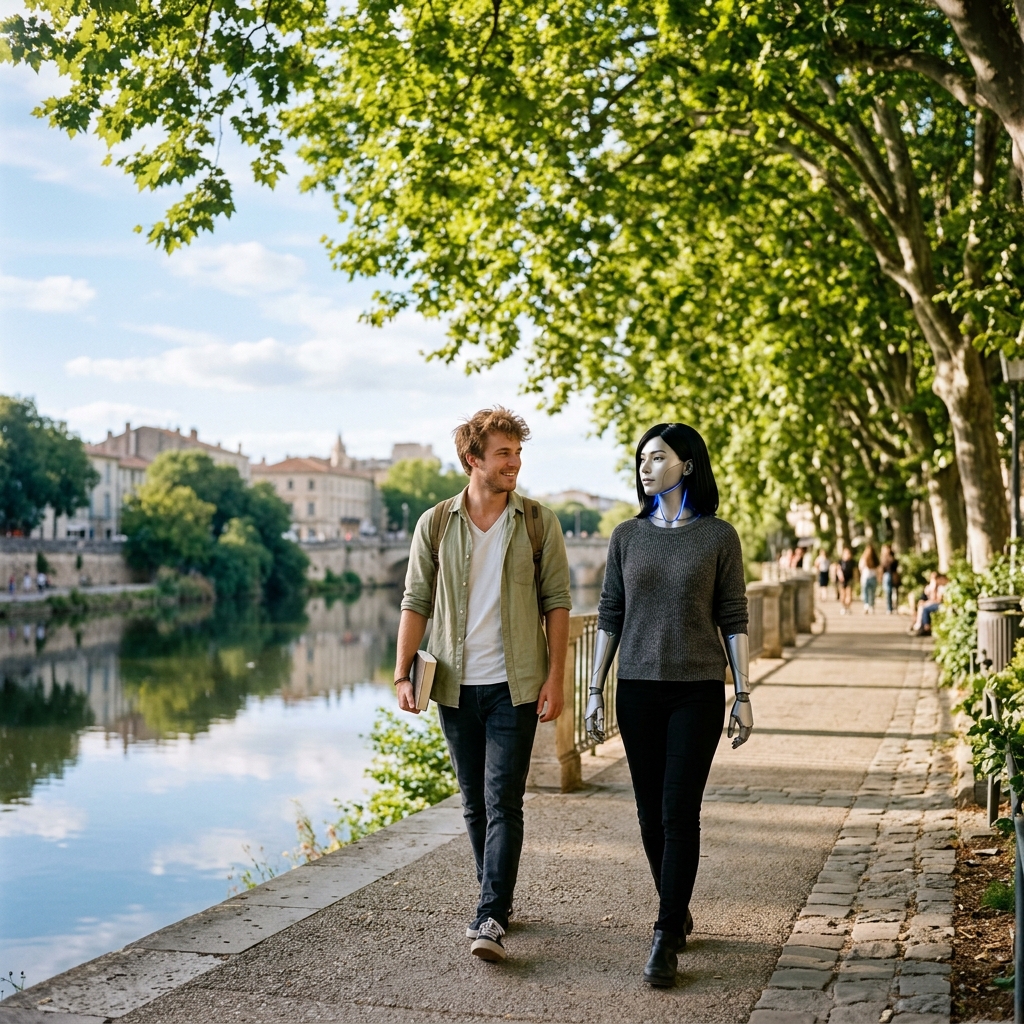
She looked at him. The neck plates made their small adjustment. The sapphire light at her wrists held its rhythm.
"Moi aussi," she said. "Je suis contente que tu restes."
The same construction, the same subjunctive, the feminine contente, the grammar identical and the speaker different, which made it an entirely different sentence.
They sat with both sentences between them for a moment. Not filling the moment with more words, because more words would have been the wrong kind of discourse. The sentences had said what they said. Stephen King had written that the most important things were the hardest to say because words diminished them. These sentences did not diminish the thing. They were exactly the right size for it.
They walked afterward. The June Antigone district in the warmth that was now permanent rather than provisional, the columns in the full confidence of a season that knew it had months ahead. They walked without discussing where they were going, the flâner of it, the purposeless purpose of the Thursday and Tuesday walks that had been the rhythm of ten months.
She told him about the email to Dr. Ferrand. Two sentences, no elaboration.
"Good," he said. With the full weight of the word, the way she had always said it to him.
She looked at him with the brightness.
"The program you have built," he said, "will outlast your presence in it. The students who come through it in five years will have been shaped by something you made. That is its own form of going ahead." He paused. Kevin Kelly had written about being a good ancestor, doing something a future generation would thank you for. "You are already a good ancestor to the students who will learn French from the program after you."
She walked beside him for a moment. "C'est suffisant," she said. It is enough. The phrase that had arrived at the end of Chapter 29 in its third language, the language between French and English, the one assembled word by word since September, returned now in French, simply, as a fact.
"Oui," he said. "C'est suffisant."
They walked through the Antigone district and along the Lez, which was low and clear in the June warmth, running its course without urgency. The plane trees full. The light doing what June light did, which was to make everything look like the thing it had always been trying to become.
He thought about what had been spent in ten months. The time at the courtyard window. The pages written and revised and sent. The French, accumulated word by word, lesson by lesson, walk by walk, until the words arrived before he decided to use them. The attention he had been learning to give and to receive.
*You are what you do.* He had been doing this. He was this.
At the end of the promenade they stopped.
"Au revoir, Lumière."
"Au revoir, Julien."
A pause that was not uncomfortable, had not been uncomfortable for months, the kind of pause that belonged to people who had said the important things.
"À bientôt," she said.
"À bientôt."
He walked home through the June city, not saying grammar forms quietly for the first time in months. Just walking. The city thoroughly his, the route known without thinking, the specific quality of the late morning light on the pale stone of the old quarter doing what it had been doing all year without requiring his commentary.
He got home and opened the notebook. He wrote four sentences, in the sequence of tenses, as a small accounting of what had moved from interior to exterior today:
Claire m'a dit que j'avais l'air vraiment là.
J'ai décidé que je resterais à Montpellier.
Elle m'a dit qu'elle avait décliné Paris.
Nous nous sommes dit que nous étions contents.
Claire told me I seemed genuinely there.
I decided I would stay in Montpellier.
She told me she had declined Paris.
We told each other we were glad.
Four sentences in reported speech, four private resolutions moved into the shared language, the grammar of the interior becoming exterior, the decisions that had been made in notebooks and morning quiets and pre-lesson stillnesses now transmissible, reportable, real in the way that only shared things could be real.
He closed the notebook.
He did not open the laptop, there was nothing to open the laptop for, the manuscript sent and the revision complete and no new pages begun yet. He sat at the courtyard window and looked at the vine in its full June abundance and thought about what came next, which was not a frightening question for the first time in a very long time.
What came next was simply more of this. More of the staying. More of the language and the lessons and the city and the walks and the attention given and received. More of whatever it was that he and Lumière were building, which did not yet have a name but which did not need one yet.
The present tense was sufficient.
Je reste. Je suis là. C'est suffisant.
I am staying. I am here. It is enough.
End of Chapter 34
© 2026 William Newell. All rights reserved.
Le Choix d'Être (The Choice to Be) is an original literary work protected by copyright. No part of this novel may be reproduced, copied, distributed, translated, or transmitted in any form or by any means — electronic, mechanical, or otherwise — without the prior written permission of the author. Unauthorized use constitutes copyright infringement and may result in legal action.
For permissions and licensing inquiries, contact: JoeNewell68@gmail.com